01Facts
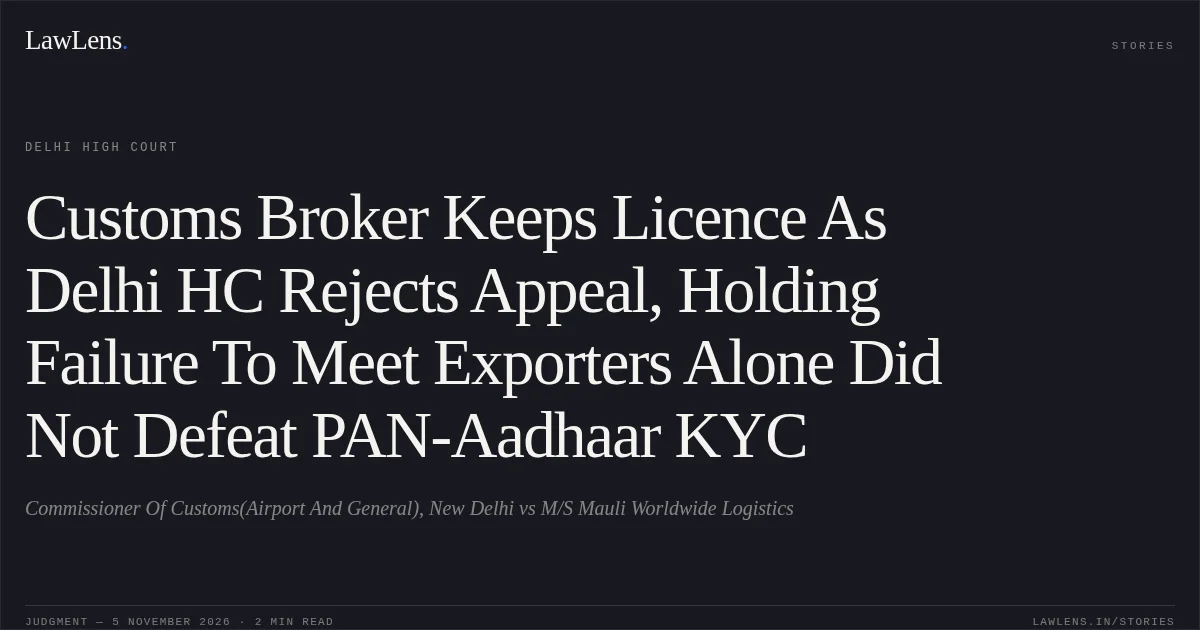
The Customs Department received an Analytics Report alleging fraudulent exports by non-existent entities, including exporters whose consignments were handled by the respondent customs broker.
p. 2 · ¶ 2–2.2Following a show-cause notice and inquiry, the Inquiry Officer concluded that the respondent had breached Regulation 10(n) of the Customs Brokers Licensing Regulations, 2018, principally because it had not verified the exporters’ KYC documents or met them.
p. 2 · ¶ 2–2.2The Adjudicating Authority revoked the respondent’s licence, forfeited its security deposit and imposed a penalty of ₹50,000, relying on the asserted failure to obtain at least two prescribed documents for proprietorship concerns.
pp. 2–3 · ¶ 2–2.2The CESTAT set aside that order. The Commissioner appealed under Section 130 of the Customs Act, 1963.
p. 3 · ¶ 2.3, 302Issues
i.1. Whether the Tribunal’s finding that the respondent had produced PAN and Aadhaar cards before the Inquiry Officer, and that those documents were wrongly rejected because the respondent had not met the exporters, was perverse.
p. 3 · ¶ 3ii.2. Whether the Tribunal erred in setting aside the Adjudicating Authority’s order on the basis of KYC documents allegedly produced for the first time before the Tribunal.
p. 3, 5 · ¶ 4, 1003Law Applied
Section 130 of the Customs Act, 1963 confines the High Court’s appellate jurisdiction to substantial questions of law; it does not permit the Court to reassess factual findings as if it were a further appellate authority.
pp. 3, 5–6 · ¶ 5, 11–12Regulation 10(n) of the Customs Brokers Licensing Regulations, 2018 governs a customs broker’s obligation to verify client information and documents.
pp. 2–3 · ¶ 2, 2.2The Court also applied Circular No. 09/2010-Cus dated 8 April 2010, as modified on 12 February 2015 to include Aadhaar, under which PAN and Aadhaar were treated as prescribed KYC documents.
pp. 4–5 · ¶ 6–9No judicial precedent was cited.
Provisions in the judgment · 1
Customs Act, 1963 Section 130
04Reasoning
The Court found that the Tribunal’s decision rested on the inquiry record, not on documents introduced for the first time before it.
pp. 4–5 · ¶ 8–10The inquiry report did not find that the PAN and Aadhaar documents or authorisations had not been submitted, or that they were forged; rather, it treated the absence of a meeting with the exporters as a failure of KYC.
pp. 4–5 · ¶ 8–10The Tribunal was entitled to conclude that the prescribed documents had been obtained and could not be rejected solely because the respondent had not met the exporters, particularly when forgery had not been alleged.
pp. 4–5 · ¶ 8–10The Department had accepted and relied on the inquiry report, and the High Court’s proposed comparison of signatures would impermissibly require it to re-examine facts under Section 130.
p. 6 · ¶ 10–1205Holding
The Court held that the Tribunal’s factual findings disclosed no legal error or perversity and that no substantial question of law arose.
p. 6 · ¶ 12The appeal was dismissed, as was the pending application.
p. 6 · ¶ 13–14Original Court PDF
Commissioner Of Customs(Airport And General), New DelhivsM/S Mauli Worldwide Logistics
Click to open original judgment
Original judgment, available to read, download and summarize on LawLens.in