01Facts
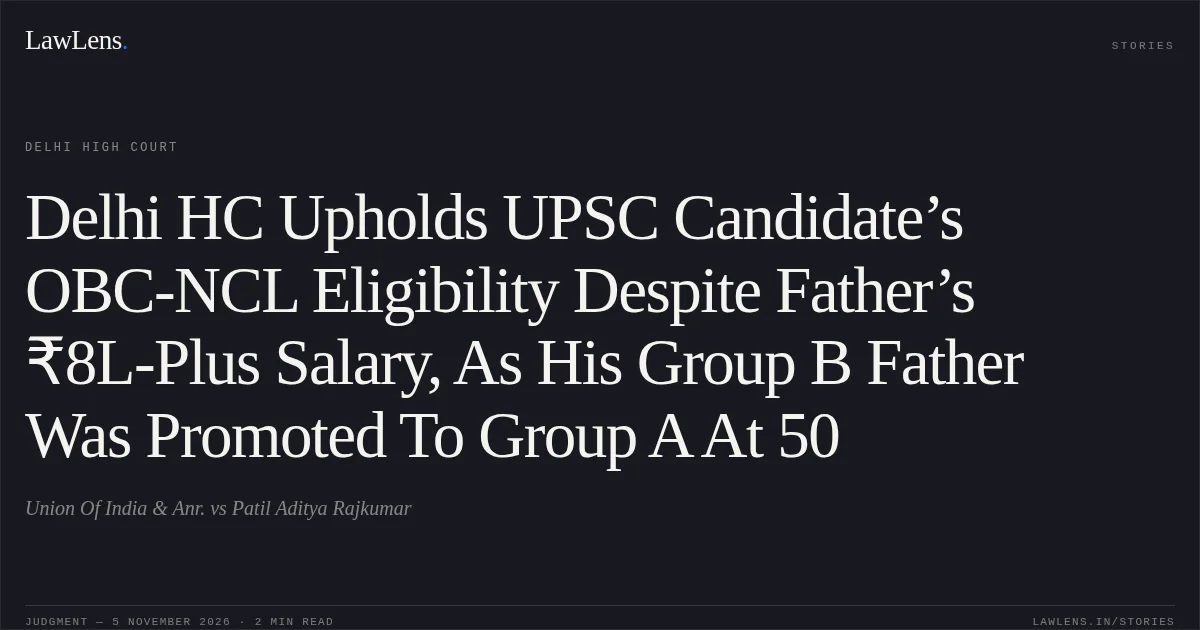
The respondent appeared in the Civil Services Examination 2022 as an OBC-NCL candidate.
p. 1The Department of Personnel and Training (DoPT) declared him ineligible for OBC-NCL status on the ground that his father was a Group-A Junior Telecom Officer in BSNL and his annual salary income exceeded ₹8 lakh in the relevant financial years
p. 1The respondent challenged that decision before the Central Administrative Tribunal, which held him eligible for OBC-NCL status on 5 December 2025.
p. 1The Union of India challenged the Tribunal’s decision in this writ petition
pp. 1–202Issues
i.Whether the DoPT Office Memorandum dated 14 October 2004, read with the Department of Public Enterprises (DPE) Office Memorandum dated 25 October 2017, entitled the respondent to OBC-NCL status despite his father’s Group-A position and salary income exceeding ₹8 lakh
pp. 2, 9–11ii.Whether the Tribunal’s decision granting the respondent OBC-NCL status warranted interference in writ jurisdiction
p. 2, 1503Law Applied
The DoPT Office Memorandum dated 8 September 1993 sets out service-category criteria for identifying the creamy layer, including criteria relating to Group-A and Group-B officers.
pp. 3–6The DoPT Office Memorandum dated 14 October 2004 clarifies the application of those criteria and, in paragraph 7, provides that children of a directly recruited Group-C or Group-D employee who enters Group A at age 40 or earlier are not to be treated as belonging to the creamy layer.
pp. 8–9The DPE Office Memorandum dated 25 October 2017 provides that executive-level posts in CPSEs are generally treated as creamy layer, subject to its stated income proviso.
p. 9Relying on Divyanshu Patel (2018 SCC OnLine Del 13288) and Sarthak Singh (2024 SCC OnLine Del 7426), the Court held that the 14 October 2004 clarification operates as an independent dispensation and must be read with the DPE memorandum; an employee’s movement from Group B to Group A after age 40 may therefore place the case outside the creamy layer.
pp. 2, 10–15Provisions in the judgment · 1
Wealth-Tax Act, 1957 Section 4
04Reasoning
The Court considered the controversy covered by Divyanshu Patel and Sarthak Singh, which it understood to establish that the 14 October 2004 clarification is not displaced by the general service-category criteria and applies alongside the DPE memorandum.
pp. 10–11Applying those decisions, it held that an employee directly recruited to Group B before age 40 who enters Group A after age 40 does not render the employee’s child ineligible for OBC-NCL status.
p. 11The Court accordingly found no basis to disturb the Tribunal’s decision.
p. 15There is an apparent factual inconsistency in paragraph 14: it describes the father as having entered Group A by promotion at age 50 after direct recruitment to Group B at age 19, and refers to CSE-2017, whereas the opening paragraphs concern a BSNL JTO and CSE-2022.
p. 1, 15The judgment does not explain this discrepancy or expressly reconcile the stated salary figures above ₹8 lakh with the income proviso in the DPE memorandum.
05Holding
The Court held that the respondent was entitled to OBC-NCL status and found no cause to interfere with the Tribunal’s decision.
p. 15The writ petition was dismissed in limine.
p. 16Original Court PDF
Union Of India & Anr.vsPatil Aditya Rajkumar
Click to open original judgment
Original judgment, available to read, download and summarize on LawLens.in