01Facts
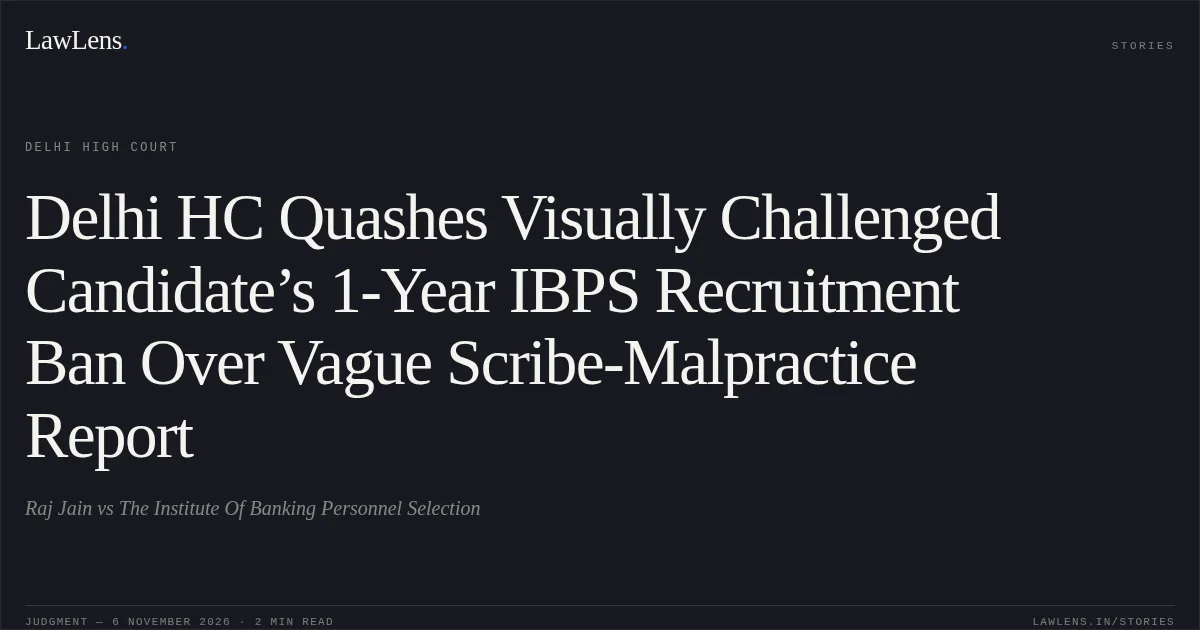
The petitioner, a visually challenged candidate who used a scribe, sat the respondent’s examination for the post of Customer Service Associate on 29 November 2025.
The respondent issued a show-cause notice alleging that the scribe had answered questions independently or prompted the petitioner. The petitioner denied the allegation, stating that the scribe had only read questions and marked answers as dictated. The respondent cancelled his candidature and debarred him from the Common Recruitment Process for 12 months by order dated 24 February 2026.
pp. 2–3The petitioner challenged that order under Article 226, contending that the invigilator’s report did not specify the alleged conduct and that the supporting material had not been supplied to him.
pp. 4–502Issues
i.Whether the invigilator’s report and the material relied on by the respondent sufficiently established that the petitioner or his scribe had used unfair means or malpractice
pp. 4–6ii.Whether the cancellation of the petitioner’s candidature and his 12-month debarment should be quashed in the circumstances
pp. 5–603Law Applied
The Court considered its power of judicial review under Article 226 of the Constitution.
It applied the principle that an adverse finding of examination malpractice—and the resulting stigma—must have a sufficiently specific and adequate evidentiary basis; merely recording a number against a generic list of possible forms of malpractice is not, by itself, a sufficient description of the alleged conduct.
pp. 5–6The Court also noted that, under the examination rules, the candidate’s examination session could have been cancelled during the examination if malpractice had then been detected.
p. 6Provisions in the judgment · 1 · Linked ones open on LawLens
Code of Civil Procedure, 1908 Section 151
04Reasoning
The invigilator’s report contained a list of possible forms of malpractice, with the number “1” recorded, but did not otherwise specify what the petitioner or his scribe had done.
pp. 5–6The impugned order also relied on material beyond the conduct identified under item 1, without providing a sufficiently clear basis for the finding. In the Court’s view, the report and order therefore did not provide adequate material to sustain the malpractice finding or the stigma attached to it.
pp. 5–6The Court further noted that the examination session had not been cancelled at the time, although the rules permitted cancellation if malpractice was detected during the examination.
pp. 5–605Holding
The Court held that the material on record was insufficient to establish that the petitioner had used unfair means or indulged in malpractice.
p. 6It allowed the petition and quashed and set aside the debarment order-cum-memorandum dated 24 February 2026; the petition and pending applications were disposed of accordingly.
p. 6Original Court PDF
Raj JainvsThe Institute Of Banking Personnel Selection
Click to open original judgment
Original judgment, available to read, download and summarize on LawLens.in