01Facts
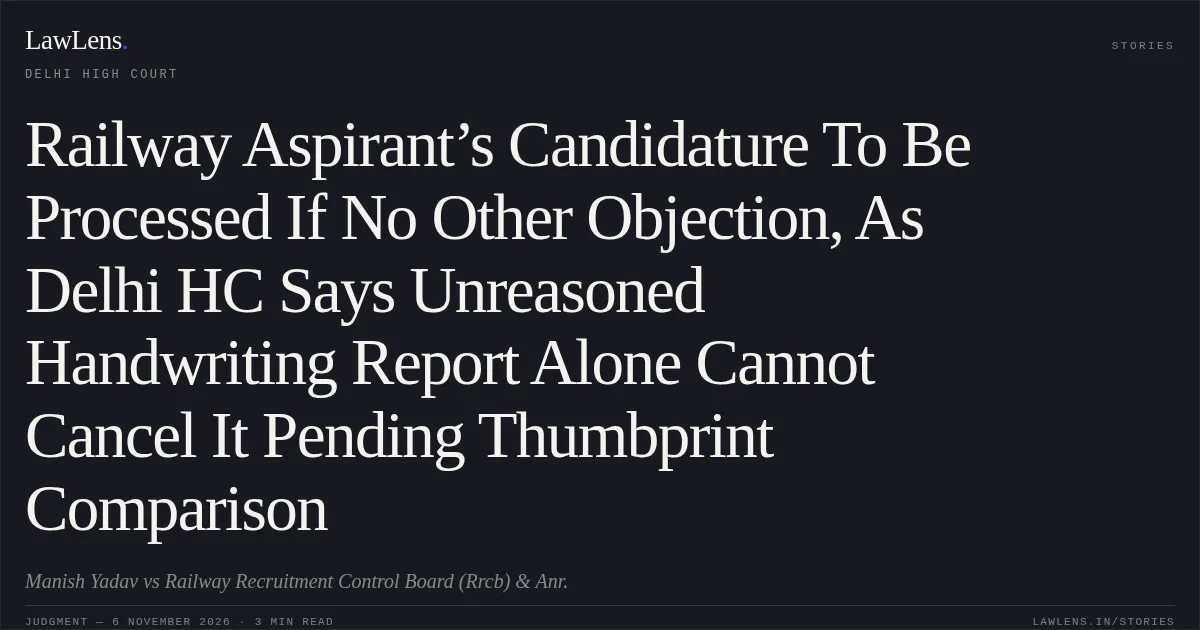
The petitioner applied for a Level 1 railway post pursuant to Centralised Employment Notice No. 02/2018.
p. 1After clearing the written examination and Physical Efficiency Test (PET), and completing document verification, his candidature was cancelled because the Government Examiner for Question Documents (GEQD) reported a mismatch between the handwriting and signatures on his original admit card and those on the admit cards used for the PET and document verification.
pp. 1–2The petitioner challenged the cancellation before the Central Administrative Tribunal, which dismissed his application on 31 January 2025; he then filed the present writ petition.
p. 2The High Court noted that thumb impressions had been taken at the original-admit-card and document-verification stages, and that the proceedings were videographed.
pp. 1–202Issues
i.1. Whether the petitioner’s candidature could be cancelled solely on the basis of the GEQD’s handwriting-comparison report, where the report was unreasoned and had not been put to the petitioner.
pp. 4–5ii.2. Whether the respondents should have obtained a comparison of the petitioner’s thumb impressions, and whether the candidature should be further processed subject to that comparison.
pp. 4–503Law Applied
In Murari Lal v. State of Madhya Pradesh, (1980) 1 SCC 704, the Supreme Court held that a handwriting expert’s opinion is not to be rejected merely because handwriting comparison is an imperfect science; rather, the opinion must be assessed by the acceptability of the reasons given, and the expert assists but does not replace the judge’s independent assessment.
p. 3The Court also applied the principle that thumb impressions provide a more reliable basis for identification than handwriting because handwriting may change over time, whereas thumb impressions remain constant.
p. 4An expert opinion lacking disclosed reasoning, and not put to the affected person for response, was insufficient by itself to sustain the cancellation in this case.
p. 504Reasoning
The Court found that the GEQD report disclosed no analysis explaining how the examiner concluded that the handwriting and signatures were by different persons; it might therefore have been merely the expert’s assertion.
p. 4The report had also not been provided to the petitioner, denying him an opportunity to respond or produce contrary evidence.
p. 5Given that thumb impressions had been taken at relevant stages, the Court questioned why they had not been sent for comparison, particularly as handwriting comparison was less conclusive.
p. 4The videography of the proceedings also offered a potential means of verifying the identity of the person who attended the PET and document verification.
p. 5The Tribunal had not adequately addressed these matters, and the handwriting report alone could not justify cancellation.
pp. 4–505Holding
The High Court allowed the writ petition to the stated extent and quashed the Tribunal’s order.
p. 5It held that the cancellation could not be sustained solely on the unreasoned handwriting-comparison report.
p. 5If there was no other objection to the petitioner, the respondents were directed to further process his candidature in accordance with law.
pp. 5–6The respondents were given liberty to send the original admit card and document-verification admit card for GEQD comparison of the thumb impressions; GEQD was directed to provide its opinion within four weeks, and any adverse report was to be supplied to the petitioner.
pp. 5–6The candidature and any appointment remained subject to the outcome of that report.
pp. 5–6Original Court PDF
Manish YadavvsRailway Recruitment Control Board (Rrcb) & Anr.
Click to open original judgment
Original judgment, available to read, download and summarize on LawLens.in