01Facts
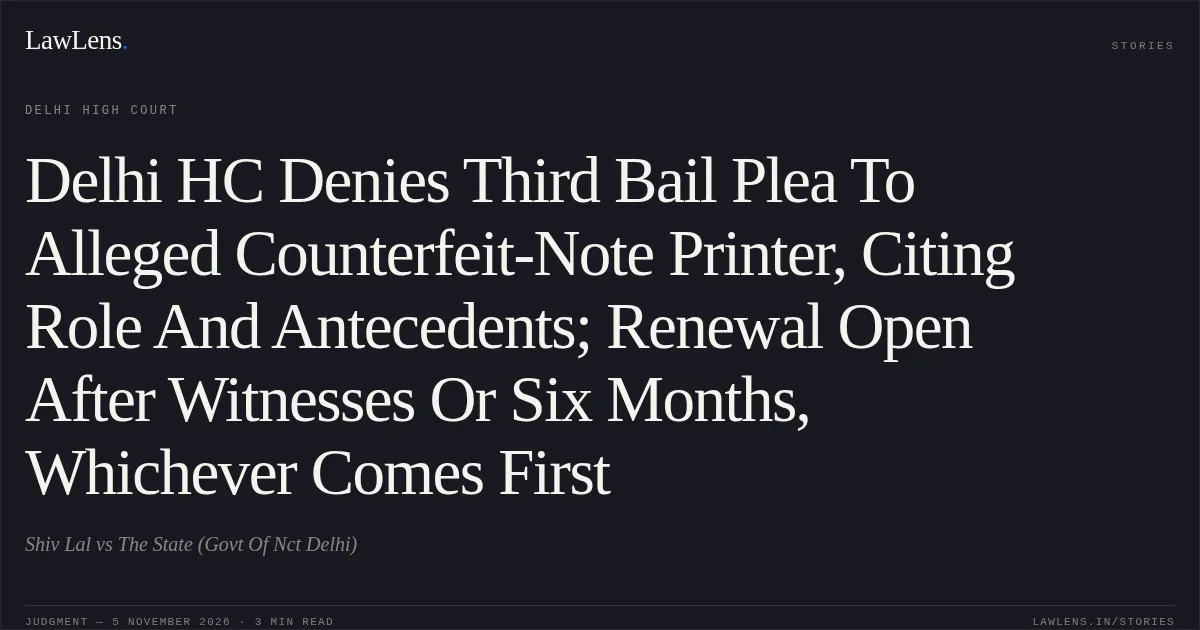
The petitioner sought regular bail under Section 483 of the Bharatiya Nagarik Suraksha Sanhita, 2023, in a case concerning alleged offences under Sections 489A, 489B, 489C, 489D, 120B and 34 of the Indian Penal Code, 1860.
¶ 1–5This was his third bail application before the High Court: his first was dismissed on merits, and his second was disposed of as “not pressed” so that material recovery witnesses could be examined.
¶ 1–5The prosecution alleged that counterfeit currency was recovered from the petitioner after his arrest in Ajmer on 24 September 2023, and attributed to him a central role in the alleged printing operation, including recovery of a printing setup at his instance.
¶ 6, 10(ii)The petitioner relied on his more than three years’ incarceration, trial delay, and a question raised by the trial court concerning whether the case should be tried by a Special Court under Section 22 of the National Investigation Agency Act, 2008.
¶ 7, 14The State opposed bail, citing the petitioner’s alleged role and the risk of reoffending or influencing witnesses.
¶ 802Issues
i.1. Whether the petitioner’s third bail application should be allowed in light of his continued custody, delay in trial, and the pending question concerning the competent trial court.
¶ 7, 14–16ii.2. Whether the petitioner’s alleged role, antecedents, and the absence of a material change in circumstances since the earlier bail decision justified refusing bail at this stage.
¶ 1003Law Applied
Section 483 of the BNSS empowers the High Court to consider an application for regular bail.
In exercising that discretion, the Court applied the considerations identified in Prasanta Kumar Sarkar v. Ashis Chatterjee, (2010) 14 SCC 496, including the prima facie basis of the accusation, its gravity, the accused’s character and antecedents, the likelihood of reoffending, the risk of witness influence, and the risk of justice being thwarted.
¶ 13On parity, the Court relied on Ramesh Bhavan Rathod v. Vishanbhai Hirabhai Makwana, (2021) 6 SCC 230, which holds that parity must be assessed by comparing the accused’s role and position, rather than by a superficial comparison of circumstances.
¶ 11The Court also treated trial delay as a relevant consideration, while assessing it alongside the allegations and the petitioner’s individual circumstances.
¶ 14–15Provisions in the judgment · 4 · Linked ones open on LawLens
Bharatiya Nagarik Suraksha Sanhita, 2023 Section 483
Indian Penal Code, 1860 Section 34Section 420
National Investigation Agency Act, 2008 Section 22
04Reasoning
The Court found no material change in circumstances since the earlier bail proceedings; the recovery witnesses remained unexamined, and the material concerning the petitioner’s alleged role and antecedents was unchanged.
¶ 10(i)The prosecution attributed to him a central role in printing counterfeit currency, including the alleged recovery of the printing setup at his instance and an invoice bearing his name.
¶ 10(ii)The Court rejected parity with a co-accused who had been granted bail because their roles were not comparable.
¶ 10(iii)It also considered the petitioner’s alleged involvement in other cases, including a case said to involve the same modus operandi, and found the concern about reoffending was not without basis.
¶ 12Although the Court acknowledged the trial delay and the unresolved question of the competent court, it concluded that, given the allegations and antecedents, expediting the examination of the recovery witnesses was preferable to granting bail at that stage.
¶ 14–1505Holding
The High Court declined bail and disposed of the application with directions.
¶ 16The trial court was requested to decide within four weeks whether it was the competent court; if the trial continued before it, it was to examine the material recovery witnesses on short dates, and if the case belonged before a Special Court, the records were to be transmitted forthwith.
¶ 16(i)The State was directed to ensure the witnesses’ presence on each hearing date.
¶ 16(ii)The petitioner was permitted to renew his bail prayer after the material recovery witnesses had been examined or after six months, whichever occurred earlier.
¶ 16(iii)The Court clarified that its observations were not an expression of opinion on the merits.
¶ 18Original Court PDF
Shiv LalvsThe State (Govt Of Nct Delhi)
Click to open original judgment
Original judgment, available to read, download and summarize on LawLens.in