01Facts
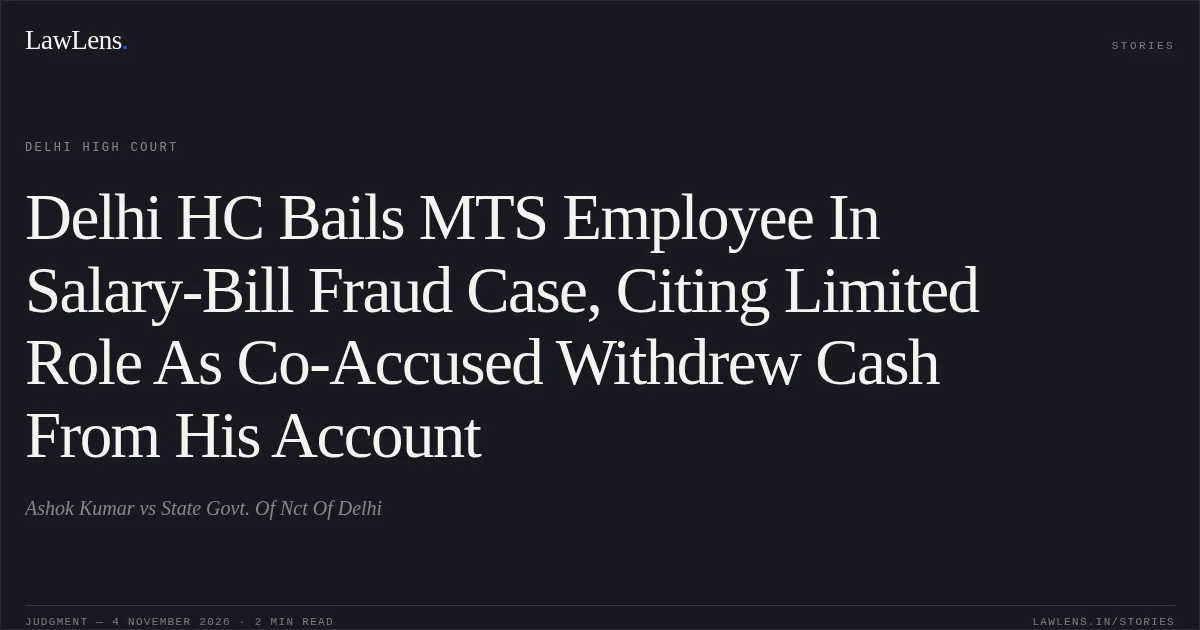
The applicant, an MTS employee of the Directorate of Coordination Police Wireless, sought regular bail under Section 483 of the Bharatiya Nagarik Suraksha Sanhita, 2023, in an FIR alleging offences under Sections 409, 420, 467, 468, 34 and 120B IPC.
pp. 1–2, paras 1–4The alleged fraud involved unauthorised “Miscellaneous Dues” entries in salary bills, causing a government loss of approximately ₹1.44 crore; about ₹32.44 lakh was credited to the applicant’s salary account.
pp. 1–2, paras 1–4The chargesheet recorded that substantial amounts were transferred from the applicant’s account to co-accused Anjani Kumar Singh, and that several self-cheques were written or signed by Singh.
p. 2, para 5 · p. 4, para 12It also recorded that the applicant had no role in preparing, verifying or approving salary bills.
p. 2, para 5 · p. 4, para 12The applicant was arrested on 28 April 2026; his earlier bail applications were dismissed before the chargesheet was filed.
pp. 2–3, paras 6–8The State did not oppose bail, noting that the evidence was documentary and collected, and that the applicant had remained in custody since his arrest.
pp. 2–3, paras 6–802Issues
i.1. Whether the applicant should be granted regular bail under Section 483 BNSS, having regard to the chargesheet, his alleged role, the evidence collected and the period of custody.
p. 1, para 1 · pp. 3–4, paras 9–14ii.2. Whether continued custody was necessary where the investigation was complete, the case rested on collected documentary evidence, and the applicant’s role appeared limited relative to the principal co-accused.
pp. 4, paras 11–1403Law Applied
Section 483 of the Bharatiya Nagarik Suraksha Sanhita, 2023, provides the procedural basis for seeking regular bail.
p. 1, para 1The Court applied the principle that “bail is the rule and jail is the exception,” and relied on *Manish Sisodia v. Enforcement Directorate*, (2024) 12 SCC 660, including its reference to *Javed Gulam Nabi Shaikh v. State of Maharashtra*, (2024) 9 SCC 813, for the proposition that bail should not be withheld as punishment and that courts should not deny bail merely to “play safe”.
p. 3, para 10Provisions in the judgment · 6 · Linked ones open on LawLens
Bharatiya Nagarik Suraksha Sanhita, 2023 Section 483
Indian Penal Code, 1860 Section 409Section 420Section 467Section 468Section 34
04Reasoning
The Court considered the chargesheet’s account that the applicant, an MTS employee, had no role in processing salary bills, while substantial sums from his account were transferred to or withdrawn by co-accused Singh through self-cheques.
p. 4, para 12Although the chargesheet alleged that the applicant permitted use of his account, his role appeared prima facie limited compared with that of the principal co-accused.
p. 4, para 12The investigation was complete, the chargesheet had been filed, and the relevant salary, banking and audit records had been collected; the applicant had also been in custody since 28 April 2026, had no previous involvement and had satisfactory jail conduct.
pp. 4, paras 11, 13–14In those circumstances, the Court found no purpose would be served by continued incarceration.
p. 4, para 1405Holding
The Court allowed the application and admitted the applicant to regular bail on a personal bond of ₹10,000 with one surety for the like amount, subject to conditions including travel restrictions, address and contact-information requirements, cooperation with the IO, monthly reporting, non-interference with witnesses or evidence, and regular court attendance.
pp. 4–5, para 15The State may seek cancellation of bail for breach of conditions; the trial court was requested to expedite proceedings, and the Court clarified that its observations were only for deciding bail and would not affect the merits at trial.
pp. 5–6, paras 16–20Original Court PDF
Ashok KumarvsState Govt. Of Nct Of Delhi
Click to open original judgment
Original judgment, available to read, download and summarize on LawLens.in