01Facts
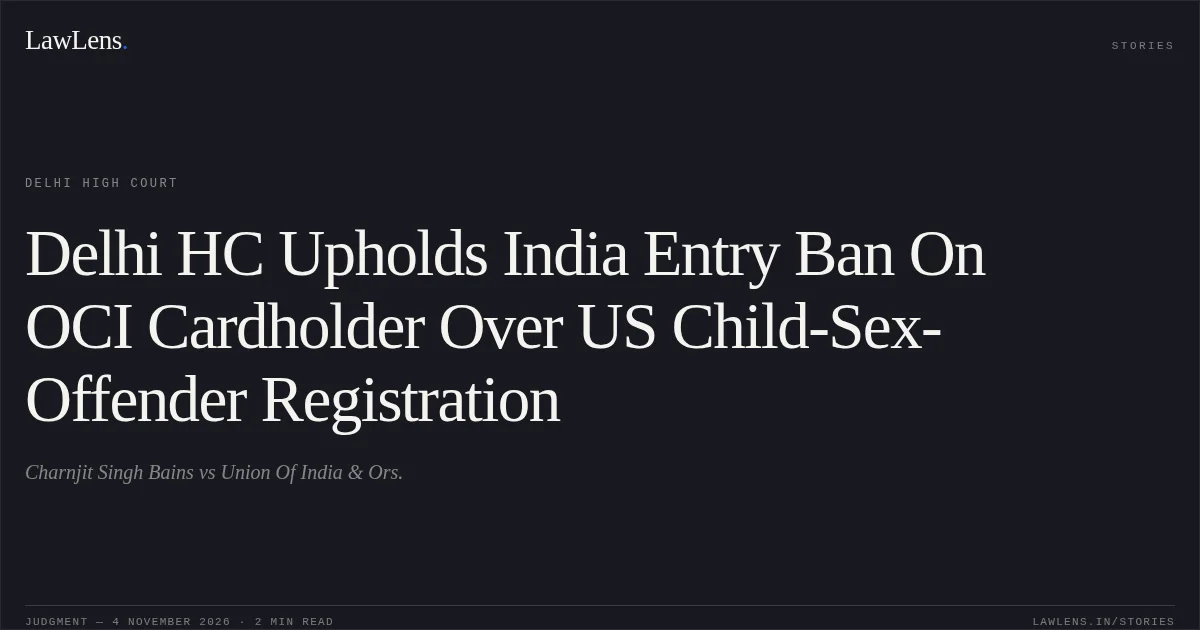
The petitioner, a person of Indian origin holding a foreign passport and an Overseas Citizen of India (OCI) Card issued on 15 November 2024, was refused permission to land in India at Indira Gandhi International Airport on 7 January 2026, under Paragraph 6 of the Foreigners Order, 1948, and directed to leave on the first available flight.
p. 1 · ¶ 2–3He challenged the refusal as non-speaking and made without notice or hearing, and contended that his OCI registration had not been cancelled or suspended under Section 7D of the Citizenship Act, 1955.
p. 2 · ¶ 4The respondents stated that he had been blacklisted because he was a registered child sex offender in the United States; the petitioner did not dispute the foreign proceedings or the resulting no-contest plea and probation, but contended that the proceedings did not involve a child or minor.
p. 2 · ¶ 5–7 · p. 3 · ¶ 11The Court heard the petition finally with the parties’ consent.
p. 1 · ¶ 102Issues
i.Whether the respondents could refuse the petitioner entry into India on the stated basis of his registration as a child sex offender in the United States.
pp. 2–4 · ¶ 7–12ii.Whether the refusal of entry warranted the High Court’s intervention under Article 226, including in light of the petitioner’s challenge to the order as non-speaking and issued without a prior hearing.
p. 2, 4 · ¶ 4, 1303Law Applied
Section 3 of the Foreigners Act, 1946 (since repealed), and Section 7 of the Immigration and Foreigners Act, 2025, empower the Central Government to prohibit, regulate or restrict foreigners’ entry into, departure from, or presence in India.
p. 3 · ¶ 8The Court relied on Hans Muller of Nurenburg v. Superintendent, Presidency, 1955 SCR (1) 1284, for the proposition that the Foreigners Act conferred broad discretion on the Central Government and preserved an unrestricted power to expel in the absence of a constitutional fetter.
p. 3 · ¶ 10The Court treated the decision to refuse entry as a sovereign function involving national security, foreign policy and administrative discretion.
p. 3 · ¶ 8The respondents also relied on the Office Memorandum dated 29 March 2023 as permitting the blacklisting of a convicted child offender.
p. 2 · ¶ 7Provisions in the judgment · 1 · Linked ones open on LawLens
Immigration and Foreigners Act, 2025 Section 7
04Reasoning
The Court considered the refusal of entry to fall within the State’s sovereign discretion and held that the authorities could take relevant factors into account when assessing entry.
p. 3 · ¶ 8It accepted the respondents’ position that the petitioner had been blacklisted as a registered child sex offender and noted that the material underlying the decision was confidential and classified and could not be disclosed in the interests of national security and integrity.
p. 3 · ¶ 9The petitioner did not dispute the foreign criminal proceedings, the no-contest plea or the probation sentence; his contention was limited to whether the proceedings involved a child or minor.
p. 3 · ¶ 11The Court concluded that, once the respondents had information that he had been involved in a crime of that nature abroad, they were entitled to prevent his entry into India.
p. 4 · ¶ 12It found no circumstance justifying the exercise of its extraordinary and discretionary jurisdiction under Article 226.
p. 4 · ¶ 1305Holding
The Court dismissed the petition, declining to interfere with the refusal of entry.
p. 4 · ¶ 14Pending applications were disposed of, and the date already fixed was cancelled.
p. 4 · ¶ 15–16Original Court PDF
Charnjit Singh BainsvsUnion Of India & Ors.
Click to open original judgment
Original judgment, available to read, download and summarize on LawLens.in