Facts
The Appellant, a Nigerian citizen, entered India in 2015 on a Student Visa and initially enrolled in a B.Tech. programme.
Source reference: no citationFollowing his father’s death, he sought admission to the Respondent University’s B.Sc. (IT) programme.
Source reference: no citationThe University issued a provisional admission offer on 6 August 2016 and subsequently a Visa Recommendation Letter, pursuant to which the Appellant obtained a fresh Student Visa and returned to India on 30 December 2017.
Source reference: p.2In 2022, the University declined to issue a bona fide certificate, and the Appellant’s applications for extension of his Student Visa were rejected for want of that certificate.
Source reference: p.3The Appellant filed a writ petition seeking, inter alia, issuance of the certificate, visa-related reliefs, restoration of educational rights and compensation.
Source reference: no citationMeanwhile, proceedings initiated by the owner of his premises led to directions for consideration of the Appellant’s deportation, and the Appellant was detained in a Deportation Facility on 2 July 2025.
Source reference: p.3The learned Single Judge dismissed the writ petition and contempt petition, holding that, after expiry of the visa, the Appellant had no legal right to remain in India and that the Central Government possessed power to expel him under the Foreigners Act, 1946.
Source reference: p.3The Appellant challenged that decision by way of the present Letters Patent Appeal.
Source reference: no citationIssues
Whether the University was justified in refusing to issue a bona fide certificate despite the Appellant’s admission to the programme and payment of fees, particularly in light of his allegation that he had been denied academic facilities and opportunities.
Source reference: pp.4–6Whether the Appellant was entitled to extension of his Student Visa beyond 31 July 2022 under the applicable provisions of the Visa Manual.
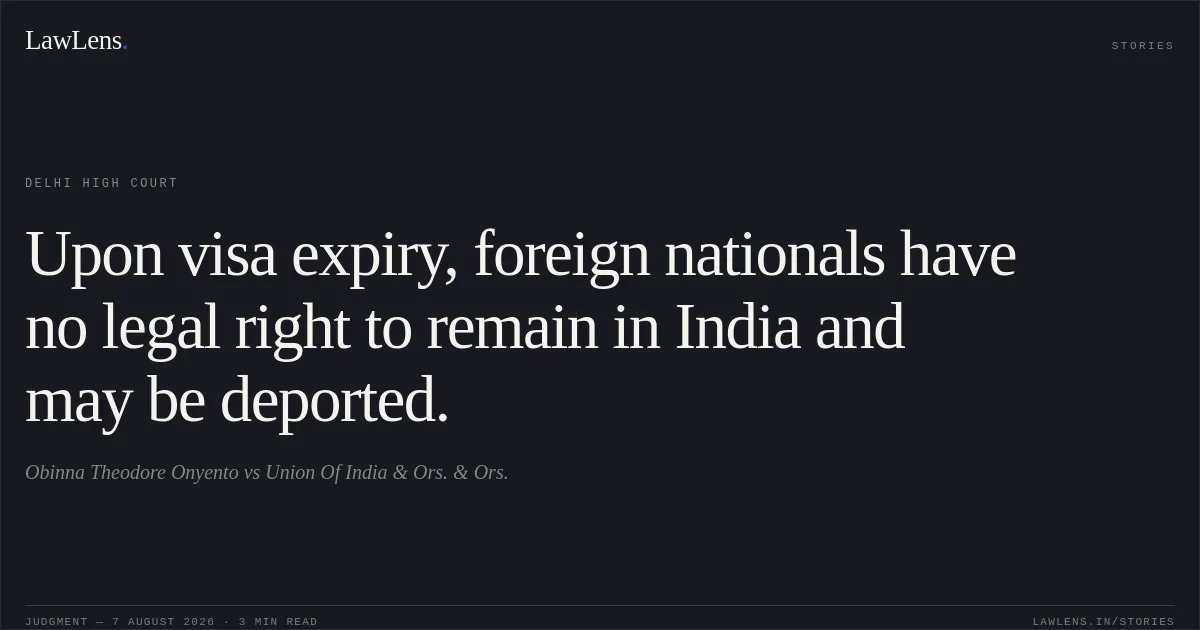
Source reference: pp.6–7Whether, after expiry of the Student Visa, the Appellant retained a legal right to remain in India and whether the Central Government could initiate deportation proceedings against him.
Source reference: pp.3, 6–7Law Applied
The Court applied the Foreigners Act, 1946, under which the Central Government has power to regulate and expel foreign nationals whose right to remain in India has ceased.
Source reference: pp.3, 6–7It also applied Clauses 15.2 and 15.3 of the Visa Manual issued by the Ministry of Home Affairs: a Student Visa is ordinarily valid for a maximum of five years or the duration of the academic course, whichever is less; where a foreign student changes course, the visa period is reckoned from the date of initial issuance; and extension beyond the prescribed period is available only in rare and exceptional circumstances, for up to two years on a six-monthly basis.
Source reference: p.6The Court further applied the principle that a university need not issue a bona fide certificate where the student has failed to satisfy the academic requirements or demonstrate genuine pursuit of the course.
Source reference: p.5Reasoning
The Court found that the Appellant had not completed the programme within the maximum permissible period of five years, had obtained only 20 of the required 138 credits, had failed to meet the eligibility requirements for award of the degree, and had not appeared in the supplementary examinations despite being given opportunities.
Source reference: p.5These circumstances supported the University’s position that the Appellant had not demonstrated bona fide participation in the programme, making the refusal to issue a bona fide certificate justified.
Source reference: p.5The Court also held that the subsequent Student Visa did not create a fresh five-year period because, under Clause 15.3, the validity period was to be calculated from the original date of issuance.
Source reference: p.6Since the last extension expired on 31 July 2022 and no rare or exceptional circumstance was established, the Appellant was not entitled to further extension under Clause 15.2.
Source reference: pp.6–7Consequently, upon expiry of the visa, he had no legal right to remain in India, and the Central Government’s power to deport him under the Foreigners Act could not be interfered with.
Source reference: p.7Holding
The Division Bench held that the University’s refusal to issue the bona fide certificate was justified, that the Appellant had not established any exceptional circumstance warranting further extension of his Student Visa, and that he had no legal right to remain in India after expiry of the visa.
The Court found no error of fact or law in the Single Judge’s judgment and dismissed the Letters Patent Appeal.
Source reference: p.7The pending applications were also disposed of, with no order as to costs.
Source reference: p.7Original Court PDF
Obinna Theodore OnyentovsUnion Of India & Ors. & Ors.
Click to open original judgment
Original judgment, available to read, download and summarize on LawLens.in