Facts
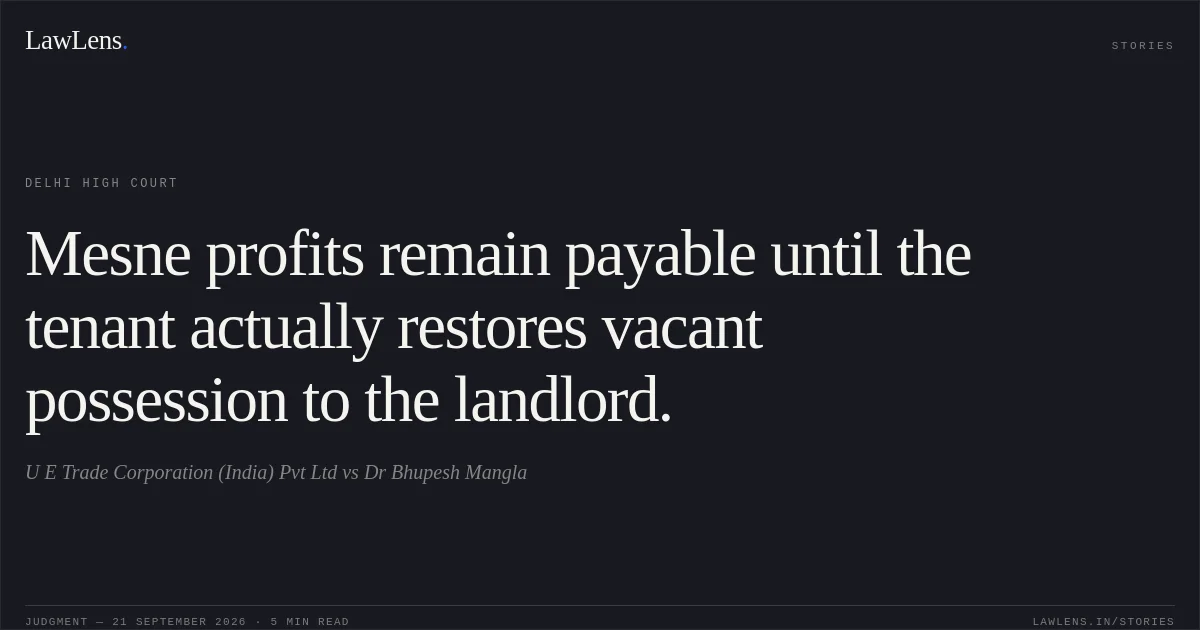
The appellant-tenant occupied Flat No. 913, Arunachal Building, New Delhi, under a three-year lease deed dated 2 December 2003, effective from 3 November 2003 to 2 November 2006, at a monthly rent of ₹20,125.
Source reference: paras. 5.3–5.4The respondent, a co-owner and receiver appointed in partition proceedings concerning the premises, executed the lease and received rent from the appellant.
Source reference: paras. 5.2–5.4, 25–26After disputes arose regarding the respondent’s authority and the claims of another co-owner, the appellant stopped paying rent and sought clarification regarding the ownership and receivership arrangements.
Source reference: paras. 5.6–5.8The respondent issued a notice dated 17 April 2006 terminating the lease for non-payment of rent and demanding possession.
Source reference: para. 5.7Although the appellant claimed that it had offered to surrender possession on 2 November 2006 and had attempted to deposit the keys, the Trial Court found that vacant and peaceful possession was actually delivered only on 3 February 2010.
Source reference: paras. 5.9–5.15, 66–71The Trial Court awarded arrears of rent, mesne profits/damages at varying monthly rates, interest at 9% per annum, and costs.
Source reference: para. 3The appellant challenged the decree in the present regular first appeal and also sought to introduce two additional documents under Order XLI Rule 27 CPC.
Source reference: paras. 1, 17, 109–114Issues
1. Whether the respondent, being one of the co-owners and the person who had executed the lease, could maintain the suit for possession, arrears of rent and mesne profits without impleading all co-owners.
Source reference: paras. 24–362. Whether the respondent validly terminated the lease by notice dated 17 April 2006 under Section 111(g) of the Transfer of Property Act, 1882.
Source reference: paras. 37–503. Whether the appellant had surrendered vacant and peaceful possession on 2 November 2006, or whether possession was delivered only on 3 February 2010.
Source reference: paras. 51–714. Whether the appellant was liable to pay mesne profits after termination/expiry of the lease under Sections 108(q) and 111 of the Transfer of Property Act, 1882.
Source reference: paras. 72–765. Whether the Trial Court correctly assessed mesne profits on the basis of comparable registered lease deeds and awarded interest at 9% per annum.
Source reference: paras. 77–1086. Whether the appellant should be permitted to produce additional documents under Order XLI Rule 27 CPC.
Source reference: paras. 109–114Law Applied
The Court applied Section 116 of the Evidence Act, 1872, which estops a tenant from denying the landlord’s title during the continuance of the tenancy.
Source reference: paras. 28–35The doctrine that one co-owner may institute eviction proceedings on behalf of the co-owners unless their disagreement is established, as stated in India Umbrella Manufacturing Co. v. Bhagabandei Agarwalla.
Source reference: paras. 28–35Sections 111(g) and 111(h) of the Transfer of Property Act, 1882, concerning termination by forfeiture and notice.
Source reference: paras. 40–47Section 108(q) TPA, which obliges a lessee, upon determination of the lease, to put the lessor in possession.
Source reference: paras. 54–60The principle that a tenant continuing in possession after determination of the lease becomes a tenant at sufferance and is liable for mesne profits, as recognised in Raptakos Brett & Co. Ltd. v. Ganesh Property, M.C. Chockalingam v. V. Manickavasagam, MEC India Pvt. Ltd. v. Lt. Col. Inder Maira and Bijay Kumar Manish Kumar HUF v. Ashwin Bhanulal Desai.
Source reference: paras. 54, 59, 73–75Mesne profits were assessed under Sections 2(12) and Order XX Rule 12 CPC, based on the rental value the property could reasonably have fetched, with permissible reasonable estimation or “honest guesswork” based on comparable premises.
Source reference: paras. 80–86, 94–99Interest was awarded under Section 34 CPC as a discretionary and equitable remedy.
Source reference: paras. 103–108Additional evidence under Order XLI Rule 27 CPC is exceptional and permissible only where the conditions specified in the Rule are satisfied, including refusal by the Trial Court, inability to produce the evidence despite due diligence, or the appellate court’s genuine requirement of the evidence.
Source reference: paras. 112–114Reasoning
The Court held that the appellant had entered into the lease with the respondent, paid rent to him and enjoyed possession under the lease; it was therefore barred from disputing the respondent’s title or authority merely because of inter se disputes among the co-owners.
Source reference: paras. 28–36Applying the doctrine of agency among co-owners, the Court found that one co-owner could terminate the tenancy and sue for possession unless the other co-owners had clearly opposed that course, which had not been shown here.
Source reference: paras. 30–31, 47–49The appellant’s failure to pay rent constituted breach of the lease conditions, and the respondent’s notice dated 17 April 2006 validly terminated the lease under Section 111(g) TPA.
Source reference: paras. 42–46The Court rejected the alleged surrender on 2 November 2006 because the appellant had not proved actual vacation, unconditional tender of possession, or delivery of the premises; its correspondence and applications concerning deposit of keys were either prospective, conditional or made in separate partition proceedings.
Source reference: paras. 60–69The appellant’s continued association with the premises, its recorded address and the absence of evidence that the premises had been vacated supported the finding that possession was delivered only on 3 February 2010.
Source reference: paras. 56–71Consequently, the appellant remained liable as a tenant at sufferance and had to pay mesne profits for the period of continued possession.
Source reference: paras. 72–76For quantification, the Court upheld reliance on certified copies of registered lease deeds relating to comparable premises in the same building, and found that the Trial Court had conservatively capped the award by the contractual ceiling and the amount claimed.
Source reference: paras. 81–101The award of 9% interest was held to be a reasonable exercise of discretion under Section 34 CPC.
Source reference: paras. 103–108The additional documents were rejected because they were within the appellant’s knowledge, could have been produced at trial, and were not necessary for pronouncing judgment.
Source reference: paras. 109–114Holding
The appeal was dismissed.
The Court affirmed that the respondent, as a co-owner and lessor, was entitled to maintain the suit and validly terminate the lease.
Source reference: paras. 115–116It upheld the finding that vacant and peaceful possession was delivered only on 3 February 2010, making the appellant liable for arrears of rent up to 2 November 2006 and mesne profits/damages thereafter at the rates determined by the Trial Court, together with 9% per annum interest and costs.
Source reference: paras. 115–116The application for additional evidence under Order XLI Rule 27 CPC was also dismissed.
Source reference: para. 114Acts & Sections Cited
11 provisions across 5 statutes referred to in this judgment. Each provision opens on LawLens.
Code of Civil Procedure, 19084
Transfer of Property Act, 18823
Indian Contract Act, 18722
Registration Act, 19081
delhi rent control act, 19581
Original Court PDF
U E Trade Corporation (India) Pvt LtdvsDr Bhupesh Mangla
Click to open original judgment
Original judgment, available to read, download and summarize on LawLens.in