01Facts
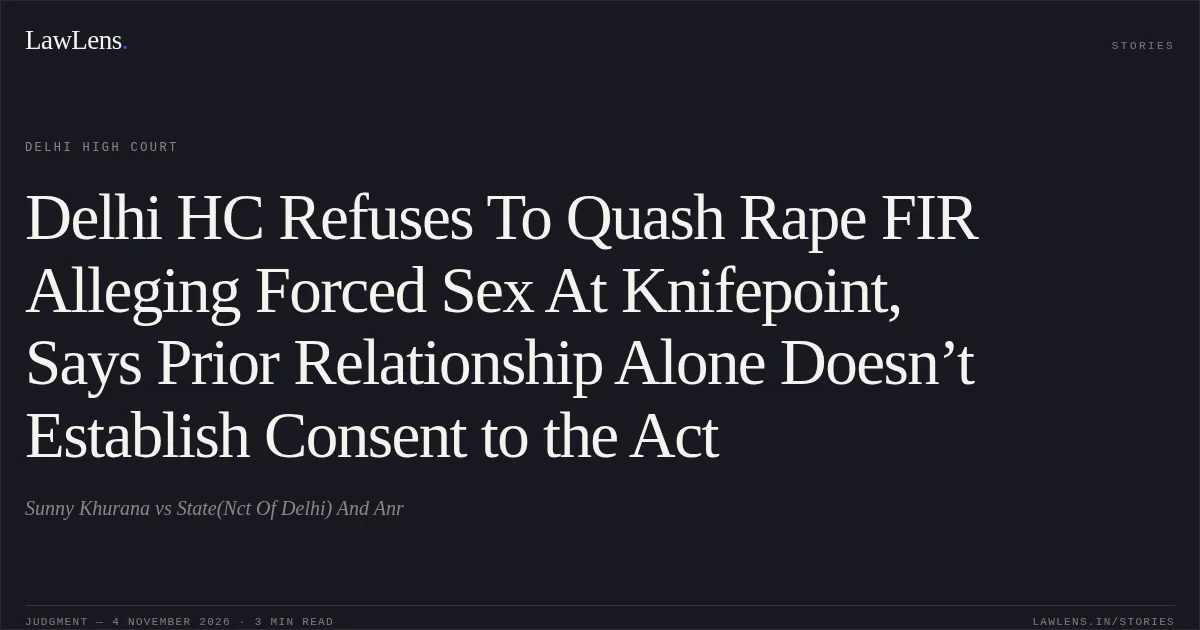
The petitioner sought quashing under Section 528 of the Bharatiya Nagarik Suraksha Sanhita, 2023 (BNSS), of an FIR registered under Sections 64(1) and 351(3) of the Bharatiya Nyaya Sanhita, 2023 (BNS), and the proceedings arising from it.
p. 1 · ¶ 1The complainant alleged that, after the parties became acquainted at a gym and developed a friendship, the petitioner forcibly had sexual intercourse with her in a hotel room while threatening her with a knife.
pp. 1–2 · ¶ 2–3The petitioner relied on messages to assert that the relationship was consensual, alleged that the complainant and her husband had assaulted him and demanded money, and claimed that he had already paid them ₹1,50,000.
p. 3 · ¶ 4–6He also relied on observations in a bail order concerning the parties’ chats.
p. 3 · ¶ 602Issues
i.1. Whether the FIR, taken at face value, disclosed offences under Sections 64(1) and 351(3) BNS warranting quashing under Section 528 BNSS.
pp. 4–5 · ¶ 11–12ii.2. Whether the petitioner’s allegations of consensual relations and mala fides, supported by disputed messages and his account of the alleged assault and monetary demand, justified quashing the FIR.
pp. 5–7 · ¶ 14–1703Law Applied
Section 528 BNSS, corresponding to Section 482 of the Code of Criminal Procedure, 1973 (CrPC), empowers the High Court to quash criminal proceedings in limited circumstances, including where the allegations, accepted at face value, do not disclose an offence or where proceedings are manifestly mala fide.
pp. 3–4 · ¶ 7–10State of Haryana v. Bhajan Lal, 1992 Supp (1) SCC 335, identifies these as grounds for exercising the quashing jurisdiction; R.P. Kapur v. State of Punjab, 1960 SCC OnLine SC 21, establishes that where the complaint itself does not disclose an offence, the question can be resolved without appreciating evidence.
p. 4 · ¶ 9–10At the quashing stage, the Court must not conduct a mini-trial or weigh competing factual versions.
pp. 4–5 · ¶ 11, 14Consent to a relationship does not, by itself, establish consent to a particular sexual act; consent under Explanation 2 to Section 63 BNS must communicate willingness to participate in the specific sexual act.
p. 5 · ¶ 13Under Pardeep Kumar Kesarwani v. State of Uttar Pradesh, 2025 SCC OnLine SC 1947, quashing on the basis of an accused’s material requires, among other things, material of sterling and impeccable quality that is not refuted and that rules out the accusations, such that proceeding to trial would abuse the process of court.
pp. 6–7 · ¶ 16–17Provisions in the judgment · 6 · Linked ones open on LawLens
Bharatiya Nagarik Suraksha Sanhita, 2023 Section 528Section 183
Code of Criminal Procedure, 1973 Section 482
Bharatiya Nyaya Sanhita, 2023 Section 64Section 351Section 63
04Reasoning
The FIR made a specific allegation of forcible intercourse under threat of a knife which, if accepted as true, disclosed the offences invoked.
p. 5 · ¶ 12The complainant’s account itself acknowledged the prior acquaintance and developing relationship; neither that relationship nor the alleged intimate messages established consent to the specific act alleged.
p. 5 · ¶ 13Determining consent or whether the FIR was malicious would require examining disputed chats and resolving competing accounts of the alleged assault and monetary demand—matters unsuitable for determination in quashing proceedings.
pp. 5–7 · ¶ 14–17The petitioner therefore did not meet the applicable threshold for quashing.
p. 7 · ¶ 1705Holding
The Delhi High Court dismissed the petition and disposed of the pending application.
p. 7 · ¶ 19It left the petitioner at liberty to raise his pleas concerning the messages, alleged assault, and alleged demand for money before the trial court, while clarifying that it expressed no opinion on the merits.
p. 7 · ¶ 20–21Original Court PDF
Sunny KhuranavsState(Nct Of Delhi) And Anr
Click to open original judgment
Original judgment, available to read, download and summarize on LawLens.in