01Facts
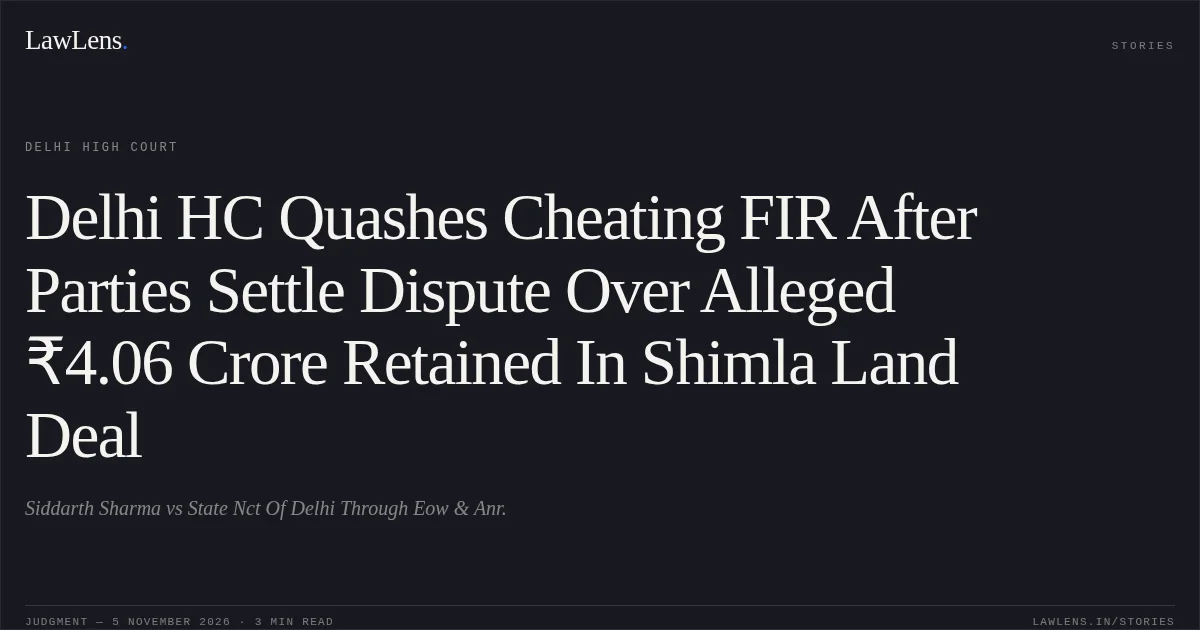
The FIR alleged that the petitioner received ₹4,55,60,000 from respondent no. 2 in 2007 for purchasing agricultural land in Shimla, refunded ₹48,72,460, and retained the balance.
p. 2Although an agreement to sell was later executed and possession of the Junga land delivered, the requisite permission was not obtained and no sale deed was executed.
p. 2The parties subsequently entered into a settlement dated 17 August 2026, under which the retained amount was treated as consideration for the Junga land, and the petitioner undertook to facilitate transfer of title, including through an irrevocable Special Power of Attorney.
pp. 3–4, 8–9The petitioner sought quashing of the FIR under Sections 420 and 406 IPC and the proceedings arising from it.
Both parties affirmed the settlement in Court, and the State submitted that the commercial dispute had been resolved.
p. 502Issues
i.Whether the FIR and consequential proceedings under Sections 420 and 406 IPC should be quashed in light of the parties’ settlement of the commercial dispute.
pp. 1, 5–8ii.Whether the petitioner should remain bound by the undertakings concerning transfer of the land, subject to compliance with applicable local laws.
pp. 8–903Law Applied
Article 226 of the Constitution and Section 528 of the Bharatiya Nagarik Suraksha Sanhita, 2023 (pari materia to Section 482 CrPC) empower the High Court to quash criminal proceedings to secure the ends of justice or prevent abuse of process, including in appropriate cases involving non-compoundable offences.
pp. 5–6Under Gian Singh v. State of Punjab, such power may be exercised where a dispute is predominantly civil or commercial, the parties have settled it, and continuation of proceedings would defeat the ends of justice; the Court must consider the nature and gravity of the offence.
pp. 5–6Narinder Singh v. State of Punjab requires consideration of the dispute’s civil or commercial character, the possibility of conviction, and whether continued proceedings would cause oppression or injustice.
pp. 6–7Ramgopal v. State of Madhya Pradesh identifies the offence’s nature and effect, the seriousness of any injury, the voluntary nature of the compromise, and the accused’s conduct as relevant considerations.
p. 7The Court also cited Reverend Rockes Barnabass Sandhu v. Govt. of NCT of Delhi concerning quashing of an FIR under Sections 420 and 406 IPC in a commercial dispute.
pp. 7–8Provisions in the judgment · 5 · Linked ones open on LawLens
Bharatiya Nagarik Suraksha Sanhita, 2023 Section 528
Code of Criminal Procedure, 1973 Section 482Section 320
Indian Penal Code, 1860 Section 420Section 406
04Reasoning
The Court treated the dispute as commercial and noted that the parties had resolved it through the settlement, which they affirmed before the Court; the State also raised no impediment to quashing.
p. 5Applying the principles governing quashing on settlement, the Court accepted the joint request to terminate the FIR and related proceedings.
pp. 5–8It preserved the petitioner’s obligations under the settlement and his undertakings concerning execution of title-transfer documents, but expressly left open the legality of the proposed transfer and any permission required under Section 118 of the Himachal Pradesh Tenancy and Land Reforms Act, 1972, or other local law.
pp. 8–905Holding
The Court quashed FIR No. 181/2025, registered at P.S. Economic Offences Wing, Delhi, under Sections 420 and 406 IPC, and all proceedings arising from it; it held the parties bound by the settlement dated 17 August 2026 and the petitioner bound by his undertakings.
pp. 8–9The Court did not determine whether the land transfer complied with applicable law and directed the parties to comply with local requirements.
p. 9Each party was directed to pay ₹25,000 to the Delhi High Court Legal Services Committee within four weeks, with proof of deposit to be filed in the Registry.
p. 9The petition and pending application were disposed of.
p. 9Original Court PDF
Siddarth SharmavsState Nct Of Delhi Through Eow & Anr.
Click to open original judgment
Original judgment, available to read, download and summarize on LawLens.in