01Facts
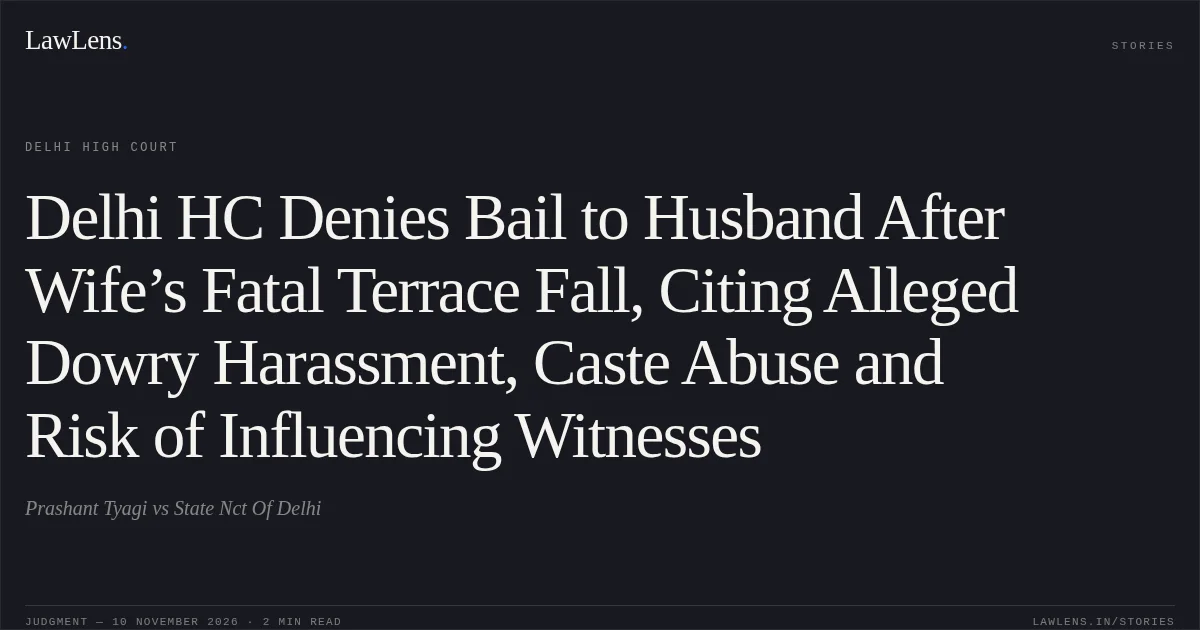
The petitioner sought regular bail under Section 483 of the Bharatiya Nagarik Suraksha Sanhita, 2023, in FIR No. 412/2025, registered under Sections 80, 85 and 3(5) of the Bharatiya Nyaya Sanhita, 2023, Section 333 of the Indian Penal Code, 1860/Section 115(2) of the BNS, and Sections 3(1)(r), 3(1)(s) and 3(2)(va) of the Scheduled Castes and the Scheduled Tribes (Prevention of Atrocities) Act, 1989.
p. 1The FIR followed the death of the petitioner’s wife, who fell from a terrace and died from a head injury; her family alleged sustained cruelty, dowry harassment and caste-based abuse.
pp. 1–2, 5The petitioner’s earlier bail application had been dismissed by the Trial Court, and the present case remained pending, with charges yet to be framed and an FSL report awaited.
pp. 2–4, 6The petitioner had been in custody since 8 November 2025.
p. 402Issues
i.1. Whether the petitioner should be released on regular bail, having regard to the seriousness of the allegations and the material collected during investigation.
pp. 9–13, 16ii.2. Whether the pending trial, awaited forensic report and risk of influencing material witnesses weighed against granting bail at this stage.
pp. 7–8, 13, 1603Law Applied
Section 483 of the BNSS empowers the High Court to grant regular bail.
p. 1In assessing bail, the court considers the nature and gravity of the accusations, potential punishment, the supporting evidence, the genuineness of the prosecution case, and the risk of witness tampering or threats, as stated in Prahlad Singh Bhati v. State (NCT of Delhi).
p. 7The Supreme Court’s observations in X v. State of Rajasthan, 2024 SCC OnLine SC 3539, caution that courts should ordinarily be reluctant to entertain bail applications in serious cases once trial has commenced, while recognising that undue delay not attributable to the accused may justify release.
pp. 6–7State of Karnataka v. Sri Darshan, (2026) 8 SCC 223, reiterates that filing a charge sheet or the prospect of a prolonged trial does not, by itself, entitle an accused to bail; gravity, prima facie material and the risk of witness tampering remain relevant.
pp. 7–8Provisions in the judgment · 7 · Linked ones open on LawLens
Bharatiya Nagarik Suraksha Sanhita, 2023 Section 483
Bharatiya Nyaya Sanhita, 2023 Section 80Section 85Section 3Section 115
Indian Penal Code, 1860 Section 333
Scheduled Castes and the Scheduled Tribes (Prevention of Atrocities) Act, 1989 Section 3
04Reasoning
The Court considered the allegations to concern the unnatural death of a married woman within seven years of marriage, accompanied by alleged continuing cruelty, dowry demands and caste-based abuse.
pp. 5–6It noted statements from the deceased’s family and an independent witness, references to prior complaints and PCR calls, and the petitioner’s last company with the deceased.
pp. 5–6Charges had not yet been framed, material witnesses—including family members and a close friend—were known to the petitioner, and the Court found a strong likelihood of their being influenced if he were released.
p. 6In light of the seriousness of the allegations and the pending forensic evidence, the Court found no ground for bail at that stage.
pp. 5–805Holding
The Court answered the bail question in the negative and dismissed the application for regular bail.
p. 8It clarified that its observations were confined to the bail application and would not be treated as an expression on the merits of the case.
p. 8Original Court PDF
Prashant TyagivsState Nct Of Delhi
Click to open original judgment
Original judgment, available to read, download and summarize on LawLens.in