01Facts
Respondent No. 2 and Petitioner No. 1 married on 4 February 2016 and had been living separately since 2019; they had no child.
pp. 1–2On Respondent No. 2’s complaint, an FIR was registered under Sections 498-A, 406, 420, 506 and 34 IPC and Sections 3 and 4 of the Dowry Prohibition Act, 1961; the allegations included misrepresentation concerning employment and property, cruelty, dowry demands and threats, and a chargesheet had been filed.
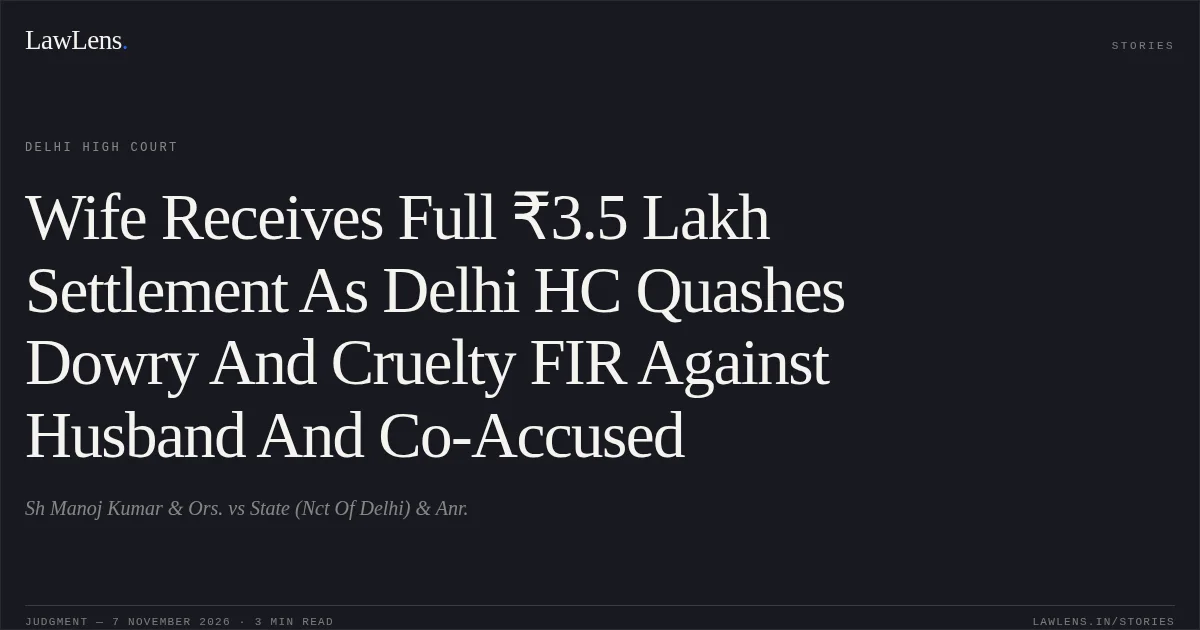
p. 2The parties later entered into a settlement before the Family Court, agreeing to dissolve the marriage by mutual consent and for Petitioner No. 1 to pay Respondent No. 2 ₹3,50,000 in full and final settlement of her claims.
pp. 2–4Respondent No. 2 confirmed that the settlement was voluntary and had no objection to quashing the FIR. The full settlement amount was paid, including the balance ₹1,00,000 handed over in court.
p. 402Issues
i.1. Whether the High Court should exercise its inherent jurisdiction under Section 528 BNSS to quash the FIR and consequential proceedings for non-compoundable offences on the basis of the parties’ matrimonial settlement.
p. 1 · pp. 4–5ii.2. Whether the settlement was a sufficient basis to quash the proceedings, considering the nature of the allegations and the circumstances of the settlement.
pp. 4–703Law Applied
Section 528 of the Bharatiya Nagarik Suraksha Sanhita, 2023, corresponding to Section 482 CrPC, empowers the High Court to quash criminal proceedings, including in cases involving non-compoundable offences, where doing so would secure the ends of justice or prevent abuse of process; this power is distinct from the statutory power to compound offences and must be exercised sparingly and with caution.
p. 1 · pp. 5–6Gian Singh v. State of Punjab, (2012) 10 SCC 303, permits quashing where a dispute is predominantly private or matrimonial, the parties have settled it, and continuation of proceedings would serve no useful purpose or defeat justice, while excluding serious offences with substantial societal impact.
pp. 4–5Narinder Singh v. State of Punjab, (2014) 6 SCC 466, directs courts to consider the nature and gravity of the offence, the settlement, the likelihood of conviction and whether continuation would cause injustice.
pp. 5–6Jitendra Raghuvanshi v. Babita Raghuvanshi, (2013) 4 SCC 58, recognises that non-compoundable offences arising from matrimonial disputes may be quashed where the settlement is amicable and voluntary.
p. 7Provisions in the judgment · 9 · Linked ones open on LawLens
Bharatiya Nagarik Suraksha Sanhita, 2023 Section 528
Code of Criminal Procedure, 1973 Section 482Section 320
Indian Penal Code, 1860 Section 406Section 420Section 506Section 34
04Reasoning
The Court treated the prosecution as arising from a matrimonial relationship and found that the parties had resolved their disputes through a settlement, including full payment of the agreed ₹3,50,000.
pp. 2–4Respondent No. 2 affirmed that she had entered the settlement freely, without pressure or coercion, and consented to quashing the FIR.
p. 4Applying the cited principles on quashing settled matrimonial disputes, the Court concluded that continuation of the prosecution would serve no fruitful purpose and that there was no impediment to allowing the petition.
p. 4 · p. 705Holding
The Court answered the issues in favour of quashing.
pp. 7–8It allowed the petition under Section 528 BNSS and quashed FIR No. 0439/2020, registered at Police Station Gokul Puri under Sections 498-A, 406, 420, 506 and 34 IPC and Sections 3 and 4 of the Dowry Prohibition Act, 1961, together with all consequential proceedings, qua all petitioners.
pp. 7–8Original Court PDF
Sh Manoj Kumar & Ors.vsState (Nct Of Delhi) & Anr.
Click to open original judgment
Original judgment, available to read, download and summarize on LawLens.in