01Facts
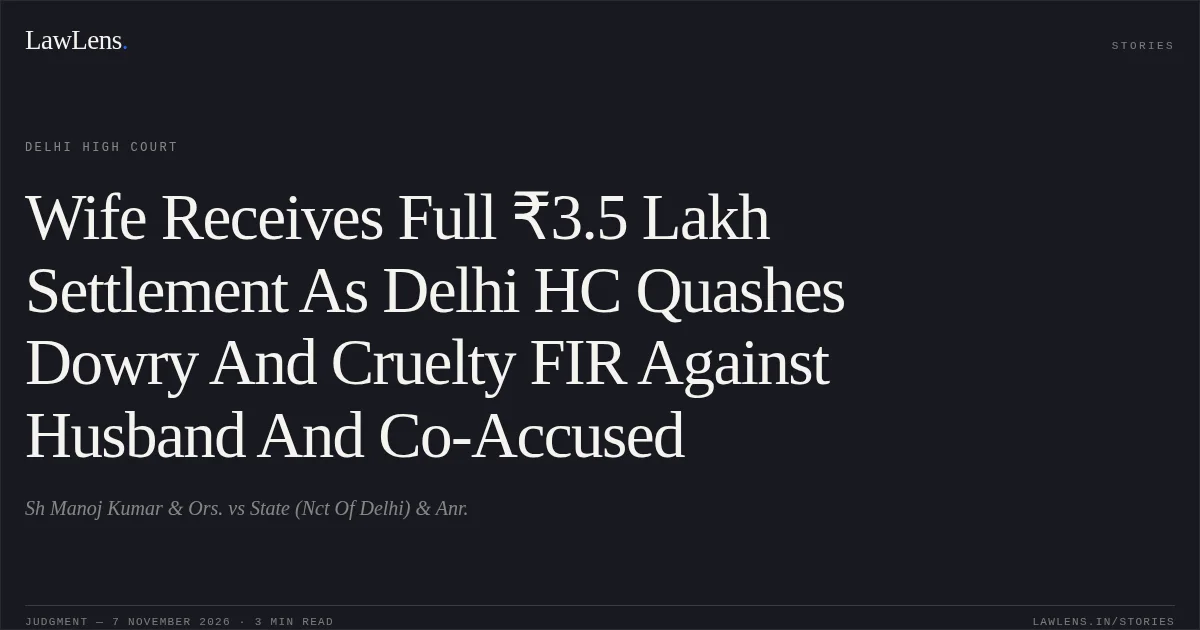
Petitioner No. 1 (husband) and respondent No. 2 (wife) married on 22 February 2023 and lived separately from 30 June 2023; no child was born of the marriage.
pp. 1–2Following the wife’s complaint alleging dowry demands, harassment and retention of her articles, FIR No. 466/2024 was registered under Sections 498A/406/34 IPC.
p. 2The parties reached a settlement through mediation on 17 September 2025, and their marriage was dissolved by mutual-consent divorce on 7 January 2026.
p. 2, 7The wife confirmed that she had received the agreed amount and motorcycle, that the settlement was voluntary, and that she had no objection to quashing the FIR.
p. 8The petitioners sought quashing of the FIR and consequential proceedings under Article 226 of the Constitution and Section 528 BNSS.
p. 102Issues
i.1. Whether the High Court should quash the FIR under Sections 498A/406/34 IPC and proceedings arising from it, in light of the parties’ settlement and the wife’s lack of objection.
pp. 1, 8–12ii.2. Whether the matrimonial nature of the dispute, the parties’ divorce, and performance of the settlement warranted quashing in the interests of justice.
pp. 8–1203Law Applied
Article 226 of the Constitution and Section 528 of the Bharatiya Nagarik Suraksha Sanhita, 2023 (pari materia with Section 482 CrPC), empower the High Court to quash criminal proceedings to secure the ends of justice or prevent abuse of process.
pp. 8–11Under Gian Singh v. State of Punjab, (2012) 10 SCC 303, Narinder Singh v. State of Punjab, (2014) 6 SCC 466, and Jitendra Raghuvanshi v. Babita Raghuvanshi, (2013) 4 SCC 58, predominantly private or matrimonial disputes may be quashed following a genuine settlement, even where the offences are non-compoundable, if the court is satisfied that the settlement is voluntary, the possibility of conviction is remote, and continuation would defeat justice.
pp. 8–11The Court also relied on Navneesh Aggarwal v. State of Haryana, 2025 SCC OnLine SC 1680, which observed that prosecution arising from a matrimonial relationship that has ended in divorce may, in appropriate circumstances, amount to an abuse of process.
p. 11Provisions in the judgment · 5 · Linked ones open on LawLens
Bharatiya Nagarik Suraksha Sanhita, 2023 Section 528
Code of Criminal Procedure, 1973 Section 482Section 320
Indian Penal Code, 1860 Section 406Section 34
04Reasoning
The Court treated the allegations as arising from a short-lived matrimonial relationship and as essentially private in nature.
p. 8It found the settlement had been reached through court-annexed mediation, reaffirmed by the parties, and acted upon; the wife had received the agreed consideration and expressly consented to quashing.
p. 8The marriage had also been dissolved by mutual consent.
p. 7Applying the cited principles, the Court concluded that continuing the prosecution after the parties had resolved their disputes would serve no useful purpose and that there was no impediment to quashing.
pp. 11–1205Holding
The High Court allowed the petition and quashed FIR No. 466/2024, registered under Sections 498A/406/34 IPC, together with all proceedings emanating from it, qua all petitioners.
pp. 11–12The petition and pending application were disposed of accordingly.
p. 12Original Court PDF
Nitesh Kumar Sharma And OrsvsState Nct Of Delhi And Anr
Click to open original judgment
Original judgment, available to read, download and summarize on LawLens.in