01Facts
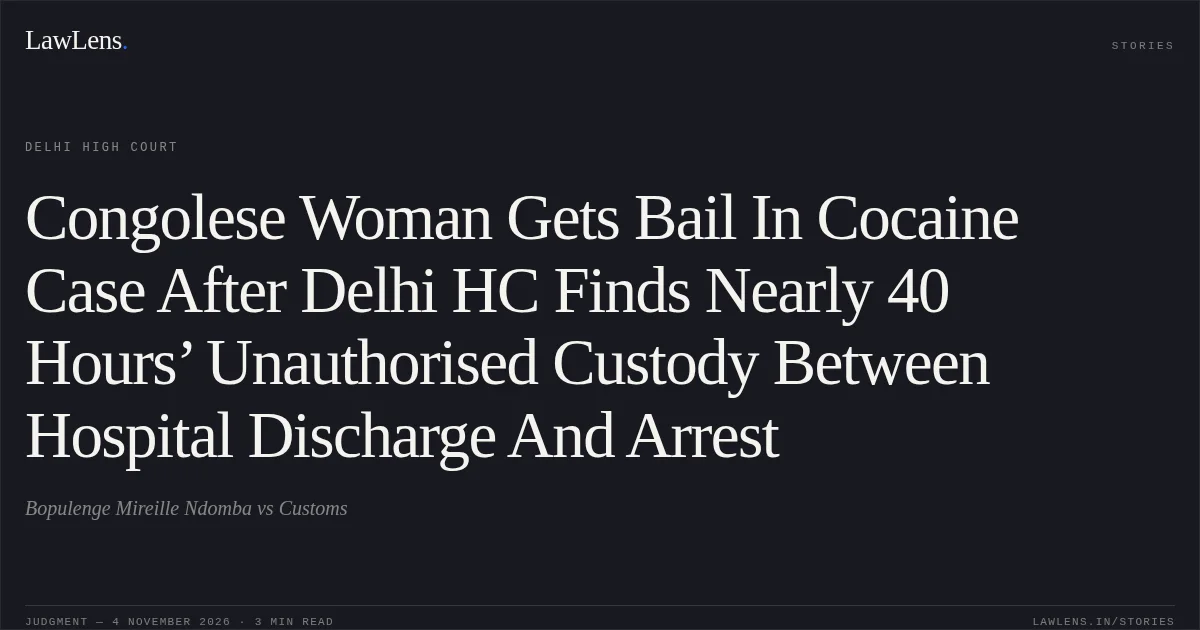
The petitioner, a Liberian national, was intercepted at IGI Airport on 7 September 2024 after arriving from Dubai.
pp. 1–2, 6–9 · ¶ 1, 3–5, 9, 13He initially ejected 28 capsules at the airport and was then taken to Safdarjung Hospital, where a further 56 capsules were recovered over the next two days. The 84 capsules contained approximately 1,660 grams of cocaine.
pp. 1–2, 6–9 · ¶ 1, 3–5, 9, 13He was formally arrested on 11 September 2024 and produced before the Trial Court that evening.
pp. 1–2, 6–9 · ¶ 1, 3–5, 9, 13The petitioner sought regular bail under Section 483 of the Bharatiya Nagarik Suraksha Sanhita, 2023; the Special Judge had dismissed his application on 9 March 2026.
p. 1 · ¶ 2By the High Court’s consideration, he had been in custody for about two years and two months, with only 8 of 23 witnesses examined.
p. 10 · ¶ 1702Issues
i.1. Whether the petitioner’s period of detention began when Customs effectively curtailed his liberty at the airport, rather than when his formal arrest was recorded, and whether his production before the court beyond 24 hours violated Article 22(2) of the Constitution.
pp. 6–10 · ¶ 11–16ii.2. Whether Section 103(8) of the Customs Act, 1962, or the petitioner’s consent to medical procedures for recovery of the capsules, displaced or qualified the Article 22(2) requirement.
pp. 9–10 · ¶ 14–16iii.3. Whether the circumstances, including the alleged constitutional violation and the length of custody relative to trial progress, warranted regular bail.
pp. 10–12 · ¶ 17–1803Law Applied
Article 22(2) of the Constitution requires a person whose liberty has been curtailed by detention to be produced before a magistrate within 24 hours, excluding only the time necessary for the journey; the period does not await formal recording of arrest or completion of investigative procedures.
pp. 7–9 · ¶ 12, 14–15, applying Sri Sujit Das and Ors. v. Union of India, 2026 INSC 1195Section 103(8) of the Customs Act dispenses with production before a magistrate for the specified screening procedure where a person voluntarily submits to action to bring out goods secreted in the body; it does not displace Article 22(2) once the person is detained.
p. 10 · ¶ 16–17The Court also relied on Kitoko Ngiembo Alain v. Customs, 2026:DHC:1338, concerning arrest and production following an initial recovery, and on Mohd. Muslim @ Hussain v. State (NCT of Delhi), (2023) 18 SCC 166, and Union of India v. Chidiebere Kingsley Nawchara, 2026 SCC OnLine SC 1585, in considering prolonged custody and the need to reconcile statutory restrictions with personal liberty.
pp. 6–7, 10–12 · ¶ 11, 17–18Provisions in the judgment · 5 · Linked ones open on LawLens
Bharatiya Nagarik Suraksha Sanhita, 2023 Section 483Section 58
Narcotic Drugs and Psychotropic Substances Act, 1985 Section 67
Customs Act,1962 Section 103
Code of Criminal Procedure, 1973 Section 57
04Reasoning
The Court found that the initial recovery of 28 capsules at the airport revealed the alleged offence, while the petitioner remained in Customs’ continuous control from 7 September until his production before the Trial Court on 11 September 2024.
pp. 6–9 · ¶ 11, 13Applying Sujit Das and Kitoko Ngiembo Alain, it held that Customs should have arrested and produced him within the constitutional period; further recovery or medical treatment could not justify delaying production, and remand could have been sought at the hospital if necessary.
pp. 6–9 · ¶ 11–15The Court rejected reliance on Section 103(8), holding that it did not authorize detention without timely production after contraband had been recovered.
p. 10 · ¶ 16–17It also considered the petitioner’s substantial custody and the limited progress of the trial in assessing the bail application.
p. 10 · ¶ 1705Holding
The High Court allowed the bail application and directed the petitioner’s release on a personal bond of ₹50,000 with two sureties of the like amount, subject to conditions addressing verification of his Delhi residence and sureties, deposit of his passport, FRRO registration, restrictions on travel, monthly police-station attendance, provision of an operational Indian mobile number, attendance at trial, and disclosure of his Indian funds and bank accounts.
pp. 12–14 · ¶ 19Customs was directed to inform the Liberian Embassy, and the Trial Court was directed to ensure compliance with the applicable surety-verification directions in Chidiebere Kingsley Nawchara and to endeavour to conclude the trial expeditiously.
pp. 13–14 · ¶ 19–20The Court clarified that its prima facie observations were confined to the bail application and would not affect the merits of the trial.
p. 14 · ¶ 21Original Court PDF
Shadrach NwogbovsCustoms
Click to open original judgment
Original judgment, available to read, download and summarize on LawLens.in