01Facts
Petitioner No. 1 and respondent No. 2 married in 2013 and had two sons, who remained in respondent No. 2’s care and custody after the parties separated in August 2023.
pp. 1–2 · ¶ 2–3Respondent No. 2’s complaint led to FIR No. 0015/2024 under Sections 498A, 406, 34, 354A and 506 IPC.
pp. 2–4 · ¶ 4–5The parties later entered into a mediated settlement providing for divorce by mutual consent, payment of ₹1.5 crore towards all claims, and respondent No. 2’s cooperation in seeking quashing of the FIR.
pp. 2–4 · ¶ 4–5The marriage was dissolved by mutual-consent decree on 9 April 2026; at the hearing, respondent No. 2 confirmed receipt of the balance ₹50 lakh and stated that the settlement was voluntary and that she had no objection to quashing.
p. 4 · ¶ 6–902Issues
i.1. Whether the High Court should exercise its inherent jurisdiction to quash the FIR and related proceedings arising from matrimonial disputes after the parties have settled them, notwithstanding that the alleged offences are non-compoundable.
pp. 5–7 · ¶ 10–13ii.2. Whether the proceedings should also be quashed against petitioner No. 5 in respect of the Section 354A IPC allegation, in light of the settlement and respondent No. 2’s position.
pp. 7–9 · ¶ 14–1603Law Applied
Section 528 of the Bharatiya Nagarik Suraksha Sanhita, 2023, which is pari materia with Section 482 CrPC, empowers the High Court to quash criminal proceedings to secure the ends of justice or prevent abuse of process.
p. 1 · ¶ 1 · p. 6 · ¶ 12Under Gian Singh v. State of Punjab, non-compoundable proceedings may be quashed where the dispute is predominantly private or matrimonial, the settlement is genuine, and continuation would serve no useful purpose or defeat justice.
pp. 5–6 · ¶ 11Narinder Singh v. State of Punjab directs the Court to consider the nature of the dispute, the likelihood of conviction, and whether continuation would cause oppression or injustice; matrimonial disputes resolved in their entirety are suitable for quashing.
p. 6 · ¶ 12Jitendra Raghuvanshi v. Babita Raghuvanshi confirms that Section 320 CrPC does not bar quashing of non-compoundable offences in a matrimonial dispute where the settlement is voluntary and quashing would secure the ends of justice.
pp. 6–7 · ¶ 13Provisions in the judgment · 9 · Linked ones open on LawLens
Bharatiya Nagarik Suraksha Sanhita, 2023 Section 528
Code of Criminal Procedure, 1973 Section 482Section 320
Indian Penal Code, 1860 Section 34Section 354Section 377Section 406Section 506Section 509
04Reasoning
The Court found that the allegations arose from a matrimonial relationship, the settlement comprehensively resolved the parties’ disputes, the marriage had been dissolved, and the settlement amount had been paid.
pp. 4–5 · ¶ 8–10, 17Although it acknowledged the gravity of the Section 354A allegation against petitioner No. 5, the Court considered that it concerned a single incident during the marital discord, respondent No. 2 described it as arising from a misunderstanding and no longer wished to pursue it, and continuation would require her to depose contrary to her stated position.
pp. 7–8 · ¶ 14Applying the cited authorities, the Court concluded that continued prosecution would be futile and that the circumstances justified quashing the proceedings against all petitioners.
pp. 8–9 · ¶ 15–1805Holding
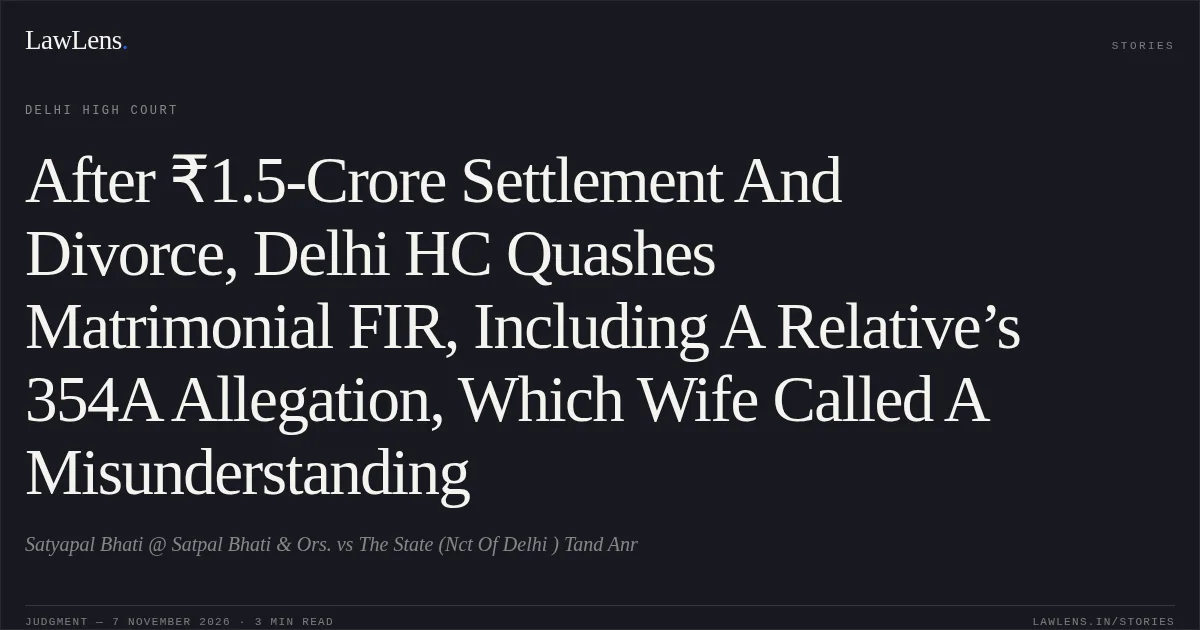
The Court allowed the petition and quashed FIR No. 0015/2024, registered under Sections 498A, 406, 34, 354A and 506 IPC, and all proceedings emanating from it, as against all petitioners.
p. 9 · ¶ 18–19The petitioners also undertook to pay ₹1,00,000 in costs to the Delhi High Court Legal Services Committee within four weeks and to file proof of payment in the Registry; the petition and pending application were disposed of accordingly.
p. 10 · ¶ 20–23Original Court PDF
Satyapal Bhati @ Satpal Bhati & Ors.vsThe State (Nct Of Delhi ) Tand Anr
Click to open original judgment
Original judgment, available to read, download and summarize on LawLens.in