01Facts
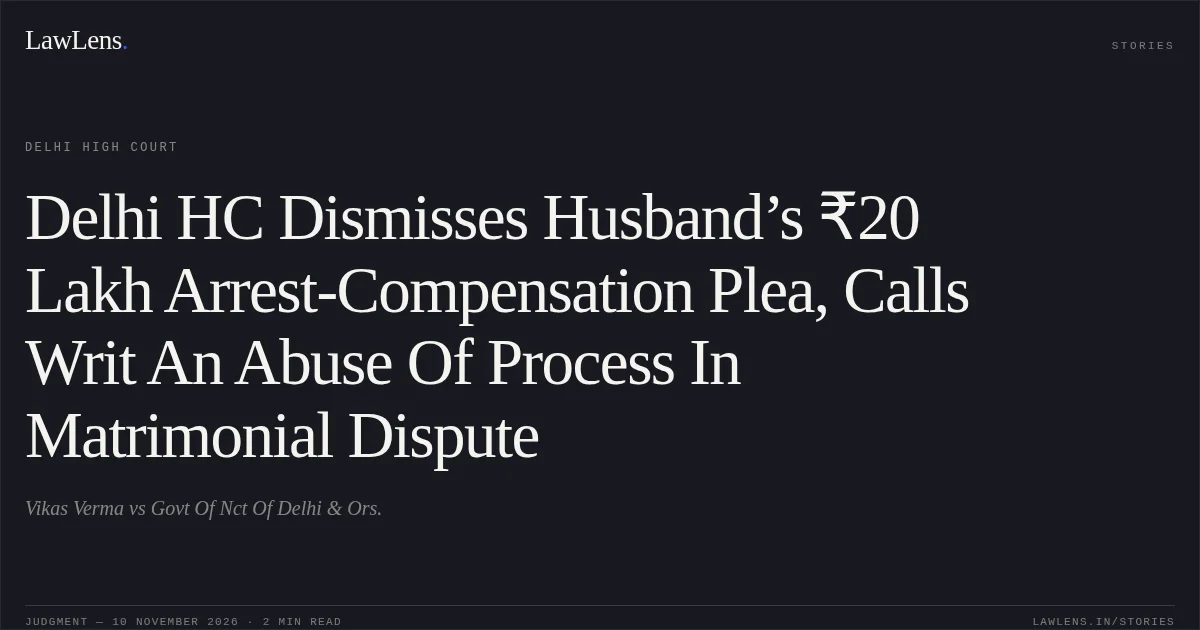
The petitioner sought public-law compensation for alleged unlawful arrest and civil imprisonment arising from execution proceedings connected with matrimonial proceedings, as well as a refund and further compensation from Respondent No. 4.
pp. 1–3 · ¶ 1–5He alleged that Family Court orders had allocated costs of ₹5,000 to Respondent No. 4 and ₹15,000 to the Delhi State Legal Services Authority (DLSA); that he paid those sums; and that, despite those payments, the execution proceedings continued, leading to his arrest and a further payment of ₹15,000 to Respondent No. 4.
pp. 1–3 · ¶ 1–5The petitioner also sought an independent inquiry and action against those responsible.
p. 2 · ¶ 102Issues
i.Whether the petitioner’s claims for compensation and an inquiry arising from the Family Court execution proceedings could be adjudicated in a writ petition under Article 226, given the disputed facts and the proceedings’ connection to the matrimonial dispute.
pp. 3–4 · ¶ 6–9ii.Whether the petitioner could pursue recovery of any excess amount allegedly paid to Respondent No. 4 in the writ petition or should seek relief before the appropriate court.
p. 4 · ¶ 1103Law Applied
Article 226 confers extraordinary writ jurisdiction, but the Court held that it could not be used as an additional forum to pursue private grievances or settle scores arising from a matrimonial dispute, particularly where the challenged events stemmed from Family Court execution proceedings and involved disputed questions of fact.
pp. 3–4 · ¶ 6–8No statutory provisions or precedents were cited in the judgment; although the petitioner invoked Article 21, the Court did not determine whether his liberty had been unlawfully deprived.
p. 1 · ¶ 1 · pp. 3–4 · ¶ 7–804Reasoning
The Court considered the alleged suppression of facts, continuation of execution proceedings, arrest, and subsequent payment to be connected to the pending matrimonial proceedings and their execution.
p. 3 · ¶ 6It found that the appropriateness of the orders made in execution involved disputed factual questions unsuitable for determination in this writ proceeding.
p. 3 · ¶ 7It further held that Article 226 could not be used to ventilate personal grievances arising from the matrimonial dispute or to pursue a private vendetta.
pp. 3–4 · ¶ 8As to the alleged excess payment, the Court directed the petitioner to pursue an appropriate application before the appropriate court.
p. 4 · ¶ 1105Holding
The Court dismissed the writ petition, holding that it amounted to an abuse of process and had unnecessarily engaged the Court’s time.
p. 4 · ¶ 9, 12Although the Court was inclined to impose costs, it waived them following counsel’s insistence.
p. 4 · ¶ 10The petitioner remained at liberty to seek recovery of any excess payment before the appropriate court.
p. 4 · ¶ 11Original Court PDF
Vikas VermavsGovt Of Nct Of Delhi & Ors.
Click to open original judgment
Original judgment, available to read, download and summarize on LawLens.in