Facts
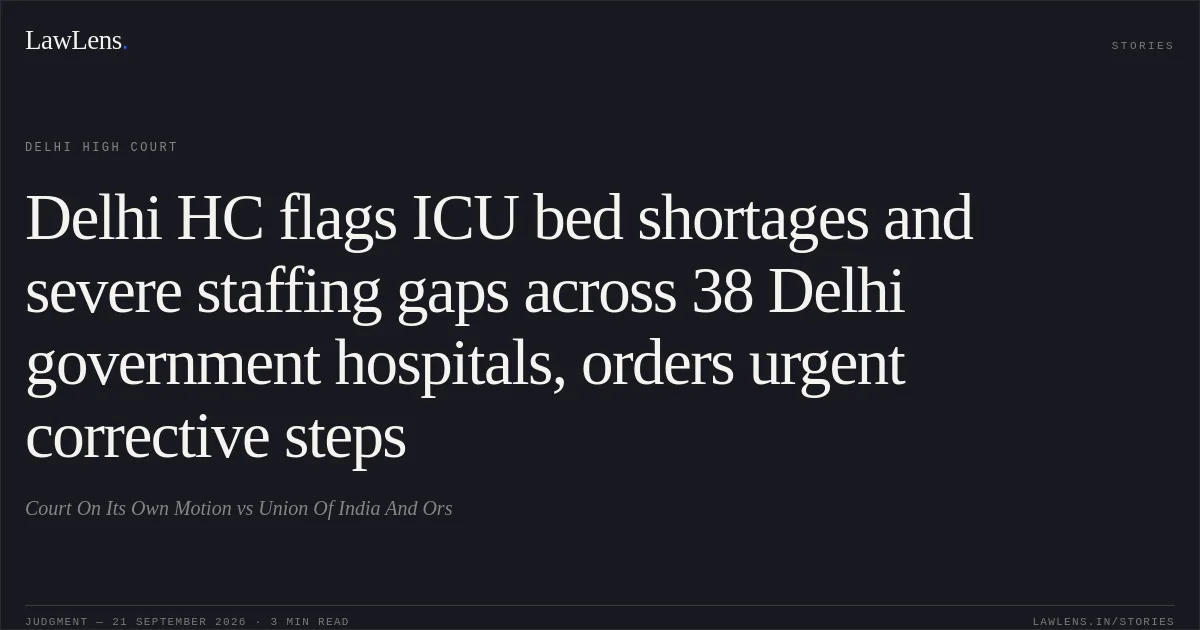
The Delhi High Court was monitoring the functioning of 38 government hospitals in Delhi, including issues concerning the NextGen e-Hospital Management Information System, common emergency helpline services, inter-hospital referrals, unused medical equipment, and shortage of medical and technical staff.
Source reference: paras. 1–4; pp. 2–3Pursuant to the Court’s earlier directions, the GNCTD filed a status report and placed on record minutes of meetings held by the Secretary, Department of Health and Family Welfare.
Source reference: para. 4; p. 3The GNCTD stated that the existing CATS toll-free number “102” had been integrated with the ICU Dashboard to provide information regarding ICU-bed availability across government hospitals.
Source reference: paras. 5–8; pp. 3–4The Court further considered the nomination of referral coordinators, staffing deficiencies, absence of a uniform recruitment policy, vacant senior administrative posts, and the failure to adequately address unused equipment in government hospitals.
Source reference: paras. 16–30; pp. 6–11Issues
Whether the CATS toll-free number “102” was adequately equipped and staffed to function as a common helpline for emergency services and ICU-bed availability across Delhi’s 38 government hospitals.
Source reference: paras. 5–15; pp. 3–6Whether each government hospital was required to maintain round-the-clock referral coordination for patients transferred between hospitals.
Source reference: paras. 16–22; pp. 6–10Whether the GNCTD had adopted an adequate and consistent mechanism for recruiting doctors, technical personnel, and other hospital staff, including filling the posts of Medical Superintendent/Medical Director.
Source reference: paras. 23–39; pp. 10–13Whether the status of “unused equipment” required a uniform and comprehensive assessment based on actual daily availability for patient care and the availability of trained manpower.
Source reference: paras. 23–32, 40; pp. 10–13Law Applied
The Court applied its constitutional and public-law supervisory jurisdiction to require governmental authorities to ensure effective administration of public hospitals, accountability in the delivery of essential healthcare services, continuity of hospital administration, and timely compliance with judicial directions.
Source reference: paras. 12–15, 20–22, 26–28, 34–40; pp. 5–13The Court proceeded on the principles that administrative arrangements must be functional rather than merely formal, that emergency healthcare services require continuous coordination and adequate staffing, and that public medical infrastructure cannot be treated as operational unless it is available for patients with appropriate manpower.
Source reference: paras. 12–15, 20–22, 26–28, 34–40; pp. 5–13Reasoning
The Court accepted “102” as the common helpline because CATS had provided its operators access to the ICU Dashboard and training to respond to ICU-bed enquiries.
Source reference: paras. 7–8; pp. 4–5However, the initial unanswered calls, the reported volume of approximately 2,200 calls per day, and around 500 daily call drops demonstrated that the existing 30 lines and 30 operators might be inadequate.
Source reference: paras. 9–15; pp. 5–6Regarding referrals, the Court held that merely nominating one coordinator in each hospital was insufficient because doctors generally work in shifts.
Source reference: paras. 19–21; pp. 9–10Effective coordination required at least three referral coordinators per hospital to ensure round-the-clock availability.
Source reference: paras. 19–21; pp. 9–10On staffing, the Court found the GNCTD’s response unsatisfactory, observing that decentralised contractual recruitment and the absence of a uniform HR policy did not provide a stable solution to persistent vacancies and administrative deficiencies.
Source reference: paras. 25–29; pp. 10–11Finally, because hospitals used the expression “unused equipment” inconsistently, the Court clarified that equipment would be treated as unused if it was not available daily to patients with proper manpower; occasional use by consultants would not suffice.
Source reference: paras. 30, 40; pp. 11–13Holding
The Court continued its supervisory proceedings and issued further administrative directions rather than finally disposing of the petitions.
The Court directed the Head of Operations, CATS, to prepare at least one month’s data concerning calls, call drops, and the required number of lines and operators, and to file a further status report.
Source reference: paras. 12–15; p. 6The referral-coordinator list was to be revised to ensure round-the-clock availability, with a further status report to be filed.
Source reference: paras. 19–22; pp. 9–10The Secretaries of Health and Family Welfare and Services, GNCTD, were directed to hold a fresh meeting with the heads of all 38 hospitals, prepare hospital-wise details of sanctioned, filled, and vacant posts, prescribe a strict recruitment timeline, and fill all MS/MD/Director posts; interim charge was to be assigned within 15 days where regular recruitment would take time.
Source reference: paras. 31–38; pp. 11–12The Court also ordered a detailed report on MRI, CT Scan, PET Scan, and USG equipment, including whether trained regular or contractual manpower was available for their daily patient use.
Source reference: para. 40; p. 13The matters were listed for further hearing on 10 October 2026.
Source reference: para. 41; p. 13Original Court PDF
Court On Its Own MotionvsUnion Of India And Ors
Click to open original judgment
Original judgment, available to read, download and summarize on LawLens.in