01Facts
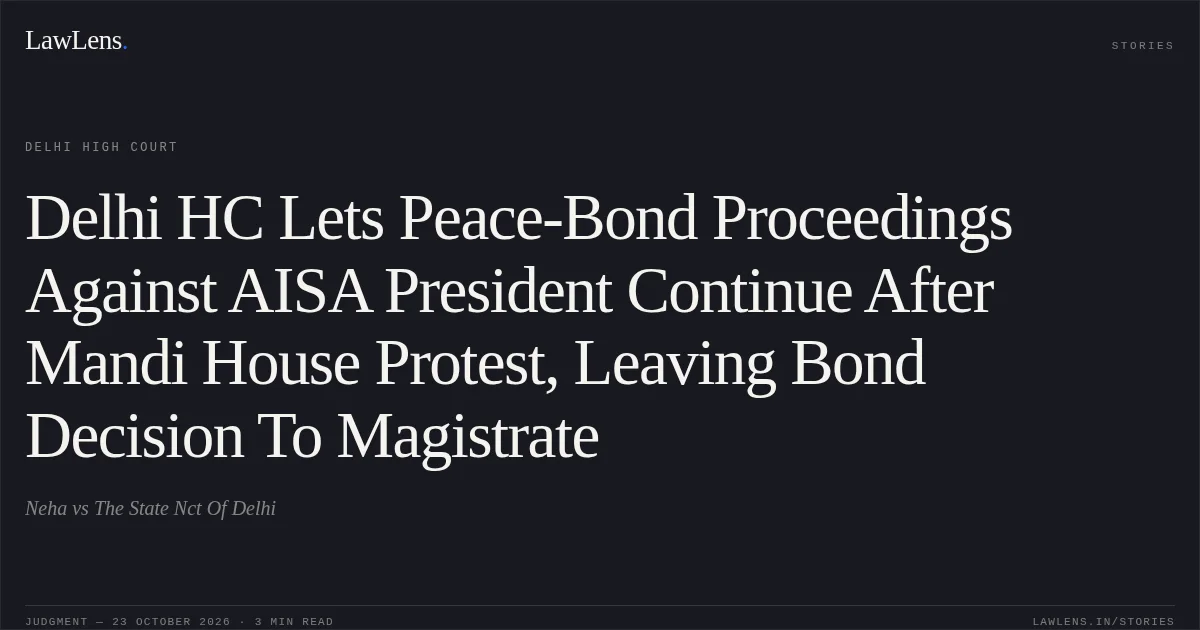
Neha, National President of the All India Students’ Association, challenged a notice dated 17 October 2026 issued by the Special Executive Magistrate (SEM) under Sections 126 and 130 of the Bharatiya Nagarik Suraksha Sanhita, 2023 (BNSS).
¶ 3–7The notice required her to show cause why she should not furnish a personal bond and surety for keeping the peace during the inquiry.
¶ 3–7It followed her participation in a protest at Mandi House on 16 October 2026 and referred to alleged protest-related conduct, including activity in areas said to be subject to prohibitory orders.
¶ 3–7The SEM’s record included a police kalandara, General Diary entries, details of FIRs and the investigating officer’s submissions.
¶ 31–3502Issues
i.1. Whether the notice under Sections 126 and 130 BNSS disclosed sufficient information and reflected the SEM’s application of mind to justify initiating preventive proceedings.
¶ 26, 37, 46–47ii.2. Whether the High Court should intervene under Article 226 at the show-cause-notice stage, and whether the notice could combine the requirements of Sections 126 and 130 BNSS.
¶ 26–29, 39–40iii.3. Whether the SEM could require an interim bond under Section 135(3) BNSS, and what safeguards govern that decision.
¶ 23, 48–5203Law Applied
Sections 126 and 130 BNSS permit an Executive Magistrate, on receiving information and forming an opinion that sufficient grounds exist, to require a person to show cause why a bond should not be ordered to prevent a likely breach of peace; the written order must state the substance of the information received and the bond’s terms.
¶ 16–18, 26Proceedings under Chapter IX are preventive, not punitive, and rest on the Magistrate’s subjective satisfaction, but that satisfaction must be based on material and the prescribed procedure.
¶ 24–26At the notice stage, writ review ordinarily asks whether any material existed and whether the Magistrate applied his mind; intervention is exceptional, including where there is patent want of jurisdiction, non-application of mind, abuse of process, or a notice founded on no material.
¶ 26–29A combined notice and order may suffice if the statutory requirements are met and the substance of the information and reasons are conveyed to the noticee [applying Farhan Nasir Khan v. State of Maharashtra, 2019 SCC OnLine Bom 1777].
¶ 39–40Under Section 135(3) BNSS, an interim bond may be directed only after the inquiry has commenced and before it concludes, where immediate measures are necessary, with written reasons and the safeguards identified in Madhu Limaye v. Sub-Divisional Magistrate, Monghyr, (1970) 3 SCC 746.
¶ 16, 23, 48–50, 52Provisions in the judgment · 31 · Linked ones open on LawLens
Bharatiya Nagarik Suraksha Sanhita, 2023 14 provisions
Section 126Section 127Section 128Section 129Section 130Section 131Section 132Section 133Section 134Section 135Section 136Section 137Section 163Section 169Bharatiya Nyaya Sanhita, 2023 9 provisions
Section 152Section 178Section 179Section 180Section 181Section 196Section 197Section 294Section 299Code of Criminal Procedure, 1973 Section 107Section 111Section 112Section 113Section 116Section 117
Delhi Police Act, 1978 Section 65
Central Excise Act, 1944 Section 37
04Reasoning
The Court found that the SEM had considered the kalandara, related General Diary entries and other supporting material, and had recorded reasons for initiating proceedings.
¶ 31–37, 46–47Given that record, the notice was not based on no material, and the Court would not reassess the sufficiency of the material as if sitting in the SEM’s place.
¶ 31–37, 46–47The notice stated the substance of the allegations and the apprehended breach of peace; a separate Section 130 order was not necessary where the combined notice met the statutory requirements.
¶ 37, 39–40The Court therefore declined to quash the notice at this preliminary stage, while distinguishing that conclusion from any decision on whether a bond should ultimately be required.
¶ 38, 50–5405Holding
The Court held that the impugned notice met the requirements of Sections 126 and 130 BNSS and dismissed the writ petition and pending applications.
¶ 51, 55It left the question of requiring a bond to the SEM, directing that the SEM independently assess the material, provide the relied-on material to the Petitioner, comply with natural justice, and apply the statutory and judicial safeguards governing an interim bond.
¶ 38, 52–54Original Court PDF
NehavsThe State Nct Of Delhi
Click to open original judgment
Original judgment, available to read, download and summarize on LawLens.in