01Facts
The petitioner, a daughter-in-law, has resided in House No. HU-79, Pitampura, Delhi (the "subject property") since her marriage in 2008, along with her son, who is in Class XII.
¶ 4Her parents-in-law, Respondents 1 and 2 (aged about 70 and 64), live on the first floor, and the parties occupy separate portions of a common structure with a shared staircase, porch, and terrace.
¶ 4, 36Matrimonial discord has led to divorce and custody proceedings, a Section 125 CrPC maintenance order (₹30,000 per month interim), PWDV Act proceedings, and multiple criminal FIRs.
¶ 5–8A civil suit for eviction filed by Respondent 2 in 2017 is pending.
¶ 6The petitioner's son has a separate suit (CS SCJ No. 1318/2019) challenging the title of Respondent 2 as HUF/coparcenary property and the conveyance deed of 2000.
¶ 9In the PWDV proceedings, applications by Respondents 2 and 3 for alternate accommodation for the petitioner were dismissed on maintainability grounds, and the appellate court observed that eviction could be sought through due process.
¶ 7, 47–48Respondents 1 and 2 applied to the District Magistrate under Rule 22 of the Delhi Maintenance and Welfare of Parents and Senior Citizens Rules, 2009 ("Delhi Rules 2009") seeking eviction; the DM declined eviction and directed co-existence with modifications.
¶ 11–12On appeal, the Divisional Commissioner (Appellate Authority) set aside the DM's order and directed the petitioner to vacate after alternate accommodation was provided within 15 days, with vacation within 7 days thereafter.
¶ 13The mediation was closed as a non-starter.
¶ 1502Issues
i.1. Whether the Appellate Authority under the Senior Citizens Act could direct a daughter-in-law, claiming residence in a shared household, to vacate the premises at the instance of senior citizen parents-in-law, and whether the directions adequately balance competing rights.
¶ 24ii.2. Whether the Appellate Authority's reversal of the DM's order, based on personal inspection, suffers from infirmity or perversity.
¶ 35iii.3. Whether the pendency of title disputes and civil proceedings divested the Appellate Authority of jurisdiction.
¶ 41iv.4. Whether the orders passed under the PWDV Act barred the Senior Citizens Act proceedings or amounted to forum shopping.
¶ 46v.5. Whether the directions in the impugned order adequately balance the competing rights of the parties.
¶ 5303Law Applied
The Maintenance and Welfare of Parents and Senior Citizens Act, 2007 defines "maintenance" to include residence (s. 2(b)), defines "property" to include rights in ancestral or self-acquired property (s. 2(f)), and has overriding effect (s. 3).
¶ 25Rule 22(3)(1)(i) of the Delhi Rules 2009 permits a senior citizen to seek eviction of a son or legal heir on account of non-maintenance and ill-treatment.
¶ 26Section 17 of the PWDV Act confers a right to reside in a shared household irrespective of title, and s. 19(1)(f) empowers the Magistrate to direct alternate accommodation.
¶ 29Per S. Vanitha v. Deputy Commissioner (2021) 15 SCC 730, eviction under the Senior Citizens Act is permissible only where necessary and expedient, the PWDV residence right cannot be defeated by summary eviction, and composite disputes require the relief to be moulded.
¶ 30Per Satish Chander Ahuja v. Sneha Ahuja (2021) 1 SCC 414, a daughter-in-law's residence right is not indefeasible against aged parents-in-law's right to peace.
¶ 31Per Ravi Kant Gupta (SC, 2026) and Samtola Devi (2025 INSC 404), eviction is available but not mandatory and must be ordered only where necessary for the senior citizen's protection.
¶ 27–28Per Delhi High Court precedents (Geeta Wahal; Piare Khan; Pritam Singh; Manju Tokas), matrimonial discord is no bar, a title dispute does not oust jurisdiction, and a "modicum of right" suffices.
¶ 38, 39, 42Per Union of India v. Cipla Ltd. (2017) 5 SCC 262, forum shopping and res judicata principles apply only where the earlier decision adjudicated the same issue.
¶ 17, 51Provisions in the judgment · 10 · Linked ones open on LawLens
Maintenance and Welfare of Parents and Senior Citizens Act, 2007 Section 2Section 3
Code of Criminal Procedure, 1973 Section 125Section 156
Indian Penal Code, 1860 Section 406Section 34
Protection of Women from Domestic Violence Act, 2005 Section 2Section 12Section 17Section 19
04Reasoning
The Appellate Authority was competent to re-appreciate the evidence and was not bound by the DM's findings.
¶ 36The DM's own observations, that the petitioner had blocked the staircase and that the parties shared common areas and amenities, indicated that co-existence was unworkable, and the rival grievances concerned common areas.
¶ 36–37Given the acrimony, the multiple proceedings over nearly a decade, and the blocking of access, the conclusion that cohabitation was unworkable was plausible and not perverse, even disregarding the disputed DC-office incident, which the Court declined to adjudicate.
¶ 40The title dispute did not divest jurisdiction, since the Senior Citizens Act does not adjudicate title and the Appellate Authority expressly disclaimed any such adjudication.
¶ 42–44The son's rights were protected by the pending civil appeal and the stay of the interim order.
¶ 45On forum shopping, the PWDV courts had dismissed the applications on maintainability and expressly pointed to eviction proceedings under due process, so their orders did not adjudicate the seniors' statutory rights and res judicata did not apply.
¶ 49, 51The Court distinguished S. Vanitha, because here the in-laws reside on the premises, but held that the petitioner's residence right must not be rendered illusory.
¶ 52The impugned directions lacked specificity on the standard of accommodation, the duration, the rent mechanism, and default consequences, and the three-week relocation period for a resident since 2008 with a Class XII child was unjustified.
¶ 54The petitioner's refusal to respond to the accommodation notices and the Respondents' offer to fund rent up to ₹35,000 per month were used to structure a balanced remedy.
¶ 55–5605Holding
There was no jurisdictional error or perversity in finding that cohabitation had become unworkable and that the petitioner and her son must relocate. The impugned order was correct in principle but must be modified to secure the petitioner's residence right.
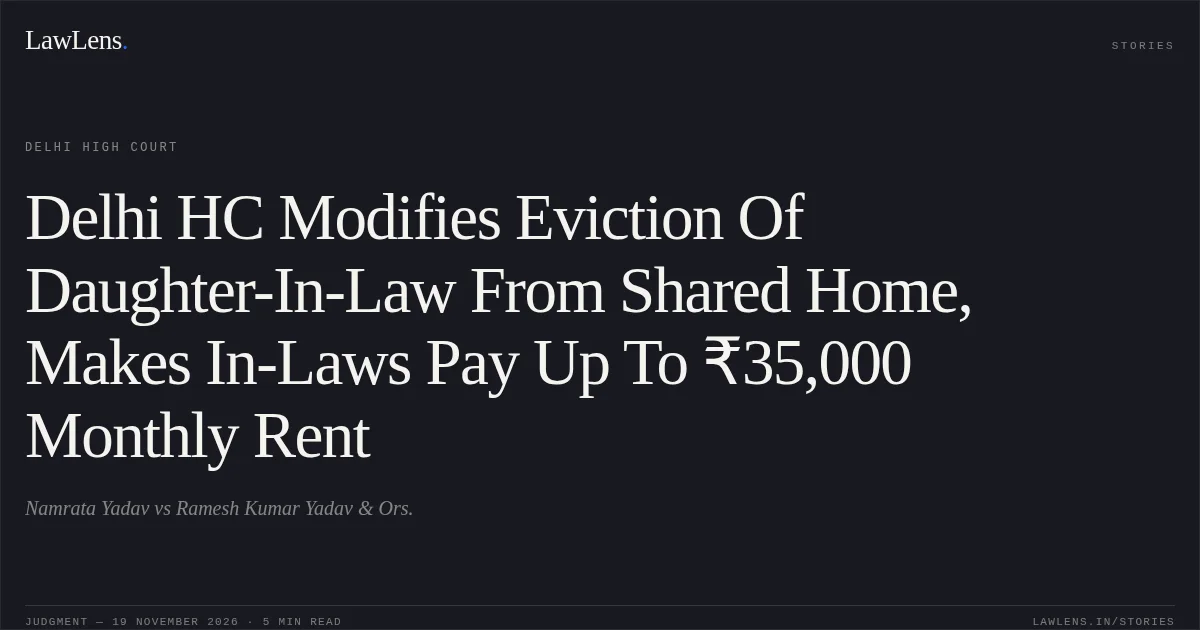
¶ 58The impugned order dated 06.08.2026 was modified as follows: (i) the petitioner must identify a two-bedroom accommodation with a drawing room and kitchen, near her son's school, within 4 weeks; (ii) Respondents 1 and 2 must bear rent up to ₹35,000 per month, plus deposit, brokerage, and shifting costs; (iii) they must pay six months' rent in advance and the deposit within 2 weeks of receiving the particulars; (iv) on the petitioner's default, Respondents may offer their own comparable accommodation; (v) the petitioner must vacate within 2 weeks of compliance, with SDM assistance; (vi) the obligation continues until the residence right is adjudicated in the PWDV or matrimonial proceedings; (vii) on two consecutive defaults, the petitioner may approach the Appellate Authority; (viii) the arrangement is in addition to maintenance and without prejudice to pending proceedings; (ix) both parties must maintain peace and comply with the DM's non-obstruction directions until shifting; and (x) the arrangement is subject to CS SCJ No. 1318/2019 and MCA SCJ No. 4/2026. The Court made no findings on title, ownership, or the merits of pending proceedings. The writ petition was disposed of accordingly.
¶ 58–60Original Court PDF
Namrata YadavvsRamesh Kumar Yadav & Ors.
Click to open original judgment
Original judgment, available to read, download and summarize on LawLens.in