01Facts
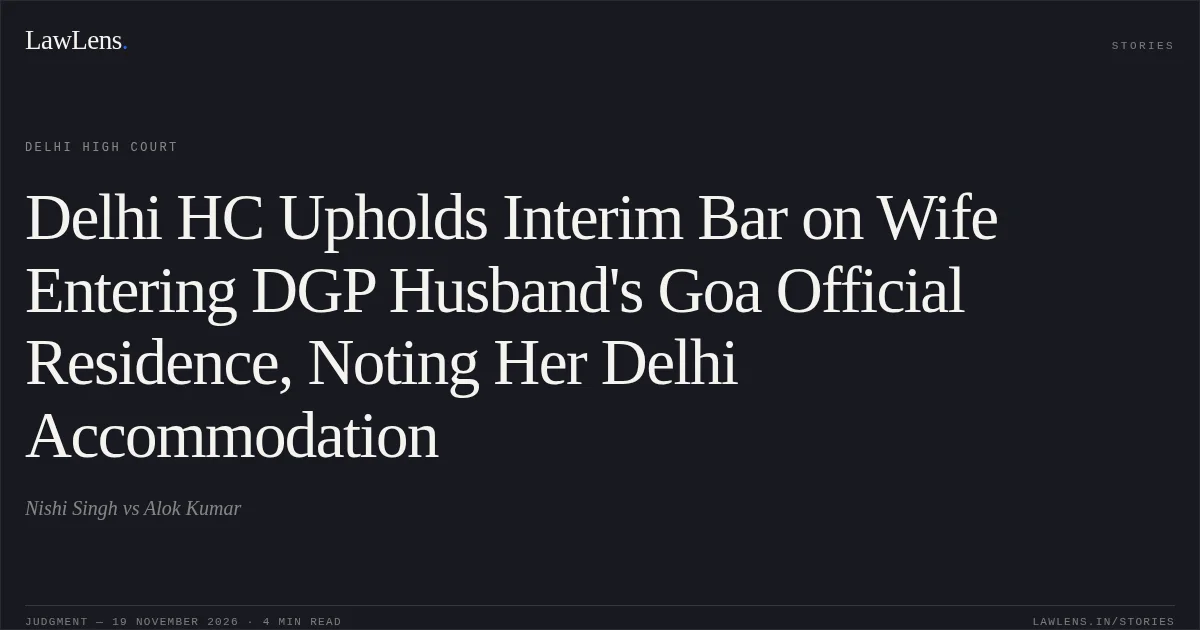
The Appellant (wife) and Respondent (husband, an IPS officer posted as DGP, Goa) are legally wedded spouses who have been living separately since February 2024 amid multiple pending matrimonial proceedings.
¶ 3–4The Respondent is allotted F-0-4, Altinho, Panaji, Goa ("subject premises"), which he uses as his official residence-cum-office.
¶ 3The Respondent is also allotted D-1/75, Rabindra Nagar, New Delhi, where the parties earlier lived with their children and which the Appellant now occupies.
¶ 3, 37The Respondent filed CS No. 02/2026 before the Family Court and an application under Order XXXIX Rules 1 and 2 CPC, alleging that in November 2025 the Appellant confronted him at the subject premises in front of staff with allegations of adultery, causing distress and reputational harm.
¶ 5The Appellant denied the allegations, contended that the Respondent's alleged extra-marital relationship caused the discord, and asserted her right to re-enter the subject premises as a shared matrimonial home.
¶ 6The Family Court allowed the application, restraining the Appellant and her relatives from entering the subject premises and from posting "incriminating material" against the Respondent on WhatsApp, YouTube and Instagram till disposal of the suit.
¶ 8, 35 (quoting Impugned Order)The Appellant appealed under Order XLIII Rule 1(r) CPC.
¶ 1, 902Issues
i.1. Whether the Family Court's grant of interim injunction, restraining the Appellant from entering the Goa premises and from social media publications, is a judicious exercise of discretion warranting appellate interference under Order XLIII Rule 1(r) CPC.
¶ 26–35, 48–50ii.2. Whether the absence of a specific prayer in the application to restrain entry into the Goa premises vitiates the impugned order.
¶ 13, 42iii.3. Whether the Appellant, as wife and a claimant of a shared household, has an absolute right to enter the subject premises, such that the availability of alternative accommodation cannot be weighed against her.
¶ 37, 40–4103Law Applied
The Court applied Order XXXIX Rules 1 and 2 CPC, which govern temporary injunctions, and Order XLIII Rule 1(r) CPC, which makes such orders appealable.
¶ 26Under the settled principles, a temporary injunction requires a prima facie case, balance of convenience and irreparable loss.
¶ 35, 43Wander Ltd. v. Antox India (P) Ltd. holds that an appeal against interlocutory discretion is an appeal on principle, and interference is warranted only where the discretion is arbitrary, capricious, perverse, or the settled principles are ignored.
¶ 28–30Mohd. Mehtab Khan v. Khushnuma Ibrahim Khan and Ramakant Ambalal Choksi v. Harish Ambala Choksi reiterate that the existence of another possible view is not, by itself, a ground for interference.
¶ 31–32Section 7(1)(d) of the Family Courts Act, as recited in the Impugned Order, confers jurisdiction over injunction proceedings arising out of marital relationships, citing Arvind Kumar Sharma v. Vineeta Sharma.
¶ 35Reena Grover v. Ramesh Grover holds that a spouse with suitable alternate accommodation of the same standard may not be entitled to re-entry into a previously shared residence.
¶ 35 (quoting Impugned Order) · ¶ 41Provisions in the judgment · 6 · Linked ones open on LawLens
Code of Civil Procedure, 1908 Section 104Section 151
Family Courts Act, 1984 Section 7
Bharatiya Nagarik Suraksha Sanhita, 2023 Section 144
Protection of Women from Domestic Violence Act, 2005 Section 2Section 19
04Reasoning
The Court defined its limited appellate role and held that it would not re-weigh the evidence or decide the merits of the matrimonial allegations at this interlocutory stage.
¶ 33, 36The Court found that the Family Court had correctly applied the prima facie, balance-of-convenience and irreparable-loss tests and correlated them to the facts.
¶ 43The Goa premises were treated as a distinct category because the Respondent holds them as his official residence-cum-office and his duties as head of police require a conducive environment. This consideration was held to be relevant, not irrelevant.
¶ 39The Appellant's marital status and past shared occupation did not confer an absolute, indefeasible right of entry. She was not left without shelter, since she occupies the Delhi government accommodation, and the parties have lived apart for over two years amid pending proceedings.
¶ 37, 40The Court accepted the Family Court's use of Reena Grover as one factor bearing on balance of convenience, not as a universal rule.
¶ 41On the absence of a specific prayer, the Court found no prejudice because the Appellant had notice of the relief, which was argued at length by both sides and referenced in the plaint.
¶ 42The social-media restraint was upheld as interim protection, without any finding on the truth of the allegations.
¶ 44–45The arguments on dignity and the children's welfare were rejected as not displacing the discretionary determination, since the order does not adjudicate children's rights.
¶ 46–4705Holding
The Family Court's order was not arbitrary, capricious, or perverse, and its conclusion was a reasonably possible view on the material before it.
¶ 48–49The Impugned Order is affirmed, and the appeal along with pending applications is dismissed.
¶ 51–52The observations are confined to this appeal and do not determine the merits of the matrimonial disputes, including the alleged extra-marital relationship, which the Family Court must adjudicate independently.
¶ 53Original Court PDF
Nishi SinghvsAlok Kumar
Click to open original judgment
Original judgment, available to read, download and summarize on LawLens.in