01Facts
A consumer complaint concerning a lost consignment was allowed against the petitioner, and the resulting decree for Rs.44,00,778, interest and costs attained finality after the Supreme Court dismissed the appeal.
¶ 2–5In execution, the petitioner contended that the decree was against an erstwhile partnership firm, dissolved in 2006, whereas the petitioner was a subsequently constituted private limited company.
¶ 5–6, 12The National Commission directed the petitioner to provide documents and particulars concerning the firm, its partners and the company, but recorded that the petitioner had not supplied complete particulars.
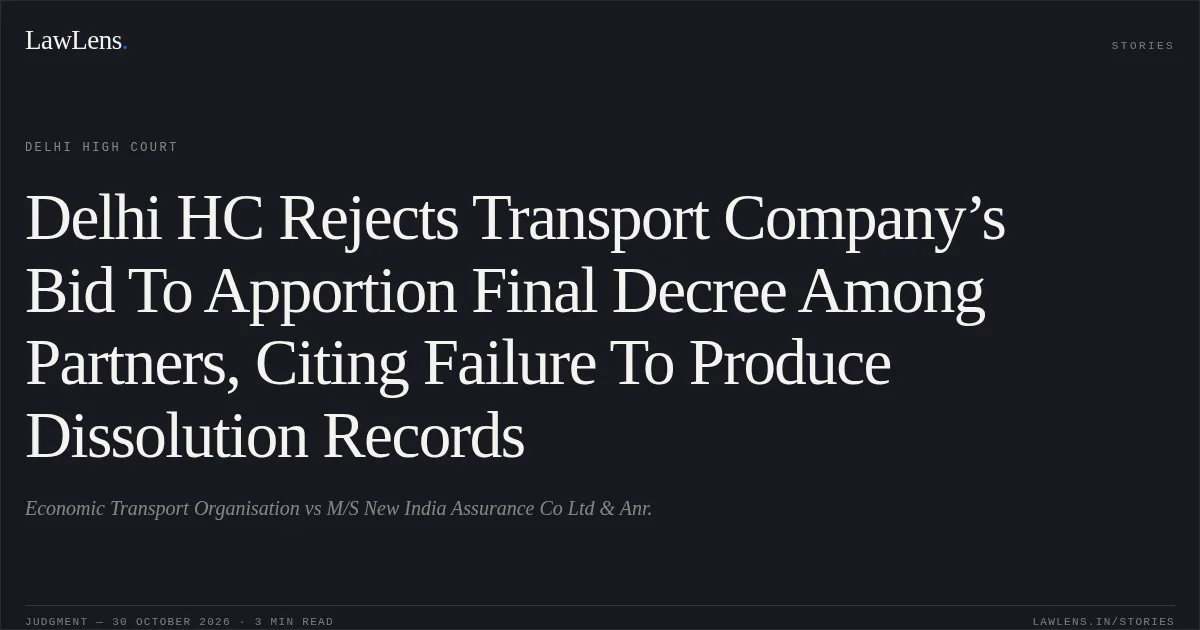
¶ 9–10, 24It dismissed the petitioner’s Section 47 CPC application in 2018 and, in 2025, rejected its application seeking determination of individual liability and restraint of an auction, holding that the decree did not require apportionment among partners.
¶ 11, 25The petitioner challenged both orders under Article 227.
¶ 102Issues
i.1. Whether, after the decree had attained finality, the National Commission could apportion decretal liability among the erstwhile partners in execution.
¶ 21ii.2. Whether the National Commission erred in holding that it was not required to apportion liability among the partners.
¶ 21iii.3. Whether the challenge to the 11 May 2018 order was maintainable before the High Court, given the appellate remedy under Section 27A of the Consumer Protection Act, 1986.
¶ 16, 25–2703Law Applied
Under Article 227 of the Constitution, the High Court exercises supervisory, not appellate, jurisdiction; it intervenes to address jurisdictional error or failure to exercise jurisdiction, not merely to substitute its view on facts.
¶ 22An executing forum cannot go behind a final decree or alter its terms, including by introducing an apportionment of liability not specified in the decree.
¶ 17–19Section 47 CPC concerns questions arising between parties to a suit relating to execution, discharge or satisfaction of the decree.
¶ 6Sections 27 and 27A of the Consumer Protection Act, 1986 provide, respectively, for consequences of non-compliance with consumer-forum orders and an appeal from an order made under Section 27; orders attracting Section 27 are appealable to the Supreme Court under Section 27A.
¶ 25–27The Court cited Saranga Anilkumar Aggarwal v. Bhavesh Dhirajlal Sheth, 2025 4 SCC 629, and Palm Groves Cooperative Housing Society v. M/s Magar Girme & Gaikwad Associates, 2025 SCC OnLine SC 1790, for the remedial purpose of statutory provisions designed to secure compliance with consumer-forum orders.
¶ 26Provisions in the judgment · 4 · Linked ones open on LawLens
Code of Civil Procedure, 1908 Section 47
Consumer Protection Act, 2019 Section 71Section 72Section 73
04Reasoning
The Court held that the petitioner could not use execution proceedings to reopen questions that could have been raised before the decree became final, particularly as the alleged dissolution predated the decree.
¶ 23The Commission had repeatedly directed the petitioner to produce the dissolution deed and complete particulars of the partners, but the petitioner failed to provide the requested material; it therefore could not complain that its liability case had not been determined as it wished.
¶ 24The decree did not provide for individual apportionment, and requiring the executing forum to apportion liability would impermissibly alter the decree.
¶ 17–19, 21The 2018 order was treated as falling within Section 27, making a challenge to it appealable under Section 27A rather than maintainable before the High Court under Article 227.
¶ 25–2705Holding
The Court found no infirmity in the impugned orders and dismissed the petition and pending applications.
¶ 29It held that the execution forum was not required to apportion liability among the partners and that the challenge to the 2018 order was not maintainable before the High Court.
¶ 21, 27, 29Original Court PDF
Economic Transport OrganisationvsM/S New India Assurance Co Ltd & Anr.
Click to open original judgment
Original judgment, available to read, download and summarize on LawLens.in