01Facts
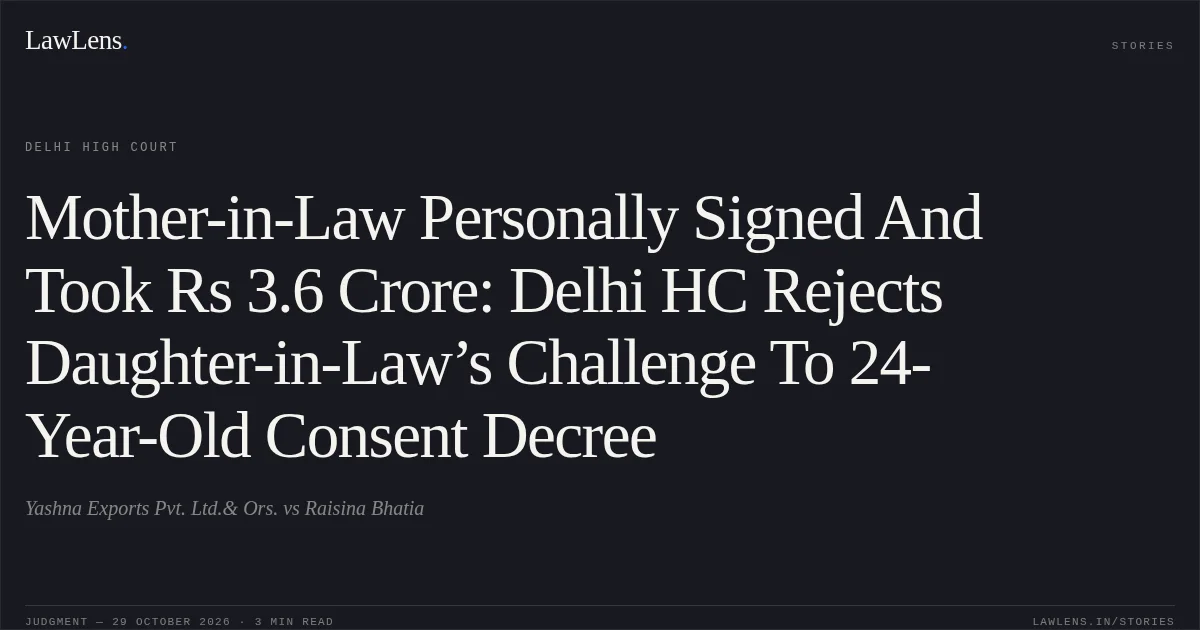
The plaintiffs obtained a compromise decree for specific performance on 20 September 2002 concerning late Raisina Bhatia’s 31.25% share in the suit property.
¶ 19–22Bhatia had signed the compromise application and supporting affidavit, appeared in person, affirmed the settlement on oath, received the balance consideration in Court, and handed over possession.
¶ 19–22In 2026, her daughter-in-law, Sangeeta Bhatia, applied under Order XXIII Rule 3 read with Sections 47 and 151 CPC to have the decree declared void for alleged fraud and want of authority, to be impleaded, and to stay execution.
¶ 2–7She also argued that the compromise violated Section 44 of the Transfer of Property Act, 1882, and that the decree exceeded the relief sought in the plaint.
¶ 13–17The plaintiffs opposed the application, relying on the record of Raisina Bhatia’s personal participation, the delay, and the absence of any challenge by her or the other heirs.
¶ 8–1202Issues
i.1. Whether the applicant, claiming through Raisina Bhatia, could challenge the 2002 compromise decree as fraudulent, unauthorised, or otherwise unlawful
¶ 23–25, 33ii.2. Whether the compromise was unlawful under Section 44 of the Transfer of Property Act or void under Section 23 of the Indian Contract Act, or whether the decree exceeded the plaint’s prayer
¶ 30–31iii.3. Whether the applicant was entitled to impleadment and a stay of execution, including on the basis of objections under Section 47 CPC
¶ 3303Law Applied
Order XXIII Rule 3 CPC requires the Court to be satisfied that a compromise is lawful; a consent decree is binding unless set aside by the Court that recorded it, on a finding that no valid compromise existed (Pushpa Devi Bhagat v. Rajinder Singh).
¶ 23A compromise decree operates as a contract with the Court’s approval, and a fraud allegation must be pleaded with specific particulars (Bishundeo Narain v. Seogeni Rai).
¶ 25A successor-in-interest ordinarily cannot claim a better right than the predecessor (Imdad Ali v. Keshav Chand); under Sections 2(a) and 9 of the Limitation Act, 1963, succession does not restart time once it has begun to run, and Section 17 requires relevant concealed fraud.
¶ 24, 28Section 44 TPA restricts a non-family transferee’s joint possession or common enjoyment of an undivided family dwelling house; it does not prohibit transfer of a co-owner’s share, and the protection is available to non-transferring family members (Dorab Cawasji Warden v. Coomi Sorab Warden).
¶ 30Order XXIII Rule 3 permits a decree in accordance with a lawful compromise even where its subject matter differs from that of the suit.
¶ 31A court executing a decree cannot go behind it and must give effect to its tenor (Vasudev Dhanjibhai Modi v. Rajabhai Abdul Rehman).
¶ 33Provisions in the judgment · 9 · Linked ones open on LawLens
Code of Civil Procedure, 1908 Section 47Section 151
Transfer of Property Act, 1882 Section 44
Indian Contract Act, 1872 Section 23
Limitation Act, 1963 Section 17Section 2Section 9Section 136Section 137
04Reasoning
The Court found that the decree rested on Raisina Bhatia’s own signed compromise, sworn affidavit, and in-person statement; she had received the consideration and delivered possession, and the Court had expressly found the settlement bona fide and lawful.
¶ 20–22The alleged powers of attorney were steps contemplated by the settlement, not its basis, and the application provided no particulars establishing fraud.
¶ 25The applicant claimed only through Raisina Bhatia, who never challenged the decree during her lifetime; neither her son, the applicant’s husband, nor the other heirs had done so.
¶ 24, 26–28The Court held that Section 44 TPA did not give the transferor or her successors a basis to undo the transfer, and that the compromise, read as a whole, distinguished the portion in Raisina Bhatia’s possession from the tenanted portions.
¶ 30–31The applicant therefore established no basis to invalidate the decree or to be impleaded in the disposed suit; execution-related objections remained for the Executing Court.
¶ 3305Holding
The Court dismissed I.A. 10738/2026, rejecting the requests to declare the compromise decree void, implead the applicant, and stay execution.
¶ 35–36It clarified that the applicant’s pending execution applications, EX.APPL.(OS) 578/2026 and 579/2026, were to be considered by the Executing Court in accordance with law, consistently with the findings on the decree’s validity.
¶ 36Original Court PDF
Yashna Exports Pvt. Ltd.& Ors.vsRaisina Bhatia
Click to open original judgment
Original judgment, available to read, download and summarize on LawLens.in