01Facts
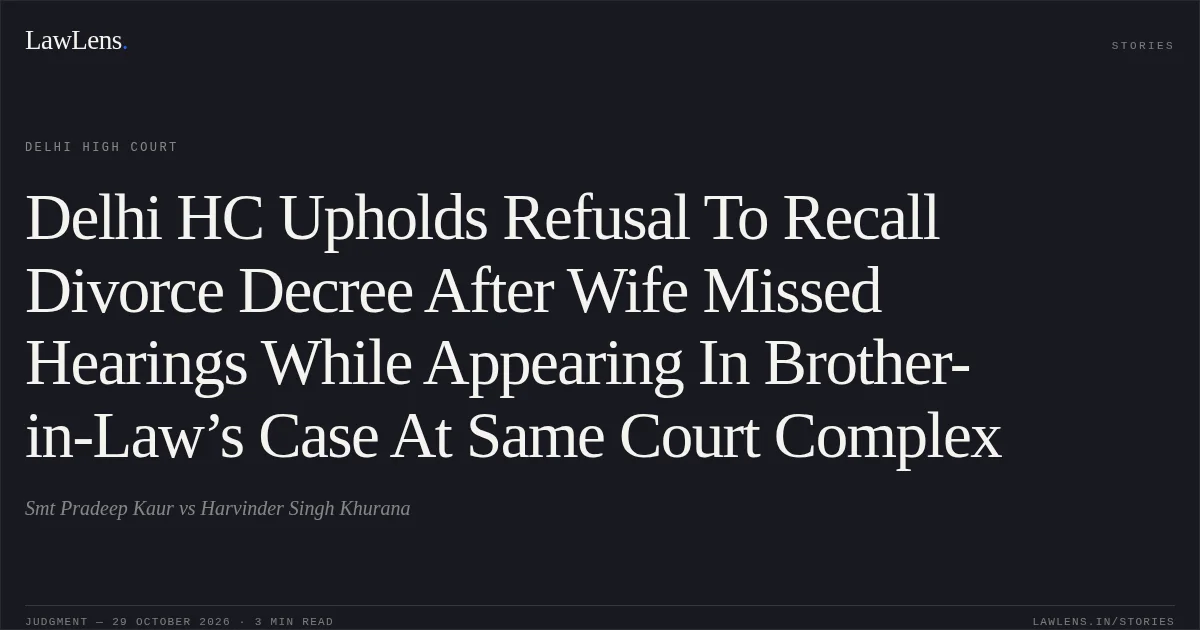
The respondent obtained a decree dissolving the parties’ marriage on the ground of cruelty on 8 February 2019.
pp. 2–3The petitioner had participated in the matrimonial proceedings but was absent on the dates fixed for her evidence and final arguments; the Family Court closed her right to lead evidence and decided the petition on the record.
pp. 2–3She later applied under Order IX Rule 13 CPC to set aside the decree, alleging that medical difficulties and her participation in parallel criminal proceedings had prevented her from appearing.
pp. 3–4The Family Court condoned the 73-day delay in filing that application but dismissed it on the merits on 11 July 2025, finding no sufficient cause for her absence.
pp. 3–4The petitioner challenged both the decree and the dismissal of her recall application in this revision petition.
p. 402Issues
i.1. Whether the Family Court erred in finding that the petitioner had not shown sufficient cause for her non-appearance, warranting interference with the dismissal of her Order IX Rule 13 application.
pp. 14–17ii.2. Whether the petitioner could challenge the 2019 divorce decree in the present revisional or supervisory proceedings after not pursuing the statutory appeal within the prescribed period and after dismissal of her Order IX Rule 13 application.
pp. 17–20iii.3. Whether the petitioner’s allegations of fraud and suppression justified reopening the decree notwithstanding the statutory appellate remedy and delay.
pp. 26–2803Law Applied
Order IX Rule 13 CPC permits setting aside an ex parte decree where the applicant establishes sufficient cause for non-appearance; Order XVII Rules 2 and 3 govern the court’s procedure when a party fails to appear or produce evidence.
pp. 8–9Sections 5 and 123 of the Limitation Act address condonation of delay and the limitation period for an Order IX Rule 13 application, respectively.
pp. 9–11Under Section 19(1) and (3) of the Family Courts Act, 1984, a non-interlocutory Family Court judgment or order is appealable to the High Court on facts and law, ordinarily within 30 days; Section 19(5) limits other appeals or revisions except as provided in that section.
pp. 18–20Article 227 is supervisory, not appellate, and does not ordinarily permit reappreciation of evidence or circumvention of an available statutory appeal; the Court relied on Estralla Rubber v. Dass Estate (P) Ltd., Radhey Shyam v. Chhabi Nath, M/s Garment Craft v. Prakash Chand Goel, Virudhunagar Hindu Nadargal Dharma Paribalana Sabai v. Tuticorin Educational Society, and Mohamed Ali v. V. Jaya.
pp. 21–23Bhanu Kumar Jain v. Archana Kumar recognises the distinct remedies of an Order IX Rule 13 application and an appeal against the decree, while S.P. Chengalvaraya Naidu v. Jagannath and A.V. Papayya Sastry v. Government of A.P. establish that fraud can vitiate a decree when proved; an allegation alone does not establish fraud.
pp. 25–27Provisions in the judgment · 6 · Linked ones open on LawLens
Code of Civil Procedure, 1908 Section 115Section 151
Hindu Marriage Act, 1955 Section 13
Limitation Act, 1963 Section 5Section 1
Family Courts Act, 1984 Section 19
04Reasoning
The High Court found that the Family Court had considered the petitioner’s medical material and explanation, along with her admitted awareness of the divorce case and her appearances in the parallel criminal proceedings—including on a date when both cases were listed at Tis Hazari.
pp. 15–17It held that the Family Court’s conclusion that she had not shown sufficient cause was based on the record and disclosed no perversity, jurisdictional error, or material irregularity warranting interference.
pp. 15–17As to the original decree, the petitioner had a statutory appeal under Section 19 of the Family Courts Act but instead pursued—and lost—her Order IX Rule 13 application.
pp. 21–27Article 227 could not be used after substantial delay to obtain a merits review that should have been pursued by appeal.
pp. 21–27The fraud authorities did not assist her because fraud had not been established, and the circumstances she relied on had already been considered in the recall proceedings.
pp. 21–2705Holding
The High Court found no ground to interfere with the Family Court’s dismissal of the Order IX Rule 13 application.
pp. 28–30It declined to entertain the challenge to the 8 February 2019 decree at this belated stage, holding that supervisory or revisional jurisdiction could not substitute for the unpursued statutory appeal absent a demonstrated jurisdictional infirmity or other exceptional circumstance.
pp. 28–30The petition was dismissed and disposed of, along with any pending applications.
p. 30Original Court PDF
Smt Pradeep KaurvsHarvinder Singh Khurana
Click to open original judgment
Original judgment, available to read, download and summarize on LawLens.in