01Facts
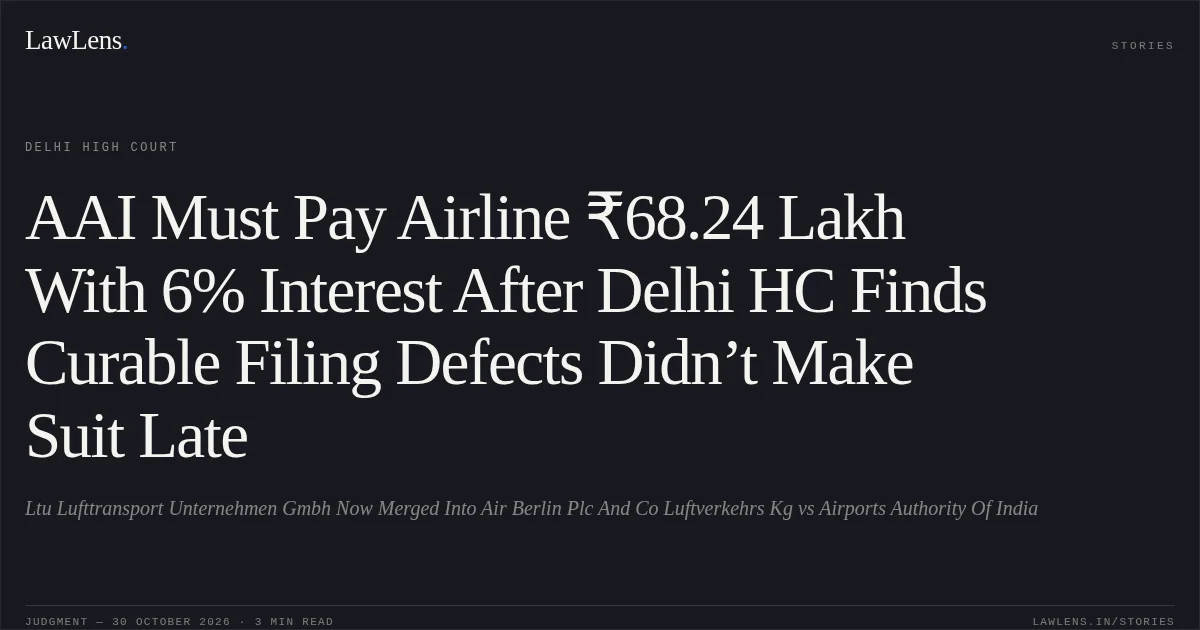
The Appellant mistakenly remitted USD 4,35,540 against an AAI bill for ₹4,35,540. AAI later acknowledged a credit of ₹1,46,33,653.71, refunded ₹78,09,000, and retained the balance of ₹68,24,653.71, claiming it had been adjusted against Western Region dues.
¶ 5–8, 14, 20 · pp. 2–6The Appellant sued for the retained balance, with interest. The Trial Court found the claim established on the merits but dismissed the suit as time-barred, treating the suit as instituted only when filing defects were cured and it was registered on 16 October 2010.
¶ 40–44 · pp. 10–12The Appellant appealed; AAI filed cross-objections challenging findings on authority and entitlement to recovery.
¶ 45, 52–60 · pp. 12–1602Issues
i.Whether the suit was instituted within limitation, given that the plaint was first presented on 6 October 2010 but filing defects were cured on 16 October 2010.
¶ 122–130 · pp. 33–36ii.Whether the suit was instituted and pursued by duly authorised persons, including whether the Plaintiff entity remained in existence when the suit was filed.
¶ 81–93 · pp. 20–23iii.Whether AAI proved that ₹68,24,653.71 was properly adjusted against outstanding Western Region dues, and whether the Appellant was entitled to interest.
¶ 94–120 · pp. 23–3303Law Applied
Section 19 of the Limitation Act, 1963 provides for a fresh limitation period from a qualifying part-payment made before expiry of limitation; Section 3 requires dismissal of a suit filed out of time.
¶ 123, 128 · pp. 34–35Under Sections 26(1) and Order IV Rule 1 CPC, a suit is instituted by presentation of a plaint, while Order IV Rule 1(3) requires compliance with the applicable pleading requirements; curable procedural defects do not necessarily make the original filing non est.
¶ 131–138 · pp. 36–40Section 149 CPC expressly permits deficient court fee to be made good, with the document then having the same force and effect as if the fee had been paid initially.
¶ 143–145 · pp. 41–42Vidyawati Gupta v. Bhakti Hari Nayak, (2006) 2 SCC 777, and Uday Shankar Triyar v. Ram Kalewar Prasad Singh, (2006) 1 SCC 75, support treating procedural defects in pleadings or vakalatnamas as curable; Mannan Lal v. Mst. Chhotaka Bibi, (1970) 1 SCC 769, applies the retrospective effect of curing a court-fee deficiency.
¶ 137, 141, 145 · pp. 38–42The Full Bench decision in Pragati Construction Consultants v. Union of India, 2025:DHC:717-FB, states that procedural defects must be assessed cumulatively and that a filing should be treated as non est only where the circumstances indicate it was not genuinely intended for adjudication.
¶ 146–149 · pp. 42–45United Bank of India v. Naresh Kumar, (1996) 6 SCC 660, recognises that a company may authorise a representative to sign pleadings and may ratify the act expressly or impliedly.
¶ 86–88 · pp. 21–22AAI, as the party asserting adjustment, had to prove the outstanding dues supporting it; interest could not be imposed unilaterally without an agreement.
¶ 114–119 · pp. 32–33Provisions in the judgment · 9 · Linked ones open on LawLens
Code of Civil Procedure, 1908 Section 96Section 26Section 149
Airports Authority of India Act, 1994 Section 22
Arbitration and Conciliation Act, 1996 Section 34Section 37
Limitation Act, 1963 Section 19Section 3Section 4
04Reasoning
The limitation period ran from the part-payment on 8 October 2007 and expired on 8 October 2010.
¶ 122–124 · p. 34The plaint had been presented on 6 October 2010; the objections concerned matters such as the vakalatnama, court fee, duplicate set, caveat report and supporting documents, and did not alter the plaint’s substance or show an intention merely to arrest limitation. The Court therefore treated them as curable and the suit as instituted on the original presentation date.
¶ 129–135, 142–157 · pp. 35–47The authority challenge failed because the powers of attorney and subsequent authorisations were proved, and the record established that the Plaintiff remained in existence when the suit was filed.
¶ 84–92 · pp. 21–23On adjustment, AAI’s witness could not establish any outstanding principal, the account statements were inadequately proved, and AAI produced no reliable record of payments or basis for the alleged dues. The Appellant’s admission that it received bills was not an admission that they remained unpaid. AAI therefore failed to prove its defence of adjustment.
¶ 104–117 · pp. 27–32The Court awarded 6% simple interest, finding no agreement supporting the higher rate claimed.
¶ 118–121 · p. 3305Holding
The Court held that the suit was within limitation, upheld the findings that it was duly authorised and that ₹68,24,653.71 was recoverable, and awarded simple interest at 6% per annum from 5 July 2007 until realisation.
¶ 159–165 · pp. 47–49The appeal was allowed, the Trial Court’s dismissal on limitation was set aside, the suit was decreed for the principal sum with interest, and AAI’s cross-objections were dismissed.
¶ 163–167 · p. 49Original Court PDF
Ltu Lufttransport Unternehmen Gmbh Now Merged Into Air Berlin Plc And Co Luftverkehrs KgvsAirports Authority Of India
Click to open original judgment
Original judgment, available to read, download and summarize on LawLens.in