01Facts
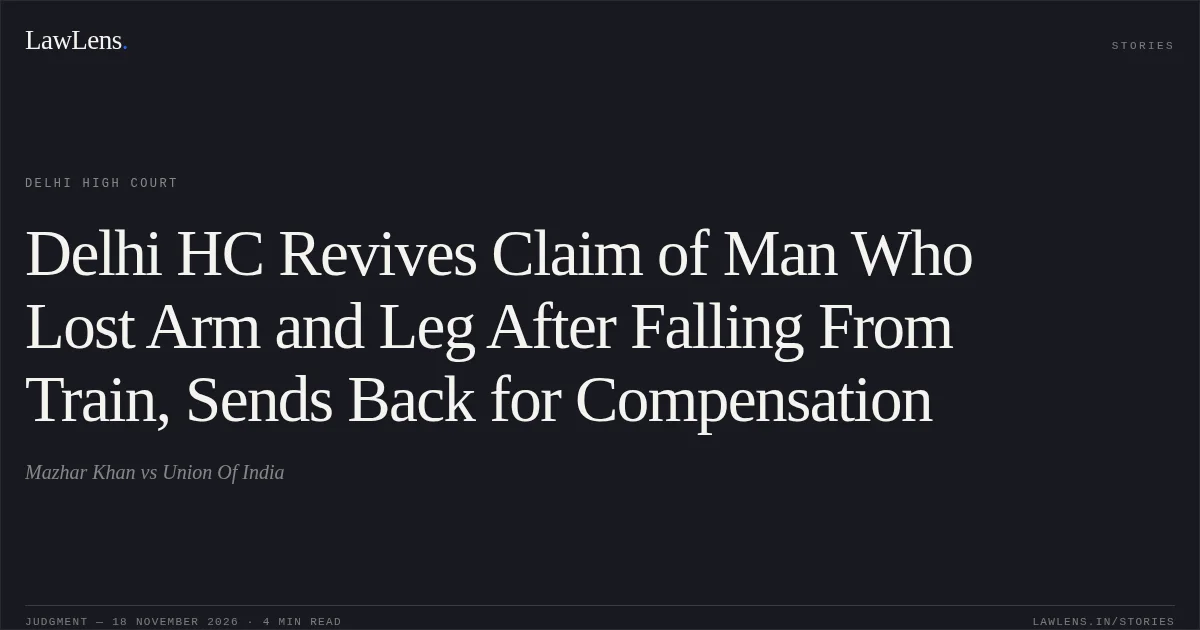
The appellant, a resident of Deoband and an illiterate person from an economically weaker section, filed an appeal under Section 23 of the Railway Claims Tribunal Act, 1987, with a 747-day delay.
p. 2 · ¶ 2He attributed the delay to poverty and injuries that prevented him from contacting counsel.
p. 2 · ¶ 2The Court condoned the delay.
p. 2 · ¶ 4–5On 28.03.2018, the appellant, with his father, travelled from Deoband to Delhi on a combined journey ticket (No. M20960293) for two passengers. His father alighted at Muzaffarnagar.
p. 3 · ¶ 2At about 6:00 p.m., near Meerut, the appellant allegedly fell from Train No. 19020 onto an adjoining track and was struck by another train. He suffered amputation of one arm and one leg.
p. 3 · ¶ 2The Tribunal dismissed his compensation claim (OA/II(u)/GZB/73/2019) by judgment dated 28.02.2022.
p. 2 · ¶ 1The Tribunal relied on the following: the ticket was verified by the Chief Booking Supervisor, Deoband, as issued from that station; the Station Diary and Train Signal Register; and a statement attributed to Shunting Master Karan Singh in a DRM enquiry report.
p. 3 · ¶ 3On that basis, it held that the appellant had alighted from Train No. 19032 from the wrong side.
p. 3 · ¶ 3The DRM report is dated 28.10.2019.
p. 6 · ¶ 10No ticket was recovered from the appellant at the scene.
p. 4 · ¶ 502Issues
i.1. Whether the appellant has shown sufficient cause for condonation of a 747-day delay in filing the appeal.
p. 2 · ¶ 4ii.2. Whether the appellant discharged the initial burden of establishing his status as a bona fide passenger despite non-recovery of the ticket at the scene.
p. 5 · ¶ 7 · p. 6 · ¶ 7iii.3. Whether the Tribunal could rely on the alleged train discrepancy (Train No. 19032 and wrong-side alighting) without confronting the appellant with that case in cross-examination.
p. 6 · ¶ 9iv.4. Whether the statement attributed to Karan Singh in the DRM enquiry report, who was not examined before the Tribunal, could be treated as conclusive proof against the appellant.
p. 6 · ¶ 1003Law Applied
The Court relied on Section 23 of the Railway Claims Tribunal Act, 1987, which provides the statutory appeal.
The Court applied the "sufficient cause" standard for condonation of delay, read in light of the beneficial nature of the legislation and the appellant's economic hardship, following Mohsina v. Union of India, 2017 SCC OnLine Del 10003 (condonation of 804 days for a financially weak claimant) and Brijesh Kumar v. Union of India, FAO 49/2022 (decided 04.04.2026) (condonation of 1326 days).
p. 2 · ¶ 3–4On the bona fide passenger question, the Court followed Union of India v. Rina Devi, (2019) 3 SCC 572: non-recovery of a ticket does not by itself negate bona fide passenger status; the claimant bears an initial burden, which may be discharged by an affidavit of the journey facts; the onus then shifts to the Railways to rebut it on the evidence and surrounding circumstances.
pp. 4–5 · ¶ 7 · p. 5 · ¶ 7The Court applied the principle that a discrepancy cannot be used against a party unless that party's case is specifically put to him in cross-examination, and that an unexamined witness's statement, without an opportunity for cross-examination, cannot be treated as conclusive proof.
p. 6 · ¶ 9–10 · no citation for authorityProvisions in the judgment · 1 · Linked ones open on LawLens
Railway Claims Tribunal Act, 1987 Section 23
04Reasoning
On delay, the Court found that the appellant's poverty, illiteracy, and injuries constituted sufficient cause, consistent with Mohsina and Brijesh Kumar.
p. 2 · ¶ 3–4On bona fides, the Court held that the appellant had discharged the Rina Devi initial burden. He consistently pleaded the Deoband–Delhi journey on 28.03.2018 with his father, and the ticket was not merely produced but verified by the Railways as issued from Deoband, which the Tribunal itself noted.
p. 5 · ¶ 7The Tribunal's train-number discrepancy (Train No. 19020 versus 19032) could not be used against him because he was never confronted in cross-examination with the Railways' case that he alighted from Train No. 19032 from the wrong side. No admission on that point was elicited.
p. 6 · ¶ 9The discrepancy, given the verified ticket, required closer scrutiny before an adverse inference was drawn.
p. 6 · ¶ 9The Railways' account of the mechanism of the accident rested mainly on the DRM report statement attributed to Karan Singh. That report was dated about 19 months after the incident. Karan Singh was not examined, so the appellant could not test his account. That statement was the principal basis for rejecting the appellant's version and therefore could not be treated as conclusive.
p. 6 · ¶ 1005Holding
The Court condoned the 747-day delay, holding that sufficient cause was shown.
p. 2 · ¶ 5The appellant discharged the initial Rina Devi burden of proving bona fide passenger status through the verified ticket.
p. 5 · ¶ 7The Tribunal could not rely on the unconfronted train discrepancy or on the unexamined Karan Singh statement to reject the claim.
p. 6 · ¶ 9–10The impugned judgment dated 28.02.2022 was set aside, and the appeal was allowed. The matter was remanded to the Railway Claims Tribunal to assess compensation in accordance with law, with directions to disburse it within two months of receipt of the order. The Tribunal was directed to list the matter on 03.12.2026. A copy of the judgment is to be communicated to the Tribunal.
p. 7 · ¶ 11–13Original Court PDF
Mazhar KhanvsUnion Of India
Click to open original judgment
Original judgment, available to read, download and summarize on LawLens.in