01Facts
The Petitioner was enrolled in the Indian Army on 08.07.2000 and discharged on 28.02.2019 following a Release Medical Board (RMB).
¶ 4 · pp. 1–2The RMB diagnosed Primary Hypertension (30%), Dyslipidemia (1–5%), Obesity (1–5%) and Hypothyroidism (20%), with a composite disability of 50% for life.
¶ 4 · pp. 1–2The RMB recorded the qualifying element of disability pension as "nil" by treating the disabilities as neither attributable to nor aggravated by military service (NANA).
¶ 4 · pp. 1–2The Petitioner was found medically fit at entry, and his service record contained no note of any pre-existing disability.
¶ 5, 10 · p. 4The Armed Forces Tribunal (AFT) dismissed OA 1803/2019 by judgment dated 29.02.2024.
¶ 9 · p. 4The AFT held that the Petitioner's overweight was the prime cause of the disabilities, noting actual weight of 97 kg against an Ideal Body Weight of 71.5 kg, and that he did not follow exercise or dietary advice.
¶ 9 · p. 4The AFT held that Hypothyroidism was unlikely given that most postings were in peace areas.
¶ 9 · p. 4The Petitioner challenged the AFT judgment under Article 226.
¶ 3 · p. 102Issues
i.1. Whether the Tribunal erred in rejecting the Petitioner's claim for disability pension despite the presumption of attributability to military service arising in his favour on entry in sound health and subsequent discharge on medical grounds.
¶ 5–6 · pp. 2–3 · ¶ 10, 12 · pp. 4–6, 12ii.2. Whether the Tribunal could independently attribute the disabilities to overweight and lifestyle factors where the RMB recorded no such causal link.
¶ 6, 11 · pp. 3, 6–7 · ¶ 12 · p. 12iii.3. Whether postings in peace areas, or the RMB's recording of onset in peace areas, justify denial of disability pension.
¶ 9, 14–15 · pp. 4, 12–1603Law Applied
Rule 5 of the Entitlement Rules, 1982 presumes sound health on entry absent a contrary record and presumes that deterioration in service is due to service, as explained in Dharamvir Singh v. Union of India, (2013) 7 SCC 316.
¶ 10 · pp. 4–5Union of India v. Rajbir Singh (2015) applies the same position.
¶ 10 · p. 5Bijender Singh v. Union of India, 2025 SCC OnLine SC 895 (paras. 45–47) holds that the burden of rebutting the presumption rests on the employer and that the RMB must give reasons if it says a disease could not have been detected at entry.
¶ 13 · pp. 8–11Union of India v. Col. NC Isaac (Retd), 2026 SCC OnLine SC 1895 holds that the 2008 amendment to Rule 5 did not alter the core presumption scheme, so the onus remains on the employer and unrebutted presumptions attract benefit of doubt.
¶ 10 · pp. 5–6 · ¶ 13 · p. 12Regulation 423 of the Regulations for the Medical Services of the Armed Forces, 2010 provides that whether onset occurs in a peace or field area is immaterial and that the benefit of reasonable doubt goes to the individual.
¶ 14 · pp. 13–14Union of India v. Col. Balbir Singh (Retd), 2025 SCC OnLine Del 7873 holds that peace-station service is inherently stressful and that a lifestyle label cannot deny pension without individual examination by the RMB.
¶ 14 · pp. 12–15Sub/Maj Hanuman Singh v. Union of India, 2026 SCC OnLine Del 493; HFL Youdhisthir Singh (Retd) v. Union of India, 2026 SCC OnLine Del 2747 (DB); Union of India v. Ex Sub Gawas Anil Madso, 2025 SCC OnLine Del 2018; and Union of India v. WO Binod Kumar Sah (Retd), W.P.(C) 3918/2025 are relied upon for the principle that a tribunal cannot supply a causal link that the RMB has not recorded and that courts cannot substitute their own medical opinion for that of the Medical Board.
¶ 11, 14 · pp. 6–15 · ¶ 11 · p. 604Reasoning
The Petitioner entered service medically fit with no pre-existing disability recorded, so the Dharamvir Singh presumption applied and the disabilities were to be treated as attributable to service unless the Respondents rebutted it with cogent material. The Respondents placed no such material on record.
¶ 10 · pp. 4–6The Tribunal's attribution of hypertension to overweight was its own creation. The RMB had recorded onset in a peace area and had not linked overweight to hypertension or hypothyroidism. Had the RMB considered lifestyle to be causative, nothing prevented it from recording that.
¶ 11 · pp. 6–7Relying on Hanuman Singh and Youdhisthir Singh, the Tribunal could not supply that causal link itself.
¶ 11, 12 · pp. 6–12The reliance on peace-area postings was rejected. Following Balbir Singh and Regulation 423, the location of onset is immaterial, military service in peace stations carries inherent stress, and a lifestyle disorder label cannot deny pension without individual RMB examination.
¶ 14 · pp. 12–15 · ¶ 15 · p. 16The Respondents could not rely on the Tribunal's Hypothyroidism reasoning because the RMB had not linked that condition to dietary iodine intake or a particular posting profile.
¶ 9, 14 · pp. 4, 12–1405Holding
The Tribunal wrongly rejected the claim, because the presumption of attributability under Dharamvir Singh, Bijender Singh and Col. NC Isaac was unrebutted, and because the Tribunal's overweight-based causal finding was not supported by the RMB.
¶ 12 · p. 12 · ¶ 13 · p. 12Peace-area postings are not a bar to disability pension.
¶ 15 · p. 16The impugned AFT judgment dated 29.02.2024 is set aside and the writ petition is allowed. The Respondents are directed to grant disability pension to the Petitioner from the date of discharge at 50%. Arrears are to be paid within 12 weeks, failing which interest at 6% per annum is payable until actual payment.
¶ 15 · p. 16The writ petition is disposed of accordingly.
¶ 16 · p. 16Original Court PDF
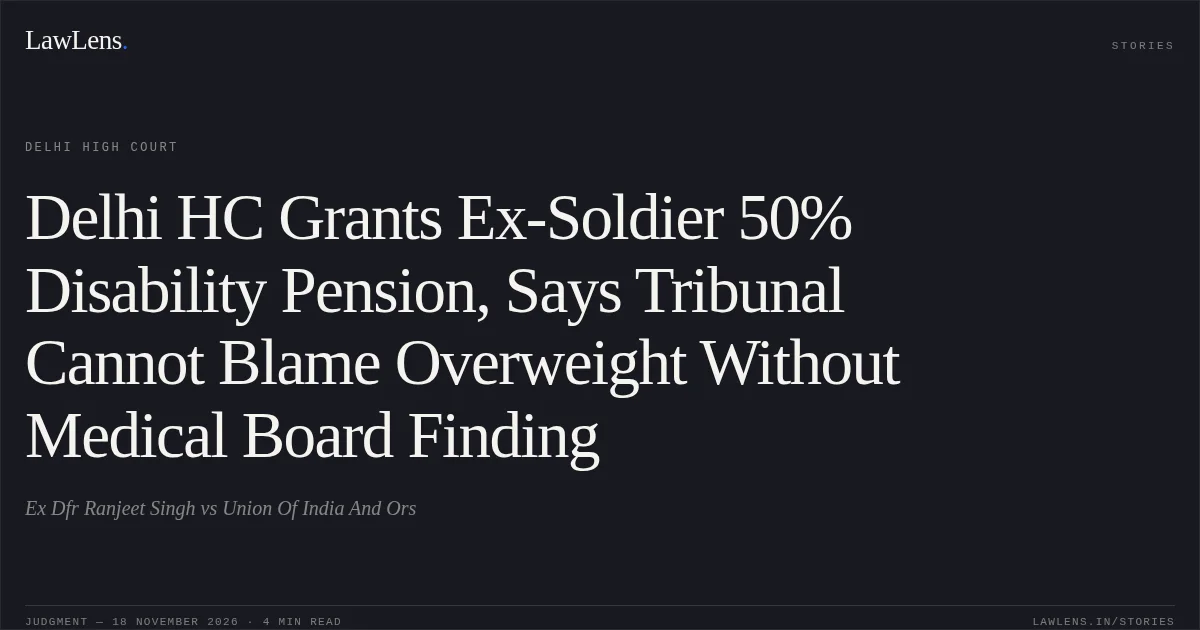
Ex Dfr Ranjeet SinghvsUnion Of India And Ors
Click to open original judgment
Original judgment, available to read, download and summarize on LawLens.in