Facts
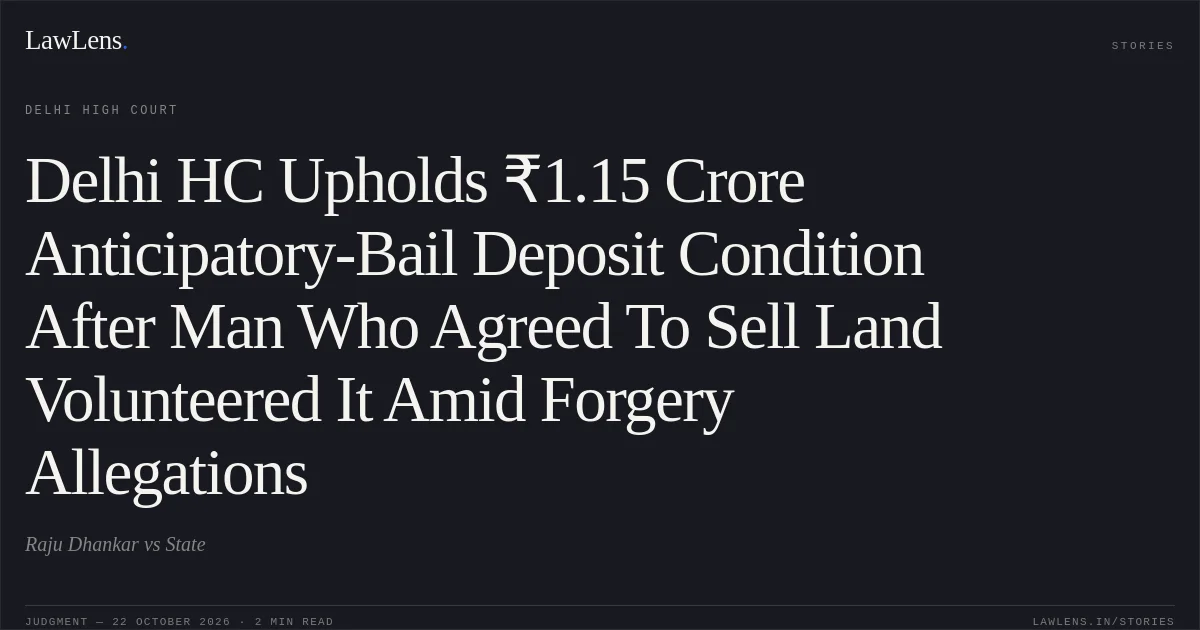
The petitioner and respondent no. 2 entered into an agreement concerning the sale of property in Neb Sarai. Following respondent no. 2’s complaint, FIR No. 0385/2020 was registered against the petitioner under Sections 420, 406, 506 and 34 IPC
Source reference: p. 2, paras. 2.1–2.2The Sessions Court granted the petitioner anticipatory bail subject to his own offer to deposit ₹1.15 crore in instalments; he deposited only ₹30 lakh, and respondent no. 2 sought cancellation of bail
Source reference: pp. 2–3, paras. 2.4–2.5, 5–7; p. 5, para. 15The petitioner invoked Section 482 CrPC to challenge or modify the deposit condition, arguing that the dispute was civil and that monetary conditions for anticipatory bail were unlawful
Source reference: p. 3, paras. 8–9The State and respondent no. 2 opposed the petition, relying on allegations that the property was Gram Sabha land and that the petitioner had used a forged SDM certificate; forgery charges had been added during the investigation
Source reference: pp. 3–5, paras. 12, 16–18Issues
1. Whether the condition requiring the petitioner to deposit ₹1.15 crore as part of the anticipatory-bail order warranted interference under Section 482 CrPC, particularly where the petitioner had offered to make the deposit
Source reference: pp. 3–6, paras. 9, 15, 19–232. Whether the allegations and investigation showed that the dispute was purely civil in nature, such that the deposit condition should be set aside or modified
Source reference: pp. 3–6, paras. 8, 17–22Law Applied
Section 482 CrPC empowers the High Court to exercise its inherent jurisdiction, including to consider a challenge to a bail condition
Source reference: p. 2, para. 1The Court considered *Amarjit Singh v. State of NCT of Delhi*, (2009) 13 SCC 769, in which the Supreme Court set aside a deposit condition where the accused had not agreed to deposit the amount
Source reference: p. 5, para. 19It also considered *Ramesh Kumar v. State of NCT of Delhi*, (2023) 7 SCC 461, which disapproved a monetary deposit condition in a predominantly civil dispute involving simpliciter cheating and remitted the pre-arrest bail application for reconsideration
Source reference: pp. 5–6, paras. 20–21The Court treated those decisions as distinguishable where the accused had himself offered the deposit and the allegations included serious forgery offences
Source reference: pp. 5–6, paras. 19–22Reasoning
The Sessions Court’s order recorded that the petitioner had offered to deposit ₹1.15 crore and that the Court granted anticipatory bail on that basis; the petitioner could not, in the High Court’s view, obtain protection on that basis and then resile from the offer
Source reference: p. 4, para. 15The Court also relied on the investigation material alleging misrepresentation of ownership of Gram Sabha land and use of a forged SDM certificate, with forgery charges under Sections 467 and 468 IPC added
Source reference: p. 5, paras. 17–18It therefore rejected the characterisation of the matter as purely civil and distinguished *Amarjit Singh* and *Ramesh Kumar* on the grounds that the petitioner had voluntarily offered the deposit and the case involved forgery allegations beyond simpliciter cheating
Source reference: pp. 5–6, paras. 19–22Holding
The Court found no infirmity in the impugned order warranting interference and dismissed the petition
It directed the Trial Court to proceed with respondent no. 2’s application for cancellation of bail and ordered that the ₹30 lakh deposited before the High Court remain subject to further orders of the Trial Court
Source reference: p. 7, paras. 24–25Pending applications were disposed of
Source reference: p. 7, para. 26Acts & Sections Cited
9 provisions across 2 statutes referred to in this judgment. Each provision opens on LawLens.
Code of Criminal Procedure, 19733
Indian Penal Code, 18606
Original Court PDF
Raju DhankarvsState
Click to open original judgment
Original judgment, available to read, download and summarize on LawLens.in