Facts
Respondents 2 and 3 filed a criminal complaint against the petitioners, accompanied by an application under Section 156(3) CrPC seeking registration of an FIR.
Source reference: para. 2–4The Magistrate dismissed the application and the complaint, finding that no offence was disclosed, without giving the complainants an opportunity to lead pre-summoning evidence.
Source reference: para. 2–4In revision, the dismissal of the Section 156(3) application was left undisturbed, but the complaint was remitted for pre-summoning evidence.
Source reference: para. 5–8The proposed accused challenged that direction, arguing that the Magistrate had already found no offence was disclosed.
Source reference: para. 5–8Issues
1. Whether the Revisional Court erred in directing the Magistrate to permit pre-summoning evidence after the Magistrate had dismissed the complaint on the ground that no offence was disclosed.
Source reference: para. 8–112. Whether, in the circumstances of this case, the complaint could be dismissed without allowing the complainants an opportunity to lead evidence.
Source reference: para. 11–14Law Applied
Under Section 200 CrPC, the Magistrate is required to examine the complainant and witnesses on oath when taking cognizance.
Source reference: para. 9As recognised in Anoop Kumar v. State and Anr., a Magistrate need not invariably permit pre-summoning evidence before dismissing a complaint where, on its face and with supporting documents, the complaint discloses no ground for action.
Source reference: para. 9The Court also referred to Sections 91 and 202 CrPC, under which the Magistrate may require production of documents and order an investigation.
Source reference: quoted revisional order, para. 15The cited decisions Mohammed Ibrahim v. State of Bihar and Bandekar Brothers Pvt. Ltd. v. Prasad Vassudev Keni were relied upon by the petitioners; the Court did not identify a separate rule from them in its reasoning.
Source reference: para. 9Reasoning
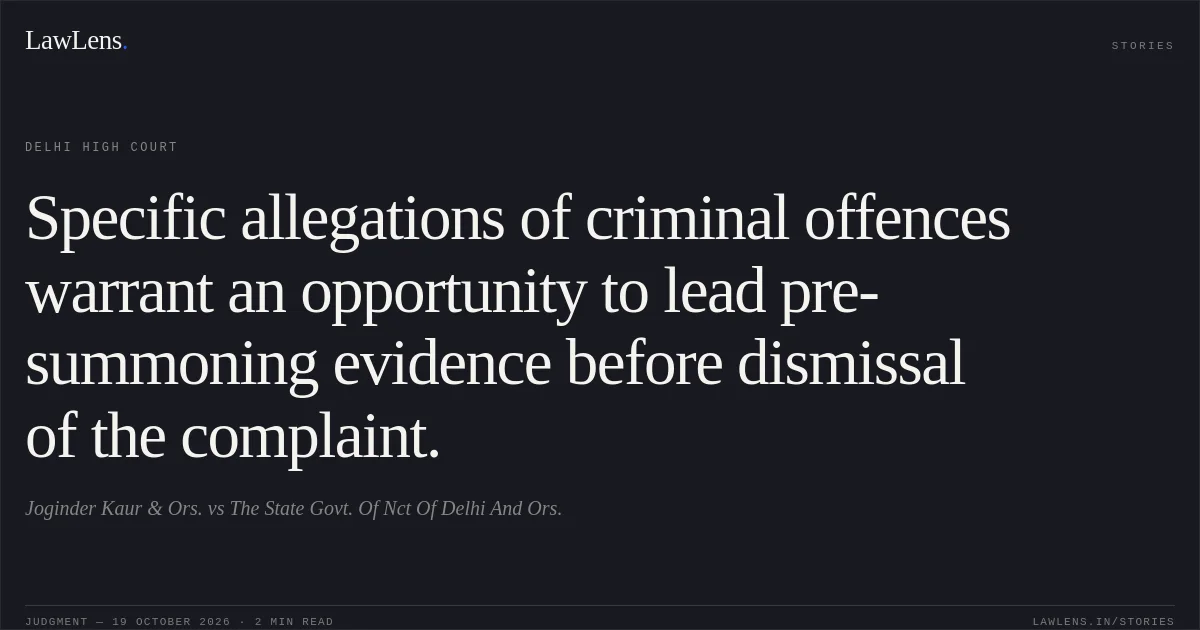
The Court accepted the general proposition in Anoop Kumar that pre-summoning evidence is not required in every case where the complaint, taken at face value, discloses no offence.
Source reference: para. 9–11It distinguished the present matter because the complaint contained specific allegations of conspiracy, cheating and forgery, including allegations concerning documents connected with the property dispute.
Source reference: para. 11–12The Revisional Court had noted that the originals of the allegedly forged documents had not been produced and that their production or examination could be pursued during the complainants’ evidence.
Source reference: quoted revisional order, paras. 14–15In those circumstances, denying the complainants the opportunity to lead evidence would frustrate their complaint; the Magistrate could still dismiss it if the evidence ultimately failed to disclose an offence.
Source reference: para. 13–14The Court emphasised that these observations were tentative and did not determine the merits.
Source reference: para. 17Holding
The High Court found no manifest illegality, jurisdictional error or miscarriage of justice in the Revisional Court’s direction permitting pre-summoning evidence.
It dismissed the petition, leaving intact the dismissal of the Section 156(3) application and the remand for the complainants to lead evidence.
Source reference: paras. 7, 16Acts & Sections Cited
5 provisions across 1 statute referred to in this judgment. Each provision opens on LawLens.
Code of Criminal Procedure, 19735
Original Court PDF
Joginder Kaur & Ors.vsThe State Govt. Of Nct Of Delhi And Ors.
Click to open original judgment
Original judgment, available to read, download and summarize on LawLens.in