Facts
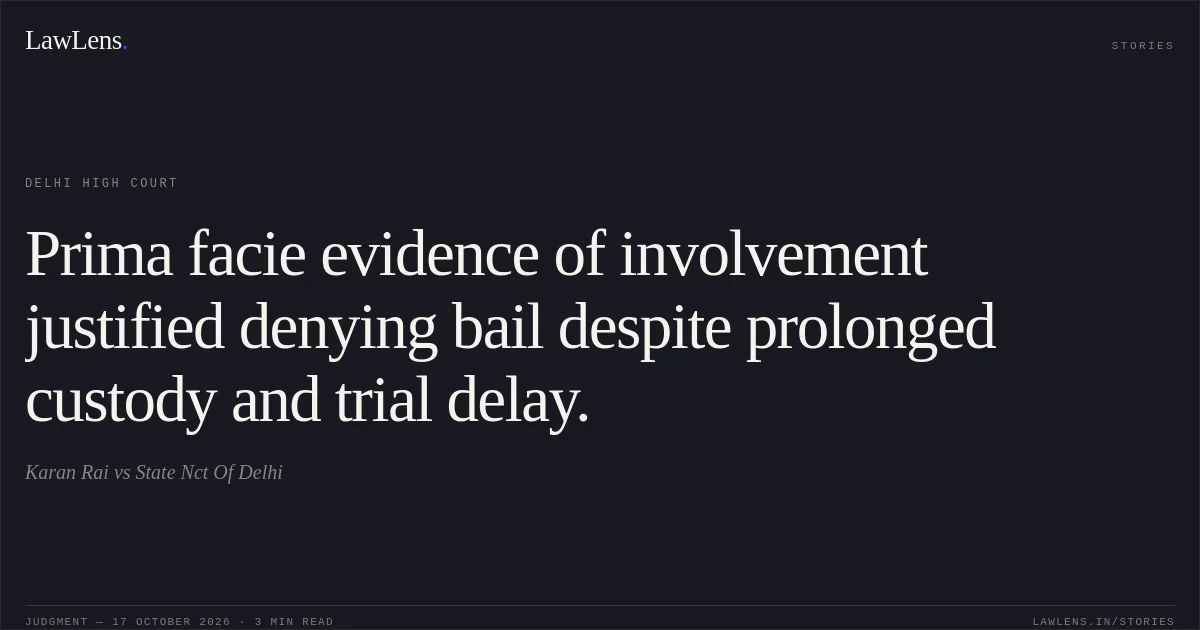
The Applicant sought regular bail under Section 483 of the Bharatiya Nagarik Suraksha Sanhita, 2023, in an FIR alleging offences under Sections 302, 120-B and 34 of the Indian Penal Code, 1860, and Section 27 of the Arms Act, 1959.
Source reference: p. 1–4The prosecution alleged that, during a planned group attack near Khan Market on 16 April 2023, the Applicant helped plan the attack, threw a brick at the deceased and restrained him while others stabbed him.
Source reference: p. 1–4The Applicant disputed his role and challenged, among other things, the alleged oral dying declaration and the CCTV evidence.
Source reference: p. 1–4He had been in custody since 17 April 2023; his earlier bail applications had been dismissed, and trial was ongoing with many prosecution witnesses yet to be examined.
Source reference: p. 1–4Issues
Whether the prosecution material made out a sufficient prima facie basis to deny the Applicant regular bail, notwithstanding the disputed evidence and the absence of an allegation that he personally inflicted a stab injury.
Source reference: p. 5–7Whether the Applicant’s period of custody, the slow progress of trial and his prior compliance with interim-bail conditions warranted release on bail.
Source reference: p. 7Law Applied
The Court considered the bail application under Section 483 of the BNSS.
Source reference: p. 5In assessing bail, it weighed the gravity of the accusation, the prima facie material connecting the Applicant to the offence, antecedents, the risk of witness interference and the likely duration of trial; seriousness alone could not justify continued detention.
Source reference: p. 5It also considered the prosecution’s reliance on Sections 34 and 120-B IPC: alleged participation in a common intention or conspiracy may attract liability even if the accused is not alleged to have personally inflicted the fatal injuries, while whether those elements are ultimately proved is for trial.
Source reference: p. 7The Court treated the reliability and weight of the alleged oral dying declaration as matters for trial rather than finally determining them at the bail stage.
Source reference: p. 6Reasoning
The Court acknowledged significant questions about the alleged dying declaration, including its omission from early police and hospital records, the lack of particulars of the auto-rickshaw and driver, and the witnesses’ failure to relay or record the deceased’s alleged identification.
Source reference: p. 5–7It nevertheless found that two witnesses maintained that the deceased had named the Applicant, and that the prosecution also relied on CCTV footage said to show the group’s movements and on allegations of the Applicant’s planning and active participation.
Source reference: p. 5–7Taken together, this provided a prima facie basis for involvement under the alleged common intention and conspiracy.
Source reference: p. 5–7The Court weighed the Applicant’s more than three years in custody, trial delay and compliance with interim bail against the nature of the alleged role and the fact that material witnesses remained to be examined.
Source reference: p. 7It did not treat the earlier FIR under Section 324 IPC as proof of guilt.
Source reference: p. 7Holding
The Court dismissed the regular-bail application, finding that the circumstances did not presently justify release.
It requested the Trial Court to expedite the recording of prosecution evidence, particularly that of the remaining material witnesses, and avoid unnecessary adjournments.
Source reference: p. 8The Court clarified that its observations were confined to the bail application and would not affect the Trial Court’s independent assessment of the evidence.
Source reference: p. 8Acts & Sections Cited
5 provisions across 3 statutes referred to in this judgment. Each provision opens on LawLens.
Bharatiya Nagarik Suraksha Sanhita, 20231
Indian Penal Code, 18603
Arms Act, 19591
Original Court PDF
Karan RaivsState Nct Of Delhi
Click to open original judgment
Original judgment, available to read, download and summarize on LawLens.in