01Facts
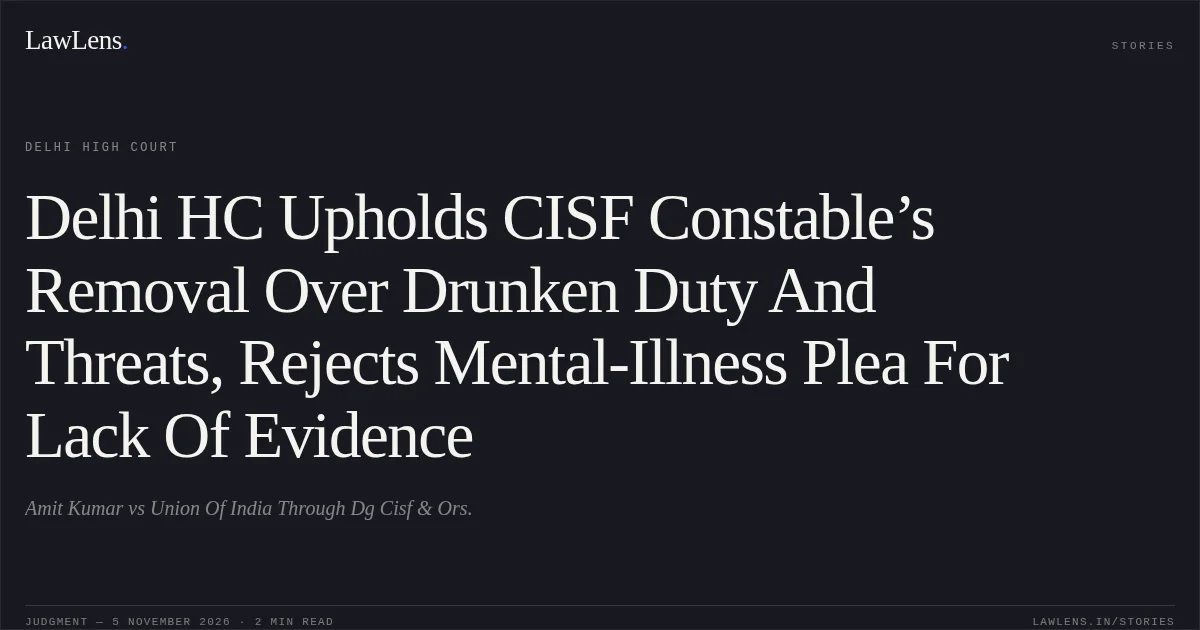
Amit Kumar, a CISF Constable, was charged with six instances of misconduct, including alleged intoxication, misbehaviour and threats toward police officers and fellow personnel, and failure to cooperate with a direction to undergo a blood test.
¶ 3–11The disciplinary authority found all charges proved and ordered his removal from service on 27 October 2020; the appellate and revisional authorities upheld that penalty.
¶ 3–11In his writ petition, Kumar challenged the evidentiary basis and fairness of the inquiry, relied on alleged alcohol dependency and mental distress, and contended that removal was disproportionate.
¶ 13–16, 28, 3202Issues
i.1. Whether the disciplinary proceedings and findings were liable to be set aside for want of sufficient evidence, procedural unfairness, or failure to account for the petitioner’s alleged mental illness and statutory protections.
¶ 21–27, 28–31ii.2. Whether removal from service was so disproportionate to the proved misconduct as to warrant interference under Article 226.
¶ 32–3503Law Applied
The Court considered Rule 36 of the Central Industrial Security Force Rules, 2001, governing disciplinary proceedings, and Rule 54, which was cited in connection with the revisional authority’s powers.
¶ 3, 11It also considered the Rights of Persons with Disabilities Act, 2016, including Sections 2(s) and 20, the Mental Healthcare Act, 2017, and Rule 91-B of the CISF Rules, as invoked by the petitioner.
¶ 15, 23, 27Relying on Ravinder Kumar Dhariwal v. Union of India, the Court noted that a person meeting the statutory definition of disability may be entitled to protection even where disability is not the sole cause of misconduct; whether those protections apply depends on the facts and evidence.
¶ 27Under B.C. Chaturvedi v. Union of India, judicial review is concerned with the decision-making process, not reappreciation of evidence; interference may be warranted where findings are based on no evidence, are perverse, or procedural rules or natural justice have been violated. A court ordinarily will not substitute its view on penalty unless the punishment shocks its conscience.
¶ 30, 33Provisions in the judgment · 4 · Linked ones open on LawLens
Rights of Persons with Disabilities Act, 2016. Section 20Section 102Section 2
General Clauses Act, 1897 Section 6
04Reasoning
The Court found no medical report, diagnosis, treatment record or other cogent evidence establishing that Kumar had alcohol dependency or another relevant mental illness during the material period; his medical records concerned an orthopaedic injury, and he had not shown that an alleged condition impaired his participation in the inquiry or that the authorities breached a statutory obligation.
¶ 24–27It also held that the challenge to the evidence did not establish procedural illegality, denial of natural justice, perversity or a finding based on no evidence; the absence of independent witnesses, by itself, was insufficient to justify interference.
¶ 29–31Given the cumulative misconduct found proved and the prior major and minor penalties, the Court held that removal was not shown to be so disproportionate as to warrant judicial intervention.
¶ 32–3505Holding
The Court answered both issues against the petitioner.
¶ 35–36It found no basis to invalidate the disciplinary proceedings, disturb the findings, or interfere with the penalty under Article 226.
¶ 35–36The writ petition was dismissed, with no order as to costs.
¶ 37–38Original Court PDF
Amit KumarvsUnion Of India Through Dg Cisf & Ors.
Click to open original judgment
Original judgment, available to read, download and summarize on LawLens.in