01Facts
Unity, Resilient and Centrum were parties to a Shareholders’ Agreement (SHA). Clauses 6.11(d) and 8 required prior written consent from Resilient and Centrum before a “Reserved Matter” could be taken up by Unity’s Board; Schedule 2 included changes to Unity’s capital structure among Reserved Matters.
pp. 4–5, 17–18 · ¶ 8, 26Unity proposed, through Agenda Item 18, to increase its authorised share capital and amend its Memorandum of Association to facilitate the issue of preference shares on conversion of warrants. Unity’s communications and the agenda described the proposal as a Reserved Matter and sought Resilient’s consent, which Resilient refused.
pp. 5–8, 22–26 · ¶ 9, 34–38Resilient applied under Section 9 of the Arbitration and Conciliation Act, 1996. The Single Judge restrained Unity from tabling, considering, deliberating on or approving Agenda Item 18, while permitting the Board meeting to proceed on other items.
pp. 3, 27–28 · ¶ 1, 39–40Unity appealed under Section 37(1)(b) of the Act.
p. 9 · ¶ 1102Issues
i.1. Whether the Single Judge’s ad interim injunction restraining Unity from tabling or considering Agenda Item 18 warranted appellate interference under Section 37 of the Arbitration and Conciliation Act, 1996.
pp. 48–50 · ¶ 86–87ii.2. Whether Agenda Item 18 concerned a Reserved Matter under the SHA and could be placed before the Board without Resilient’s prior written consent.
pp. 9–11, 52–54 · ¶ 13–20, 95–99iii.3. Whether the SHA’s consent requirements were displaced by the Articles of Association, RBI directions, or the provisions concerning initial capital investment.
pp. 51–57 · ¶ 92–10503Law Applied
Section 9 of the Arbitration and Conciliation Act, 1996 empowers the court to grant interim measures of protection, and an appeal from such an order lies under Section 37(1)(b).
¶ 1, 11Under *Wander Ltd. v. Antox India (P) Ltd.*, an appellate court should not substitute its discretion for that of the first-instance court unless the discretion was exercised arbitrarily, capriciously or perversely, or settled principles governing interim injunctions were ignored; the appeal is one “on principle”.
pp. 48–50 · ¶ 86–87Under the SHA, Clause 6.11(d) prohibited a Reserved Matter from being taken up for discussion or approval without written consent, while Clause 8 prohibited decisions or action on Reserved Matters without the specified approval and required consent to be sought in advance.
pp. 4–5, 14–15 · ¶ 8, 26Schedule 2(f) classified changes to the company’s capital structure, including new issues of shares or securities, as Reserved Matters.
p. 18 · ¶ 26Provisions in the judgment · 8 · Linked ones open on LawLens
Arbitration and Conciliation Act, 1996 Section 9Section 21Section 37
Banking Regulation Act, 1949 Section 22Section 47
Companies Act, 2013 Section 13Section 61Section 179
04Reasoning
The Court held that Agenda Item 18 proposed an increase in authorised share capital and a consequential amendment to the MOA, and therefore fell within Schedule 2(f) as a change to Unity’s capital structure.
pp. 54–55 · ¶ 99Unity’s own agenda and repeated communications had identified the proposal as a Reserved Matter and sought Resilient’s consent; the Court rejected the explanation that these references were inadvertent errors.
pp. 52–54 · ¶ 95–98As Resilient had withheld consent, the proposal could not be tabled consistently with Clauses 6.11(d) and 8.
pp. 9–11 · ¶ 13–20The Court further held that the absence of a Reserved Matters provision in the AOA did not displace the independent contractual obligation in the SHA, and that the asserted RBI requirements did not justify bypassing the SHA’s consent procedure.
pp. 51–52, 57 · ¶ 92–94, 106–107Applying *Wander*, it found no basis to disturb the Single Judge’s discretionary order.
pp. 48–50, 57–58 · ¶ 86–87, 108–11005Holding
The Court answered the issues against Unity. It held that Agenda Item 18 was a Reserved Matter requiring Resilient’s prior written consent and that the Single Judge had not exercised discretion on an erroneous principle.
pp. 58–59 · ¶ 111–112The appeal was dismissed, leaving in place the ad interim restraint on tabling, considering, deliberating on or approving Agenda Item 18; the Board meeting could proceed on other items.
pp. 58–59 · ¶ 111–112 · ¶ 40Original Court PDF
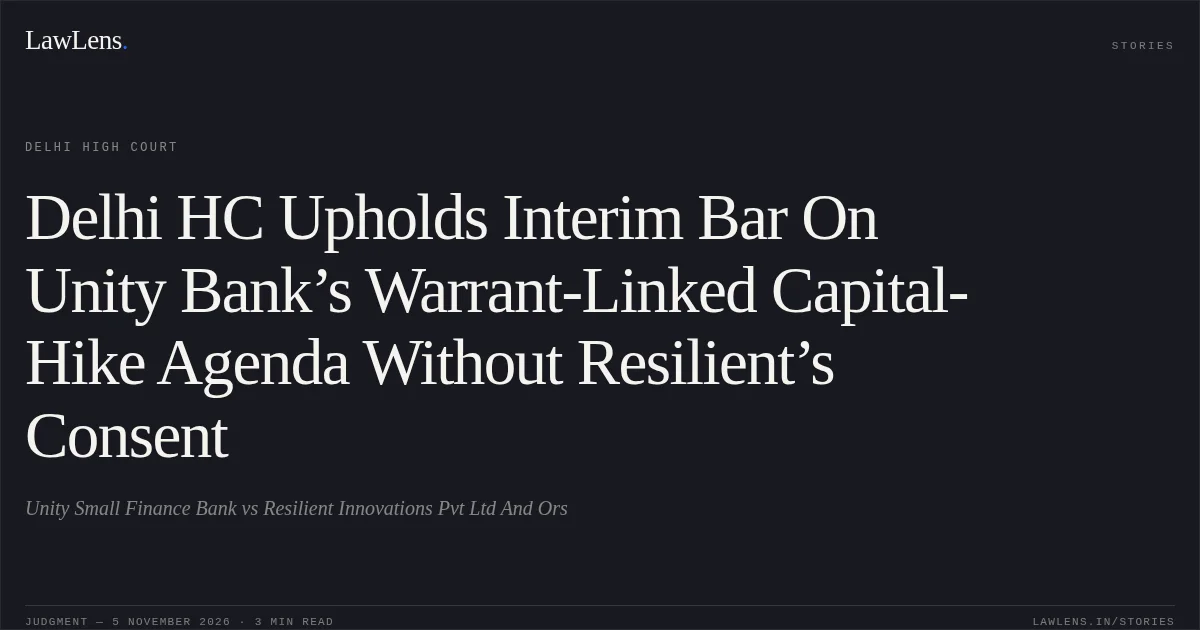
Unity Small Finance BankvsResilient Innovations Pvt Ltd And Ors
Click to open original judgment
Original judgment, available to read, download and summarize on LawLens.in