01Facts
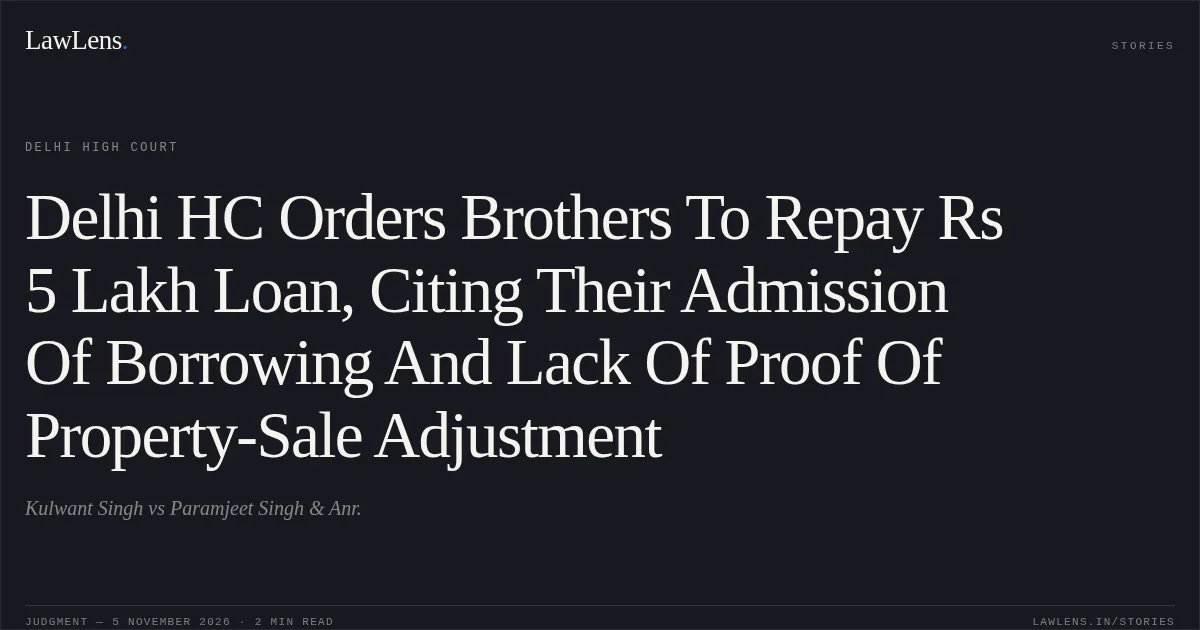
The appellant-plaintiff sued to recover ₹10,34,000, alleging that he had advanced the respondents-defendants ₹5,00,000 on 14 December 2012, recorded in a promissory note, with interest at 3% per month.
pp. 1–2The defendants admitted borrowing money and executing promissory notes, but claimed the loan was ₹25,00,000 and had been adjusted against the consideration for a property purchased by the plaintiff’s sister-in-law. The trial court dismissed the suit, finding the defendants’ account more probable, including because the plaintiff had not examined the alleged sources of the funds or the promissory-note witness. The plaintiff appealed under Section 96 read with Order XLI CPC.
pp. 1–2, 6–702Issues
i.1. Whether the plaintiff proved that the defendants owed him ₹5,00,000 under the promissory note and was entitled to recover that amount
pp. 5–6, 9–13ii.2. Whether the defendants’ asserted adjustment of the loan against the property transaction displaced the plaintiff’s claim
pp. 10–13iii.3. Whether the plaintiff was entitled to interest, and, if so, at what rate
p. 5, 1403Law Applied
The appeal was brought under Section 96 read with Order XLI of the Code of Civil Procedure, 1908, which provides for a first appeal from an original decree.
p. 1The court’s reasoning turned on the evidentiary significance of admissions in pleadings and testimony, considered alongside the proved promissory note: the defendants’ admissions of borrowing, executing promissory notes, and paying interest supported the plaintiff’s case.
pp. 9–11The court also considered the defendants’ contention that the transaction was barred by money-lending law, but did not identify a specific statutory provision or cite any precedent in addressing it.
p. 13Provisions in the judgment · 2 · Linked ones open on LawLens
Code of Civil Procedure, 1908 Section 96Section 41
04Reasoning
The court held that the defendants’ own pleadings and evidence established that they had borrowed from the plaintiff, executed promissory notes, and paid interest on the loan; the dispute therefore concerned the amount, not whether a loan existed.
pp. 9–11The promissory note was proved, and the defendants’ challenge did not establish that it had been signed blank and later filled in by the plaintiff.
pp. 10–11The asserted property adjustment was unsupported by documents, concerned a purchase made by the plaintiff’s relative rather than the plaintiff, and was inconsistent with the defendants’ failure to pursue recovery of the alleged ₹51,00,000 balance.
pp. 11–13Given these admissions and the promissory note, the plaintiff’s failure to examine family members, his maternal uncle, or the note’s witness was not fatal.
p. 13The court also rejected the money-lending objection, reasoning that the parties’ admitted friendly relationship and the agreed interest did not, by themselves, make the transaction prohibited.
p. 1305Holding
The High Court set aside the trial court’s dismissal and decreed the suit for ₹5,00,000, with pre-suit, pendente lite, and future interest at 6% per annum until payment.
pp. 13–14The appeal was allowed, and any pending applications were disposed of.
pp. 13–14Original Court PDF
Kulwant SinghvsParamjeet Singh & Anr.
Click to open original judgment
Original judgment, available to read, download and summarize on LawLens.in