Facts
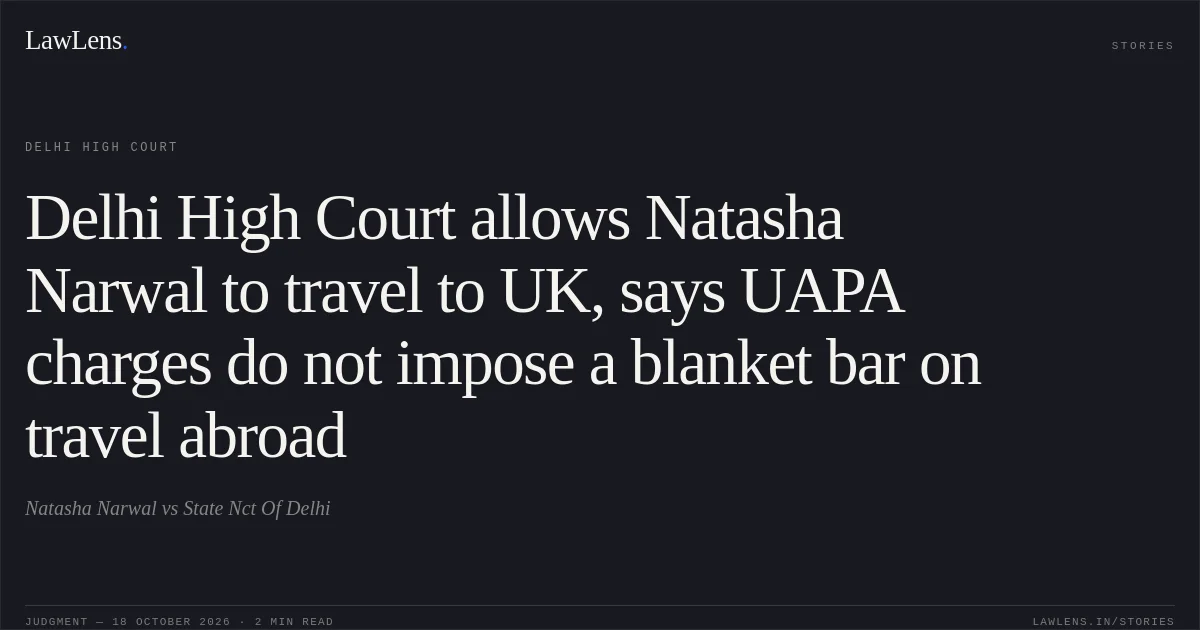
The petitioner sought permission to travel to the United Kingdom from 2 November to 1 December 2026 to present a paper at an academic conference and meet her PhD supervisors at the University of Warwick.
Source reference: para. 2–7She was on bail in two criminal cases, including one involving UAPA charges, and her bail conditions required her to surrender her passport and obtain the Trial Court’s prior permission before travelling abroad.
Source reference: para. 2–7The Trial Court rejected her applications, principally because of the seriousness of the UAPA allegations.
Source reference: para. 7The petitioner challenged those orders, relying on her academic commitments, her family ties in India, and her history of compliance with bail conditions.
Source reference: para. 8–11, 18, 20Issues
Whether the petitioner should be permitted to travel to the United Kingdom for the stated academic purposes despite the serious charges against her and the restriction in her bail order requiring prior court permission
Source reference: para. 3, 7–8, 12, 19Whether safeguards could adequately address the State’s concerns about the petitioner’s return to India and compliance with her bail conditions
Source reference: para. 10, 12, 21–25Law Applied
The Court relied on Maneka Gandhi v. Union of India, (1978) 1 SCC 248, for the principle that the right to travel abroad is a facet of the right to life and personal liberty under Article 21 and may be restricted only in accordance with procedure established by law.
Source reference: para. 14The Court also considered the petitioner’s existing bail condition requiring prior permission to travel abroad and treated the seriousness of the charges, including UAPA charges, as relevant but not sufficient to impose a blanket bar on foreign travel.
Source reference: para. 3, 19It did not identify a separate statutory test for granting temporary travel permission.
Source reference: no citationReasoning
The Court found that the proposed visit had substantiated academic purposes: the petitioner’s supervisors specifically invited her for in-person meetings, training and research activities, and her paper had been accepted for presentation at an international conference.
Source reference: para. 15–17Although the State raised concerns about possible asylum and difficulties in extradition, the Court noted that the petitioner had been on bail since 2021 without any alleged breach, that the trials were likely to take considerable time, and that she had close family in the NCR.
Source reference: para. 12, 18, 20In light of the Article 21 principle, the Court held that the seriousness of the charges did not, by itself, justify a blanket denial of travel; it considered the risks manageable through specified undertakings, security and reporting requirements.
Source reference: para. 19, 21–22Holding
The petitions were allowed, and the petitioner was permitted to travel to the United Kingdom from 2 November to 1 December 2026, subject to conditions including undertakings by her and her brother to ensure her return, not to apply for asylum, and not to comment on the merits of the cases; a cumulative personal bond of ₹1,00,000 with her brother as surety; and submission of her visa, tickets and itinerary to the Investigating Officer before departure.
The Trial Court was directed to release her passport, any Look Out Circular was suspended for the travel period, and she was required to surrender her passport within 48 hours of returning to India.
Source reference: para. 23–25Acts & Sections Cited
36 provisions across 4 statutes referred to in this judgment. Each provision opens on LawLens.
Indian Penal Code, 1860
Arms Act, 19592
Unlawful Activities (Prevention) Act, 19674
Original Court PDF
Natasha NarwalvsState Nct Of Delhi
Click to open original judgment
Original judgment, available to read, download and summarize on LawLens.in