01Facts
Devika died after being found unconscious in a bathroom at her matrimonial home. She had been married to respondent No. 1 for approximately two and a half years and had a young daughter.
¶ 1–2Her father alleged that she had faced physical and mental harassment over household work and lodged a complaint against her husband, sister-in-law and mother-in-law under Sections 498A, 306 and 114 of the IPC.
¶ 1–2The Sessions Court acquitted the accused. During the State’s appeal under Section 378 of the CrPC, respondent No. 3 died and the appeal against her abated; the appeal continued against respondents Nos. 1 and 2.
¶ 6, 1102Issues
i.1. Whether the prosecution proved that respondents Nos. 1 and 2 subjected Devika to cruelty within the meaning of Section 498A IPC
¶ 12–15ii.2. Whether the evidence established that respondents Nos. 1 and 2 abetted Devika’s suicide, so as to sustain a conviction under Section 306 read with Section 107 IPC
¶ 15iii.3. Whether the Sessions Court’s acquittal disclosed an error warranting appellate interference
¶ 17–2203Law Applied
Sections 498A, 306, 107 and 114 of the IPC require proof of the ingredients of the respective offences; in particular, Section 306 requires proof of abetment as defined in Section 107, including instigation, intentional aid or other conduct amounting to abetment.
¶ 15The Court also considered the presumptions under Sections 113A and 113B of the Indian Evidence Act, observing that their application requires proof of the relevant foundational facts and that the short duration of a marriage alone is insufficient.
¶ 14On an appeal against acquittal, the appellate court may review and reappreciate the evidence, but must account for the reinforced presumption of innocence; where two reasonable views are possible, it should not disturb the acquittal.
¶ 17–20Chandrappa v. State of Karnataka, (2007) 4 SCC 415; Rajesh Prasad v. State of Bihar, (2022) 3 SCC 471; Babu Sahebagouda Rudragoudar v. State of Karnataka, (2024) 8 SCC 149; and Ramesh v. State of Karnataka, (2024) 9 SCC 169.
¶ 17–20Provisions in the judgment · 5 · Linked ones open on LawLens
Code of Criminal Procedure, 1973 Section 378Section 313
Indian Penal Code, 1860 Section 107Section 114Section 306
04Reasoning
The Court found that the prosecution witnesses described the marriage as generally harmonious and did not provide specific evidence of sustained cruelty or harassment by respondents Nos. 1 and 2.
¶ 12–14The evidence about occasional quarrels over household work did not establish the required cruelty, and no sufficient foundational facts were shown to invoke the statutory presumptions.
¶ 12–14The medical evidence supported death by hanging, but did not connect the respondents to the death or establish instigation, intentional aid or other abetment.
¶ 15On reappreciation, the Court considered the trial Court’s assessment reasonable and found no perversity, illegality or other basis to interfere with the acquittal.
¶ 16, 21–2205Holding
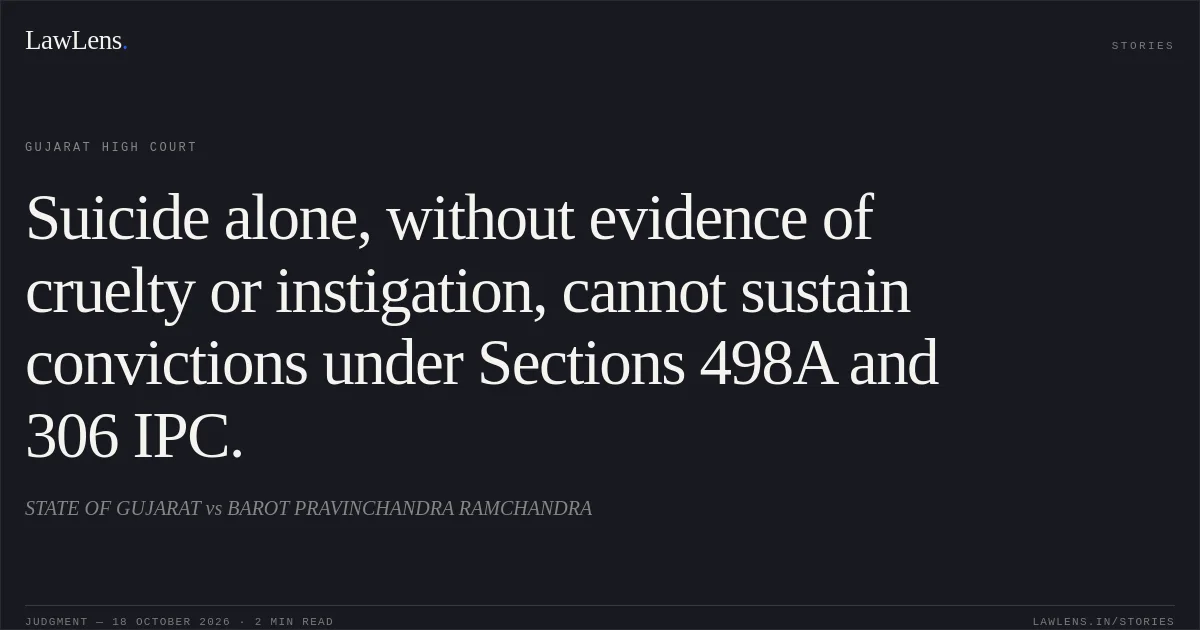
The Court held that the prosecution had not proved the charges against respondents Nos. 1 and 2 beyond reasonable doubt and that the acquittal disclosed no ground for appellate interference.
¶ 21–22The State’s appeal was dismissed and the Sessions Court’s acquittal was confirmed; the appeal against respondent No. 3 had already abated.
¶ 6, 23The bail bonds were cancelled and the record and proceedings were directed to be returned to the trial Court.
¶ 23Original Court PDF
STATE OF GUJARATvsBAROT PRAVINCHANDRA RAMCHANDRA
Click to open original judgment
Original judgment, available to read, download and summarize on LawLens.in