Facts
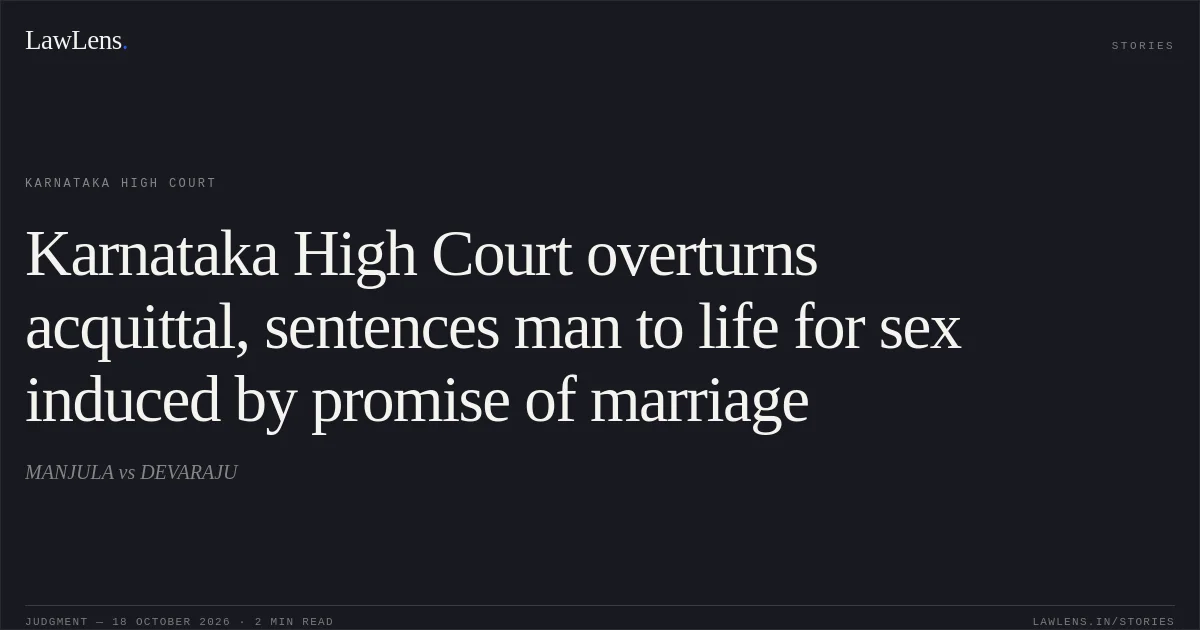
The complainant, Manjula, alleged that Devaraju repeatedly had sexual intercourse with her after promising to marry her, and threatened her when she refused to terminate her pregnancy.
Source reference: p. 3–8She gave birth to a daughter.
Source reference: p. 3–8The prosecution relied, among other evidence, on her testimony, the medical evidence and a DNA report identifying Devaraju as the child’s biological father
Source reference: p. 3–8, 13–14The Sessions Court acquitted Devaraju of offences under Sections 417, 376 and 506 IPC, treating the relationship as consensual.
Source reference: p. 2, 5–7Manjula appealed under Section 372 CrPC
Source reference: p. 2, 5–7The High Court allowed the appeal, set aside the acquittal and convicted Devaraju; it then heard him on sentence
Source reference: p. 18, 22–23Issues
1. Whether the trial court’s acquittal was perverse and required appellate interference, including conversion of the acquittal into a conviction
Source reference: p. 102. What orders, including sentence and victim compensation, should follow from the appeal
Source reference: p. 18, 22–26Law Applied
The Court considered Sections 375 and 376 IPC concerning rape, Section 90 IPC concerning consent given under fear or misconception, and Sections 417 and 506 IPC concerning cheating and criminal intimidation
Source reference: p. 4, 14–16It also referred to Section 357A CrPC as the basis for directing victim compensation
Source reference: p. 18–19On appellate interference with an acquittal, the Court relied on Mallappa v. State of Karnataka, (2024) 3 SCC 544, and P. Yuvaprakash v. State, represented by Inspector of Police (18 July 2023), stating that an acquittal may be reversed where cogent evidence has not been properly appreciated and that failure causes a miscarriage of justice.
Source reference: p. 18Reasoning
The High Court held that the trial court had focused on the complainant’s admissions that she and Devaraju were in a relationship and had sexual intercourse, without properly considering her evidence that he repeatedly promised marriage and that she continued the relationship in reliance on that promise
Source reference: p. 10–13It also found that the trial court had failed to assess the complaint and testimony concerning the alleged threat, or to give adequate consideration to the DNA evidence identifying Devaraju as the child’s father
Source reference: p. 13–17In the High Court’s view, the absence of physical injuries did not establish consent in the circumstances alleged, and the trial court’s omissions amounted to perversity causing a miscarriage of justice.
Source reference: p. 13–18Holding
The Court allowed the appeal, set aside the acquittal and convicted Devaraju under Sections 417, 376 and 506 IPC
It imposed one year’s imprisonment and a fine of ₹1,00,000 under Section 417; life imprisonment and a fine of ₹5,00,000 under Section 376; and two years’ imprisonment and a fine of ₹1,00,000 under Section 506, with the sentences to run concurrently
Source reference: p. 23–24It directed that ₹5,00,000 of the fine be placed in a fixed deposit for the child until majority and that the remaining ₹2,00,000 be released to the complainant; it also directed the District Legal Services Authority to award compensation within four months.
Source reference: p. 24–26Acts & Sections Cited
8 provisions across 2 statutes referred to in this judgment. Each provision opens on LawLens.
Indian Penal Code, 18605
Code of Criminal Procedure, 19733
Original Court PDF
MANJULAvsDEVARAJU
Click to open original judgment
Original judgment, available to read, download and summarize on LawLens.in