Facts
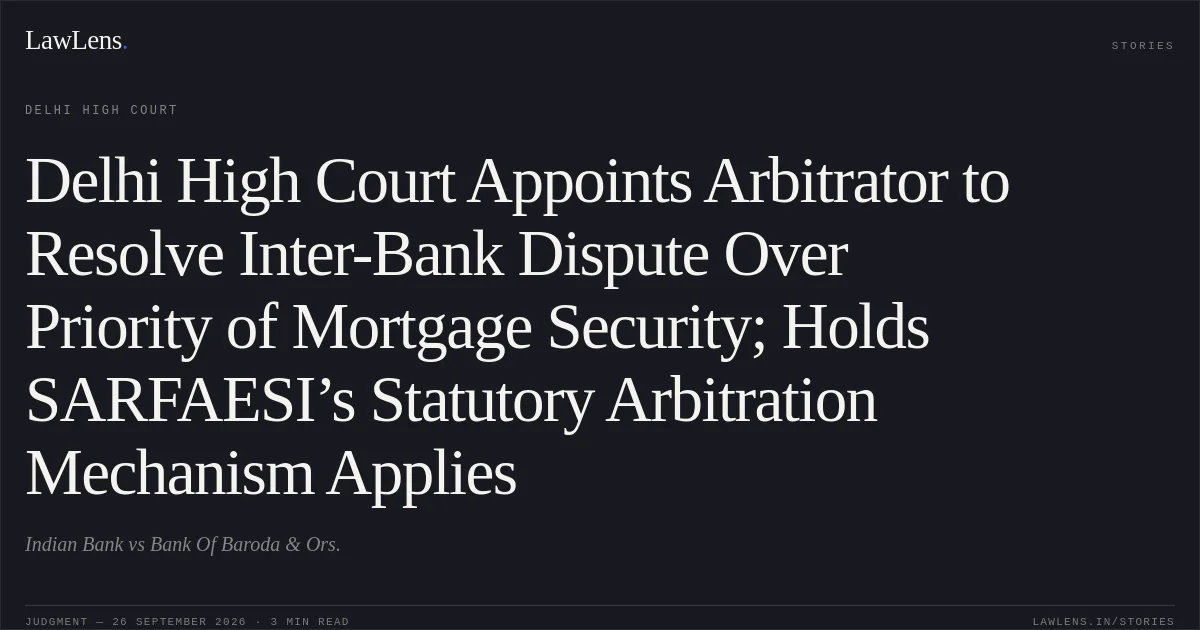
Indian Bank filed a petition under Section 11(6) of the Arbitration and Conciliation Act, 1996, read with Section 11 of the SARFAESI Act, seeking appointment of a sole arbitrator to resolve disputes with Bank of Baroda concerning their competing priority/charge over the same mortgaged properties and the consequential right to enforce security interests.
Source reference: p.1Indian Bank had previously instituted TSA No. 131/2022 before the Debt Recovery Tribunal-I, Delhi. By order dated 28 January 2026, the DRT dismissed the proceedings, holding that the inter se dispute between the banks was required to be resolved through arbitration under Section 11 of the SARFAESI Act.
Source reference: p.2No arbitrator had been appointed, and Bank of Baroda did not consent to the appointment.
Source reference: p.2Issues
1. Whether the dispute between the two banks concerning competing security interests and priority over the same mortgaged properties falls within the statutory arbitration mechanism under Section 11 of the SARFAESI Act.
Source reference: pp.1–32. Whether an arbitrator could be appointed under Section 11(6) of the Arbitration and Conciliation Act, 1996 despite the absence of an independently executed arbitration agreement and the respondent’s lack of consent.
Source reference: pp.2–3Law Applied
Section 11(6) of the Arbitration and Conciliation Act, 1996 empowers the Court to appoint an arbitrator where the agreed appointment mechanism has failed; at this stage, the Court’s enquiry is confined to determining the prima facie existence of an arbitration agreement, as held in SBI General Insurance Co. Ltd. v. Krish Spinning , 2024 SCC OnLine SC 1754.
Source reference: p.1Section 11 of the SARFAESI Act provides that disputes relating to securitisation, reconstruction or non-payment of amounts due between specified entities, including banks and financial institutions, shall be resolved by conciliation or arbitration under the Arbitration Act, “as if” the parties had consented in writing.
Source reference: pp.2–3In Bank of India v. Sri Nangli Rice Mills Pvt. Ltd. & Ors. , (2025) 9 SCC 225, the Supreme Court held that Section 11 of the SARFAESI Act creates statutory arbitration, does not require an independent arbitration agreement, and constitutes a mandatory mechanism that cannot be bypassed by resort to another forum.
Source reference: p.3Reasoning
The Court found that the dispute concerned competing claims of two banking institutions regarding priority and enforcement of security interests over the same mortgaged properties, thereby falling within the subject matter contemplated by Section 11 of the SARFAESI Act.
Source reference: pp.1–3The statutory fiction under Section 11—that the parties are deemed to have consented in writing to arbitration—removed the need for Bank of Baroda’s separate consent or an independently executed arbitration agreement.
Source reference: p.3The DRT’s prior determination that the dispute was required to be resolved through arbitration further supported the invocation of Section 11(6) of the Arbitration Act.
Source reference: p.2Accordingly, the respondent’s non-consent did not prevent the Court from constituting the arbitral tribunal.
Source reference: p.2Questions concerning arbitrability, jurisdiction and other substantive pleas were left open for determination by the arbitrator.
Source reference: p.4Holding
The Court held that the dispute fell within the statutory arbitration framework of Section 11 of the SARFAESI Act and that there was no impediment to appointing an arbitrator despite the absence of independent consent.
Mr. Mohit Kumar Mudgal, Advocate, was appointed as the sole arbitrator, with directions to enter upon the reference within three weeks and furnish the disclosures required under Section 12(2) of the Arbitration Act.
Source reference: p.3The arbitration was directed to be conducted under the rules and aegis of the Delhi International Arbitration Centre, with fees payable according to its schedule.
Source reference: p.4The parties were permitted to raise all pleas, including objections to arbitrability and jurisdiction, before the arbitrator. The petition was disposed of accordingly.
Source reference: p.4Acts & Sections Cited
3 provisions across 2 statutes referred to in this judgment. Each provision opens on LawLens.
Arbitration and Conciliation Act, 19962
Securitisation and Reconstruction of Financial Assets and Enforcement of Security Interest Act, 20021
Original Court PDF
Indian BankvsBank Of Baroda & Ors.
Click to open original judgment
Original judgment, available to read, download and summarize on LawLens.in