Facts
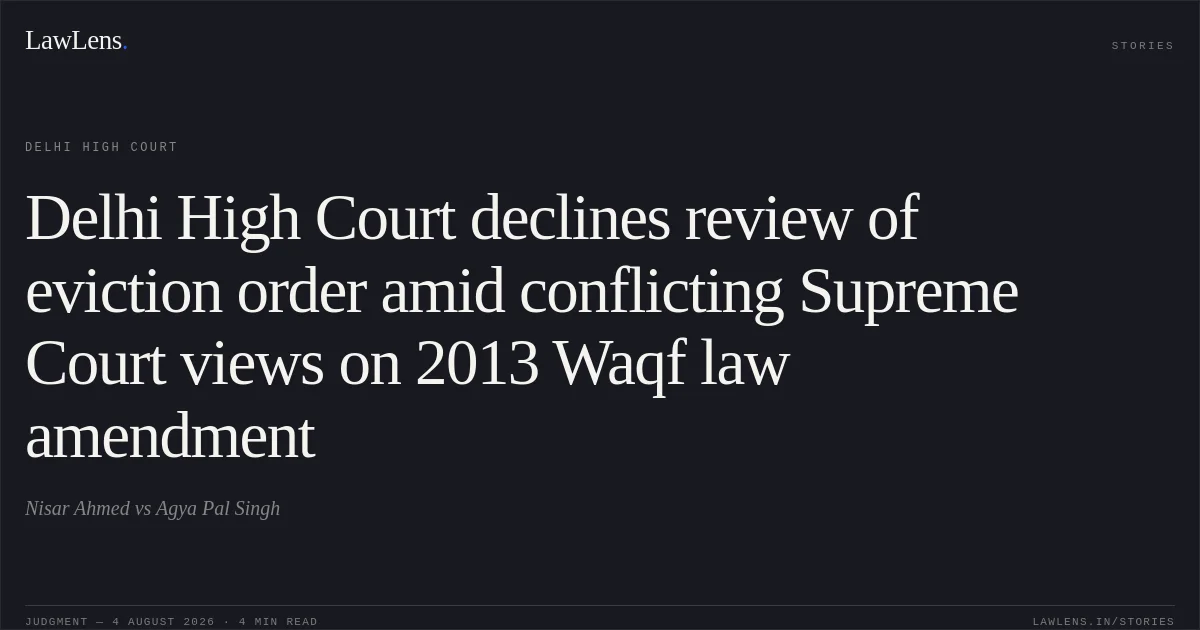
The petitioner/landlord instituted an eviction petition under the Delhi Rent Control Act, 1958 (“DRCA”) in 2009 concerning premises claimed to be Waqf property.
Source reference: pp. 1–5The petition was initially rejected under Order VII Rule 11 CPC on 26 May 2011; that order was set aside in revision on 11 February 2015, and the matter was remanded for trial.
Source reference: pp. 1–5The Supreme Court dismissed the challenge to the remand order on 7 May 2015.
Source reference: pp. 1–5After trial, the eviction petition was dismissed by the Rent Controller on 7 June 2018.
Source reference: pp. 1–5In RC.REV. 367/2018, the High Court, by judgment dated 7 July 2023, allowed the landlord’s revision and passed an eviction order.
Source reference: pp. 1–5The respondent/tenant thereafter sought review under Order XLVII Rule 1 read with Section 151 CPC, contending that the Waqf (Amendment) Act, 2013 retrospectively transferred jurisdiction over eviction of tenants of Waqf property from the Rent Controller to the Waqf Tribunal under Section 83 of the Waqf Act, 1995, with the consequence that the eviction proceedings and the revision were without jurisdiction.
Source reference: pp. 1–5, 30–33Issues
1. Whether the amendment to Section 83 of the Waqf Act, 1995, introduced by the Waqf (Amendment) Act, 2013, operated retrospectively so as to oust the jurisdiction of the Rent Controller in eviction proceedings instituted before the amendment.
Source reference: pp. 2–12, 30–332. Whether the judgment dated 7 July 2023 suffered from an “error apparent on the face of the record” warranting review under Section 114 and Order XLVII Rule 1 CPC.
Source reference: pp. 33–48, 55–563. Whether subsequent or overlooked precedents concerning the retrospective operation of the amendment could be relied upon to reopen the judgment in review jurisdiction.
Source reference: pp. 49–55Law Applied
The Court applied Section 114 and Order XLVII Rule 1 CPC, under which review is confined to discovery of new and important matter despite due diligence, a patent error apparent on the face of the record, or an analogous sufficient reason; review is not an appeal in disguise and cannot be used merely to substitute a different legal view.
Source reference: pp. 33–48This principle was drawn from Shri Ram Sahu v. Vinod Kumar Rawat, Aribam Tuleshwar Sharma v. Aribam Pishak Sharma, Meera Bhanja v. Nirmala Kumari Choudhury, Parsion Devi v. Sumitri Devi, and State of West Bengal v. Kamal Sengupta.
Source reference: pp. 33–48The Court also considered Sections 83 and 85 of the Waqf Act, 1995, Section 9 CPC, and the principles governing retrospectivity of procedural amendments and changes of forum stated in New India Assurance Co. Ltd. v. Shanti Misra, Hitendra Vishnu Thakur v. State of Maharashtra, Sudhir G. Angur v. M. Sanjeev, Shiv Shakti Coop. Housing Society v. Swaraj Developers, and Neena Aneja v. Jai Prakash Associates Ltd.
Source reference: pp. 2–12It noted the conflicting approaches in Ramesh Gobindram v. Sugra Humayun Mirza Wakf, Rashid Wali Beg v. Farid Pindari, Mumtaz Yarud Dowla Waqf v. Badam Balakrishna Hotel, and the subsequent decision in Habib Alladin v. Mohammed Ahmed concerning the effect of the 2013 amendment.
Source reference: pp. 49–55Reasoning
The Court held that the tenant’s contention required a substantive examination of the retrospectivity of the 2013 amendment, the scope of Sections 83 and 85, and the interaction between the Waqf Act and the DRCA.
Source reference: pp. 49–56These were matters on which competing judicial views existed, rather than a patent mistake evident from the record.
Source reference: pp. 49–56The judgment under review had expressly considered the objection regarding the Waqf Tribunal’s jurisdiction and had held that the eviction petition, instituted before the 2013 amendment, remained maintainable before the Rent Controller; it had also distinguished the authorities relied upon by the tenant.
Source reference: pp. 30–33, 49–52The later decision in Mumtaz Yarud Dowla was delivered after the judgment under review, while Habib Alladin subsequently adopted a view contrary to Rashid Wali Beg and Mumtaz Yarud Dowla, thereby demonstrating that the legal issue was debatable and not self-evident.
Source reference: pp. 53–56Applying the settled limits of review jurisdiction, the Court concluded that correcting the alleged legal error would require appellate reargument and a fresh interpretation of the statutory scheme, which was impermissible in review proceedings.
Source reference: pp. 34–48, 55–56Holding
The review petition was dismissed.
The Court held that no error apparent on the face of the record was established in the judgment dated 7 July 2023, and that the question whether the Waqf Amendment Act, 2013 retrospectively altered the forum for pending eviction proceedings was not capable of being reopened in review jurisdiction.
Source reference: paras. 25–27; pp. 55–56The order dated 8 January 2024 restraining initiation of execution proceedings was vacated, and the landlord was permitted to initiate execution in accordance with law.
Source reference: para. 28; p. 56The tenant was directed to pay ₹50,000 per month towards use and occupation charges from 8 January 2024 until 3 August 2026, with any further determination left to the executing court.
Source reference: para. 29; pp. 56–57Original Court PDF
Nisar AhmedvsAgya Pal Singh
Click to open original judgment
Original judgment, available to read, download and summarize on LawLens.in