Facts
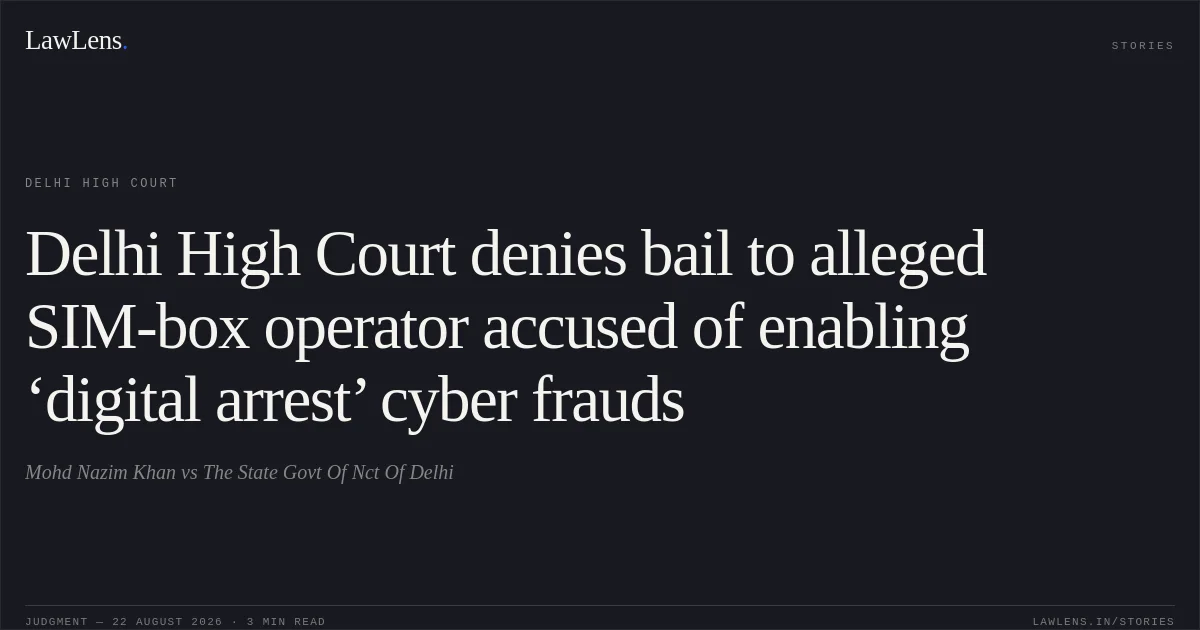
The petitioner sought regular bail in e-FIR No. 88/2026 registered at Police Station Special Cell for offences under Sections 318(4), 319(2), 61(2), 3(5) and 112(2) of the Bharatiya Nyaya Sanhita, 2023, Section 66D of the Information Technology Act, Section 42 of the Telecommunication Act, and Sections 4, 20 and 25 of the Indian Telegraph Act.
Source reference: p.1The prosecution alleged that the petitioner supplied and facilitated illegal SIM Boxes and GSM Gateway devices for routing international VoIP calls into Indian telecom networks, thereby assisting cyber-fraud operations, including “digital arrests”.
Source reference: p.2He was arrested on 13.04.2026, and the chargesheet was filed on 04.06.2026.
Source reference: p.2The petitioner contended that the evidence was entirely electronic, that nothing incriminating had been recovered from him, and that he had never visited Delhi.
Source reference: p.2The State opposed bail, alleging that he was the key handler who supplied SIM cards, SIM Boxes, laptops and remotely controlled setups, operated them through AnyDesk, instructed co-accused persons, and maintained links with foreign-based handlers.
Source reference: p.2Forty-four SIM cards and four SIM covers bearing his mobile number were allegedly recovered during investigation.
Source reference: pp.2–3The prosecution also relied on his alleged involvement in an earlier similar SIM Box case registered in Mumbai.
Source reference: p.3Issues
1. Whether the petitioner was entitled to regular bail merely because the prosecution evidence was primarily electronic and the chargesheet had already been filed.
Source reference: pp.2, 42. Whether the alleged nature and scale of the offence, the possibility of tampering with electronic evidence, the petitioner’s alleged foreign links and flight risk, and his previous similar involvement justified continued detention.
Source reference: pp.3–4Law Applied
The Court considered the offences alleged under Sections 318(4), 319(2), 61(2), 3(5) and 112(2) of the Bharatiya Nyaya Sanhita, 2023, Section 66D of the Information Technology Act, Section 42 of the Telecommunication Act, and Sections 4, 20 and 25 of the Indian Telegraph Act.
Source reference: p.1It applied the general principles governing regular bail, including assessment of the nature and gravity of the accusation, the likelihood of tampering with evidence, the risk of absconding or fleeing from justice, antecedent or repeated criminal conduct, and the broader impact of the alleged offence on society.
Source reference: no citationThe Court specifically held that the electronic nature of evidence does not by itself eliminate the possibility of tampering, particularly where the accused possesses relevant technical expertise and may use remote-access software.
Source reference: p.3Reasoning
The Court treated the alleged offence as serious and extensive because the petitioner was alleged to have facilitated SIM Box and GSM Gateway operations used in cyber frauds affecting the Indian telecom network.
Source reference: pp.1–2His alleged role as a key handler, the recovery of 44 SIM cards and SIM covers linked to his mobile number, his alleged foreign connections, and his prior involvement in a similar SIM Box case weighed against bail.
Source reference: pp.2–3The Court rejected the argument that electronic evidence could not be tampered with, reasoning that a technically skilled accused could potentially interfere with such evidence through remote software similar to AnyDesk.
Source reference: p.3It also accepted the prosecution’s concern that the petitioner’s alleged connections with foreign-based handlers made him a potential flight risk.
Source reference: p.3Finally, the Court considered the adverse impact of such cyber-enabled telecom crimes on society and the national economy.
Source reference: p.4Holding
The Court held that the petitioner had not made out a fit case for regular bail.
The filing of the chargesheet and the electronic character of the evidence did not outweigh the seriousness and repeated nature of the alleged offence, the possibility of electronic evidence tampering, the petitioner’s alleged foreign links, and the risk of flight.
Source reference: pp.3–4The bail application and accompanying application were dismissed, and a copy of the order was directed to be sent to the concerned Jail Superintendent for communication to the petitioner.
Source reference: p.4Acts & Sections Cited
9 provisions across 3 statutes referred to in this judgment. Each provision opens on LawLens.
Bharatiya Nyaya Sanhita, 20235
Telecommunications Act, 2023.1
Indian Telegraph Act, 18853
Original Court PDF
Mohd Nazim KhanvsThe State Govt Of Nct Of Delhi
Click to open original judgment
Original judgment, available to read, download and summarize on LawLens.in