Facts
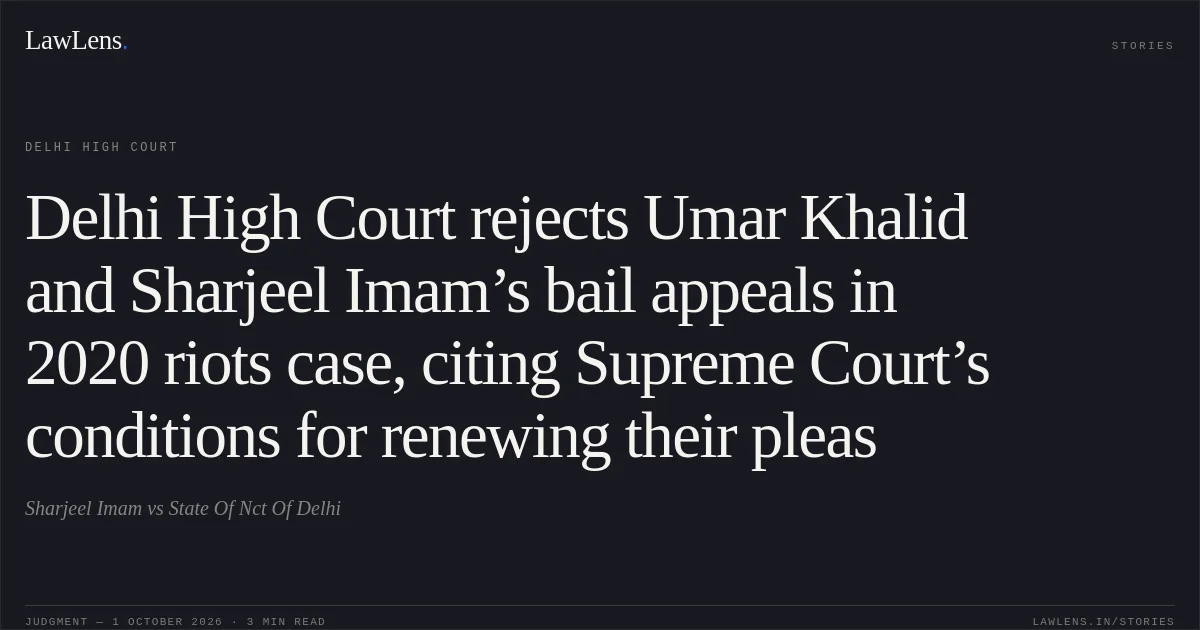
The appellants challenged the Trial Court’s order dated 4 July 2026 rejecting their applications for regular bail in FIR No. 59/2020, concerning the North-East Delhi riots and offences under the Unlawful Activities (Prevention) Act, 1967 (UAPA).
Source reference: pp. 2–3, paras. 2–6The Supreme Court had previously rejected their bail appeals in Gulfisha Fatima v. State (Govt. of NCT of Delhi), while permitting them to renew their bail prayers upon completion of examination of the prosecution’s protected witnesses or expiry of one year from 5 January 2026, whichever occurred earlier.
Source reference: pp. 7–8, 12, paras. 11–12Before the High Court, the appellants relied on subsequent decisions concerning delay and bail, parity with co-accused granted interim bail, and further passage of time.
Source reference: pp. 8–10, 13, paras. 13–16, 26The State submitted that the appellants’ alleged roles as central conspirators differed from those of the co-accused.
Source reference: pp. 10, 13, paras. 17–18, 28The Court was informed that arguments on charge had concluded, but the Trial Court was awaiting the outcome of proceedings concerning inspection of unrelied documents sought by a co-accused.
Source reference: p. 11, paras. 19–21Issues
1. Whether the appellants could obtain bail on the asserted changed circumstances before the conditions for renewing their bail prayers specified by the Supreme Court in Gulfisha Fatima had occurred.
Source reference: pp. 8–9, 12–13, paras. 12–13, 24, 272. Whether the appellants were entitled to bail on grounds of parity with co-accused granted interim bail, or on the basis of delay and the progress of the trial.
Source reference: pp. 9–10, 13, paras. 14–17, 23, 26–28Law Applied
Section 21(4) of the National Investigation Agency Act, 2008 provides the appellate route invoked to challenge the bail-rejection order.
Source reference: p. 2, para. 2Under Section 43D(5) of the UAPA, the statutory threshold for bail applies where the prosecution material, taken at face value, discloses a prima facie case; the Supreme Court held that this threshold was attracted against these appellants on the material before it.
Source reference: pp. 7–8, para. 11Article 21 requires courts to guard against continued pre-trial detention without meaningful progress, but Gulfisha Fatima specifically permitted these appellants to renew their bail prayers upon either of two stated events: completion of examination of the protected witnesses or expiry of one year from the order, whichever was earlier.
Source reference: p. 8, para. 11The High Court held that it was bound by judicial discipline not to modify those conditions; it also applied the distinction drawn in Gulfisha Fatima between the appellants’ alleged central roles and the roles attributed to other accused.
Source reference: pp. 12–13, paras. 24, 27–28Reasoning
The Court treated the Supreme Court’s directions in Gulfisha Fatima as specifically governing these appellants.
Source reference: p. 12, para. 24It held that the general discussion there concerning Article 21 and Section 43D(5) did not displace the express, conditional liberty to renew their bail prayers, and that the High Court could not vary those conditions.
Source reference: p. 12, para. 24The subsequent decisions relied on by the appellants did not justify departing from that binding direction; nor did the Court find parity, because the Supreme Court had distinguished the appellants’ alleged central and strategic roles from those of other accused, including local-level facilitators.
Source reference: pp. 12–13, paras. 27–28On delay, the Court noted that no prosecution-caused delay was alleged, that arguments on charge had concluded, and that the Trial Court was awaiting the outcome of proceedings brought by a co-accused.
Source reference: pp. 11–12, paras. 19–23It therefore found no basis to interfere with the Trial Court’s order.
Source reference: p. 14, para. 31Holding
The High Court rejected the appellants’ regular-bail prayers and dismissed both appeals, finding no fault with the Trial Court’s order dated 4 July 2026.
Pending applications, if any, were also disposed of.
Source reference: p. 14, para. 32Acts & Sections Cited
33 provisions across 6 statutes referred to in this judgment. Each provision opens on LawLens.
National Investigation Agency Act, 20081
Indian Penal Code, 1860
Unlawful Activities (Prevention) Act, 19674
Arms Act, 19592
Code of Criminal Procedure, 19731
Original Court PDF
Sharjeel ImamvsState Of Nct Of Delhi
Click to open original judgment
Original judgment, available to read, download and summarize on LawLens.in