01Facts
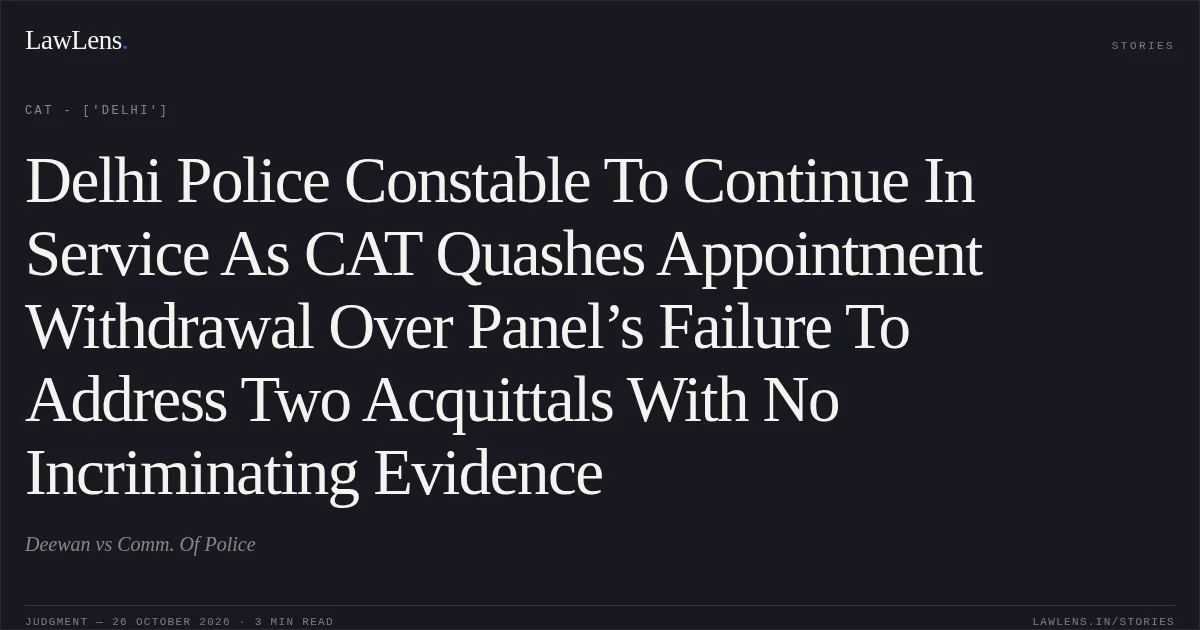
The applicant, selected as a Delhi Police Constable, had disclosed his involvement in two criminal cases, both of which ended in acquittal.
pp. 10–11 · ¶ 4After an earlier Tribunal order and dismissal of the respondents’ challenge by the Delhi High Court, he was appointed, joined service and was confirmed on 19 February 2016.
pp. 10–11 · ¶ 4Following the Supreme Court’s common order dated 22 November 2016 in connected proceedings, the respondents reconsidered his suitability and, by order dated 17 January 2017, withdrew his appointment.
p. 11 · ¶ 4.1The applicant challenged that decision, contending that the trial courts had found no incriminating evidence against him and that the Screening Committee had not properly considered the manner of his acquittals.
pp. 11–13 · ¶ 4.1–4.5In both cases, material prosecution witnesses did not support the prosecution; in the second case, the trial court dispensed with the applicant’s statement under Section 313 CrPC for want of incriminating evidence.
pp. 13–16 · ¶ 6.2–6.302Issues
i.1. Whether the Screening Committee meaningfully assessed the nature and manner of the applicant’s acquittals, in accordance with the applicable principles governing suitability for appointment to the police force.
pp. 13–16 · ¶ 6.1–6.6ii.2. Whether the respondents’ decision to withdraw the applicant’s appointment was sustainable despite the trial courts’ findings that no incriminating evidence connected him with the offences.
pp. 15–18 · ¶ 6.4–6.1003Law Applied
Under Avtar Singh v. Union of India, an employer assessing a candidate’s antecedents must consider the relevant circumstances of the criminal case, including the nature of the offence and the manner of acquittal; disclosure of a criminal case does not, by itself, resolve the separate question of suitability.
p. 13 · ¶ 6.1 · p. 17 · ¶ 6.8Commissioner of Police v. Mehar Singh, Commissioner of Police v. Shani Kumar and Jainendra Singh v. State of U.P. recognise that antecedents and the circumstances of an acquittal are relevant to suitability for police service, but do not dispense with an individual assessment based on the actual record.
p. 17 · ¶ 6.8An acquittal does not automatically confer a right to appointment in a disciplined force; however, the discretion to assess suitability must be exercised on relevant material and through a reasoned consideration of the particular case.
pp. 15–16 · ¶ 6.5–6.6Provisions in the judgment · 5 · Linked ones open on LawLens
Code of Criminal Procedure, 1973 Section 313Section 315
Indian Penal Code, 1860 Section 323Section 506Section 146
04Reasoning
The Tribunal found that the trial judgments recorded the failure of the material prosecution witnesses to support the allegations and expressly stated that no evidence connected the accused with the offences; in the second case, the Section 313 CrPC statement was dispensed with because there was no incriminating material.
pp. 13–15 · ¶ 6.2–6.3The Screening Committee characterised the acquittals as being on technical grounds but did not adequately reconcile that conclusion with the trial courts’ findings or identify what material against the applicant survived the trials.
pp. 14–16 · ¶ 6.4–6.6Nor could hostility of the witnesses, without a finding or supporting material, itself establish that the applicant had won them over.
p. 16 · ¶ 6.7Although the respondents could independently assess suitability, their reliance on the FIR allegations and perceived gravity of the offences, without proper consideration of the trial record, amounted to non-consideration of relevant circumstances.
pp. 17–18 · ¶ 6.9–6.10The applicant’s subsequent service record was also a relevant circumstance for that assessment, though not determinative by itself.
pp. 17–18 · ¶ 6.9–6.1005Holding
The Tribunal held that the respondents’ assessment was legally unsustainable because it did not adequately consider the trial courts’ findings and the actual manner of acquittal.
p. 20 · ¶ 7.1–7.3It quashed and set aside the order dated 17 January 2017 withdrawing the applicant’s appointment and directed the respondents to treat him as continuing in service, with consequential benefits on a notional basis in accordance with law.
p. 20 · ¶ 7.1–7.3The O.A. was allowed, with no order as to costs.
p. 20 · ¶ 7.4Original Court PDF
DeewanvsComm. Of Police
Click to open original judgment
Original judgment, available to read, download and summarize on LawLens.in