Facts
The petitioner was selected for appointment as an ICDS Supervisor, subject to verification.
Source reference: no citationIn her verification roll, she answered “No” to whether she had been convicted or charge-sheeted in a criminal proceeding, although four criminal cases were pending against her and charges had been framed before she completed the roll.
Source reference: para. 6–8She was subsequently acquitted in all four cases.
Source reference: para. 8The Director of ICDS cancelled her candidature on 20 February 2025, finding deliberate suppression.
Source reference: no citationThe petitioner challenged that decision, relying on the nature and outcome of the cases and a departmental recommendation dated 21 May 2024 that her appointment be recommended.
Source reference: para. 1–2, 9, 21Issues
1. Whether the petitioner’s deliberate failure to disclose the pending criminal cases justified cancellation of her candidature without consideration of the circumstances of the cases and her acquittals.
Source reference: para. 5, 18–202. Whether the cancellation order was arbitrary for failing to consider relevant factors, including the nature of the alleged offences, the petitioner’s antecedents, and the departmental recommendation.
Source reference: para. 20–22Law Applied
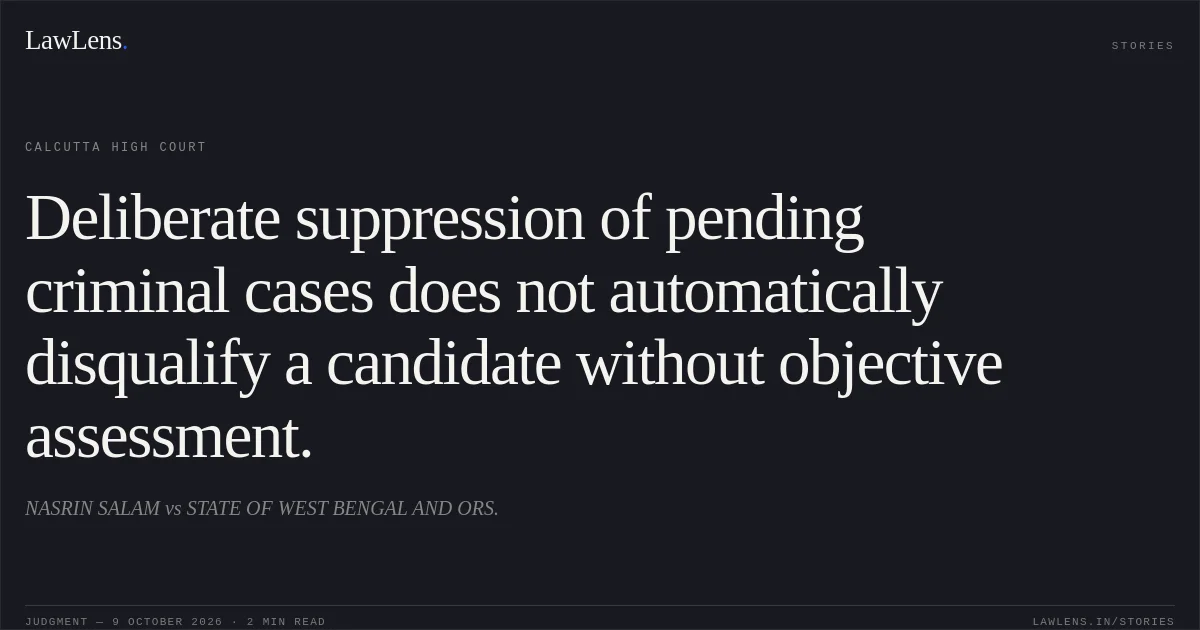
Under Avtar Singh v. Union of India, (2016) 8 SCC 471, information sought in a verification form must be truthfully disclosed, but cancellation of candidature for suppression is not automatic: the employer must act objectively, reasonably, and after considering the nature of the post, the circumstances of the case, the gravity of the alleged offence, and applicable rules or instructions.
Source reference: para. 10–14Pawan Kumar v. Union of India, (2023) 12 SCC 317, similarly holds that suppression does not by itself authorize arbitrary disqualification; the employer must assess relevant facts and the candidate’s suitability.
Source reference: para. 10–14The Court also considered Ravindra Kumar v. State of Uttar Pradesh, (2024) 5 SCC 264, Ram Kumar v. State of Uttar Pradesh, (2011) 14 SCC 709, and Union of India v. Shishupal alias Shiv Pal, 2024 SCC OnLine SC 1769, noting that even where acquittal does not determine suitability, the employer must consider relevant circumstances before finding a candidate unfit.
Source reference: para. 16, 21The verification question concerned conviction or charge-sheeting in criminal proceedings.
Source reference: para. 6Reasoning
The Court found that the petitioner knew of the pending cases when she completed the verification roll and that her non-disclosure was deliberate.
Source reference: para. 17–18However, deliberate suppression did not make cancellation automatic. The four cases arose within a close period, involved family members, concerned offences described by the Court as generally bailable and Magistrate-triable, and had all ended in acquittal; the record did not establish that the petitioner was a habitual offender.
Source reference: para. 17, 21The authority’s order relied on suppression alone and failed to assess these circumstances or the departmental recommendation that her case be recommended for appointment. The Court therefore held that the decision was contrary to the governing principles and arbitrary.
Source reference: para. 21–22Holding
The Court allowed the writ petition and set aside the Director of ICDS’s order dated 20 February 2025 as unsustainable.
It directed respondent No. 6 to take steps for the petitioner’s immediate appointment to the post for which she had been selected and to issue her appointment letter within four weeks of communication of the judgment.
Source reference: para. 24Acts & Sections Cited
5 provisions across 1 statute referred to in this judgment. Each provision opens on LawLens.
Indian Penal Code, 18605
Original Court PDF
NASRIN SALAMvsSTATE OF WEST BENGAL AND ORS.
Click to open original judgment
Original judgment, available to read, download and summarize on LawLens.in