Facts
On January 11, 2023, the appellant was intercepted by police based on confidential information. A personal search allegedly yielded three live cartridges and a mobile phone.
Source reference: p. 2The appellant’s disclosure led to the recovery of a "MADE IN USA" revolver from co-accused Prince Sharma.
Source reference: p. 3The prosecution alleged that the appellant intended to supply these arms to an active Maoist Commander, Hungo Madkami.
Source reference: p. 2The appellant sought bail on grounds of deteriorating health (tuberculosis), acquittal in previous criminal cases, and parity with co-accused Sudhir Tripathi, who was granted bail by the Supreme Court.
Source reference: p. 4-5This was the appellant's second bail application after a previous dismissal in 2025.
Source reference: p. 4Issues
1. Whether the appellant is entitled to enlargement on bail based on the principle of parity with co-accused Sudhir Tripathi.
Source reference: p. 52. Whether the appellant’s medical condition and the conclusion of prior criminal cases constitute a material change in circumstances justifying bail.
Source reference: p. 43. Whether there is a prima facie case against the appellant under the Unlawful Activities (Prevention) Act (UAPA) that would bar the grant of bail.
Source reference: p. 6-7Law Applied
The Court considered Sections 13(1), 38(2), and 39(2) of the Unlawful Activities (Prevention) Act, 1967, which govern membership and support to terrorist organizations.
Source reference: p. 2It applied Section 25 of the Arms Act, 1959 regarding illegal possession of ammunition.
Source reference: p. 2The court also assessed the principle of parity in bail jurisprudence, which dictates that similarly situated accused should be treated equally unless distinguishable by role or antecedents.
Source reference: p. 7-8Finally, the court evaluated the weight of criminal antecedents and the "clean acquittal" doctrine versus acquittals due to hostile witnesses.
Source reference: p. 8Reasoning
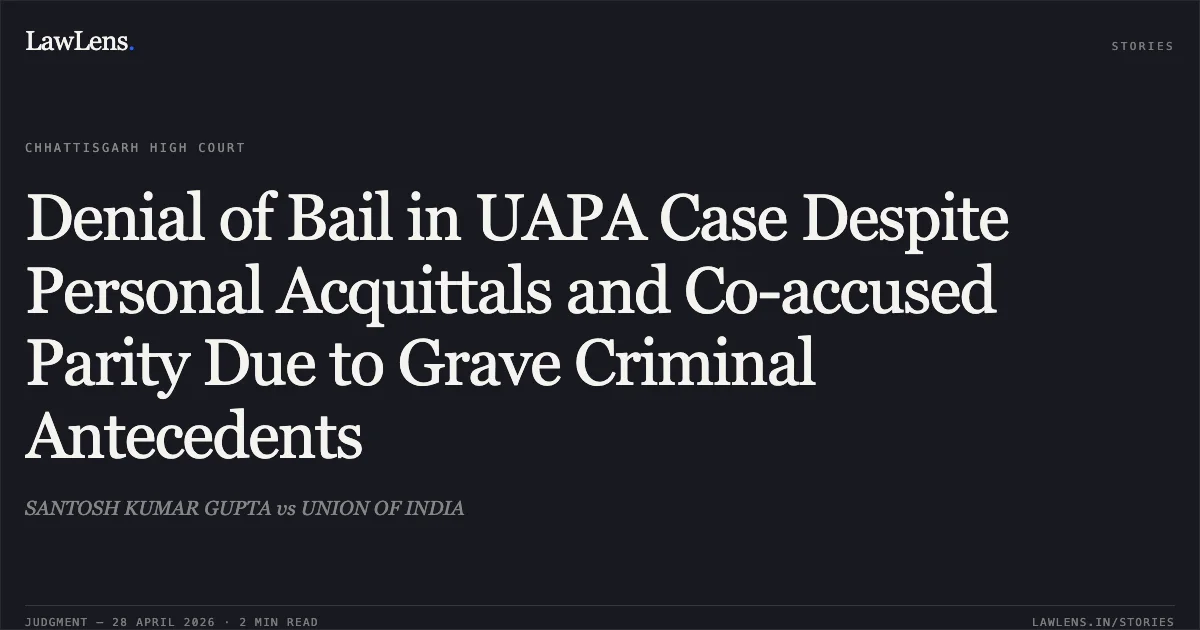
The Court rejected the plea for parity, noting that co-accused Sudhir Tripathi lacked the extensive criminal history of the appellant, whose role was found to be "distinct and distinguishable" and more "grave".
Source reference: p. 8Regarding the appellant's acquittals in other cases, the Court observed these were not "clean acquittals" but resulted from witnesses turning hostile, which did not diminish his perceived dangerousness.
Source reference: p. 8The Court emphasized that 15 out of 25 prosecution witnesses had already supported the NIA's case, establishing a strong prima facie nexus between the appellant and the banned Maoist organization.
Source reference: p. 6, 8The gravity of supplying arms to extremist elements, which threatens state security, outweighed the appellant's claims of medical distress.
Source reference: p. 6, 7Holding
The High Court dismissed the criminal appeal, holding that no case for bail was made out given the gravity of the offence and the appellant's criminal antecedents.
The Court directed the trial court to conclude the proceedings as expeditiously as possible, ideally within six months, in light of the advanced stage of the trial.
Source reference: p. 9Acts & Sections Cited
8 provisions across 5 statutes referred to in this judgment. Each provision opens on LawLens.
National Investigation Agency Act, 20081
Indian Penal Code, 18602
Arms Act, 19591
Unlawful Activities (Prevention) Act, 19673
Code of Criminal Procedure, 19731
Original Court PDF
SANTOSH KUMAR GUPTAvsUNION OF INDIA
Click to open original judgment
Original judgment, available to read, download and summarize on LawLens.in