Facts
The petitioner, appointed as an Assistant Engineer (Civil) on 3 January 1995, was promoted as Executive Engineer on 5 August 2016 and as Superintending Engineer on 25 October 2023.
Source reference: p. 2; para. 3During his service, four disciplinary proceedings were initiated against him: the first concerned alleged failure to undertake sufficient maintenance work while he was posted as Executive Engineer, Works Division, Patori; the second concerned non-submission of a brick-compressive-strength test report relating to his tenure as Assistant Engineer, Works Division, Begusarai; the third concerned alleged delayed joining upon promotion as Superintending Engineer; and the fourth concerned alleged irregularities in the evaluation of a technical bid while he was Superintending Engineer, Works Circle, Darbhanga.
Source reference: pp. 2–4; paras. 4–7The petitioner submitted replies to all the charges.
Source reference: no citationHis explanation in respect of the first charge was accepted by the Department on 25 September 2025.
Source reference: p. 8; para. 16An order imposing the punishment of censure for the period 2023–24 was nevertheless issued by the Additional Secretary on 29 August 2025 in relation to the technical-bid proceedings.
Source reference: pp. 5, 12–14; paras. 9, 26–27The petitioner challenged the three subsequent charge memoranda and the punishment order, principally contending that they had not been issued by the competent disciplinary authority and that the punishment was discriminatory and unsupported by the petitioner’s individual responsibility.
Source reference: pp. 4–6; paras. 8–10Issues
Whether the charge memoranda dated 25 July 2023 and 12 February 2024 were issued by the competent disciplinary authority in accordance with Rule 17(3) of the Bihar Government Servants (Classification, Control and Appeal) Rules, 2005 and the Rules of Executive Business, 1979?
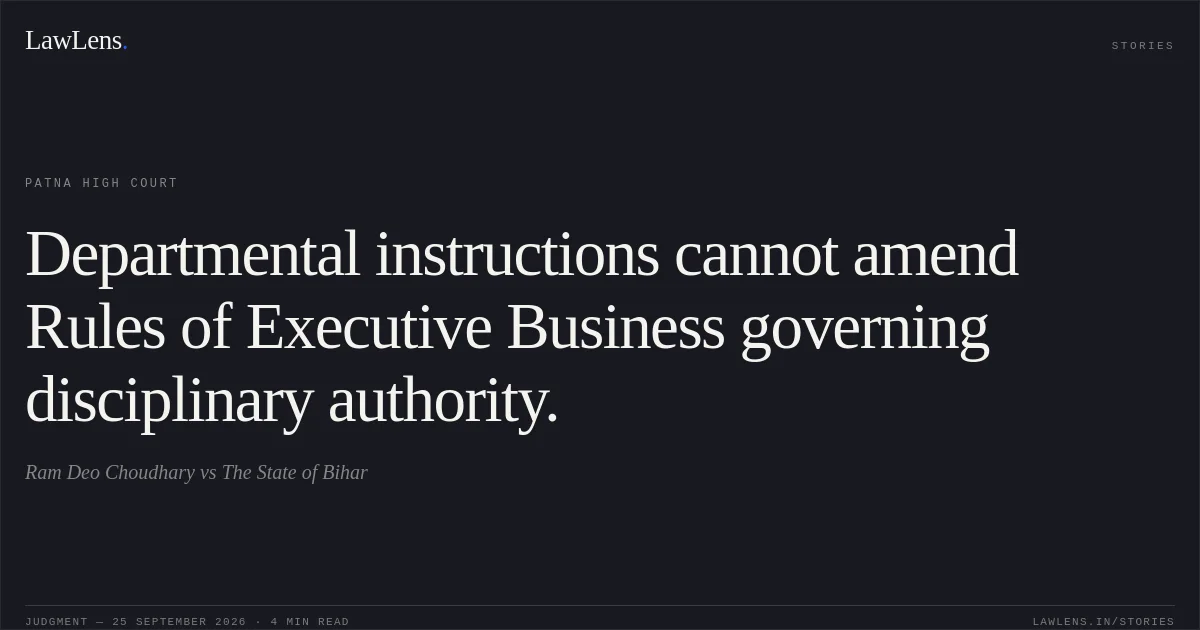
Source reference: pp. 8–12; paras. 18–25Whether departmental letter no. 6968 dated 12 July 2021 could alter or override the allocation of disciplinary decision-making prescribed by the Rules of Executive Business, 1979?
Source reference: pp. 9–12; paras. 20–25Whether the punishment of censure imposed on the petitioner for alleged irregularities in technical-bid evaluation was sustainable when the evaluation was undertaken by a multi-member committee and the petitioner’s defence regarding the role of the Divisional Accountant and other members had not been properly displaced?
Source reference: pp. 12–14; paras. 26–27Whether the first charge memorandum dated 22 November 2019 required interference after the petitioner’s explanation had been accepted by the Department?
Source reference: p. 8; paras. 16–17Law Applied
The Court applied Rule 2(j) of the Bihar Government Servants (Classification, Control and Appeal) Rules, 2005, under which the disciplinary authority is the appointing authority, and Rule 17(3), which requires the disciplinary authority to draw up, or cause to be drawn up, the substance of the imputations of misconduct.
Source reference: pp. 4, 11–12; paras. 8, 24It further applied Rules 22(2)(i) and 32(a)(vii) of the Rules of Executive Business, 1979, framed under Article 166(3) of the Constitution: disciplinary cases concerning specified Group ‘B’ officers are to be submitted to the Minister-in-Charge, while cases involving other State Service officers, outside the scope of Rule 22(2)(i), are to be submitted to the Chief Minister through the Chief Secretary.
Source reference: pp. 9–11; paras. 20–22The Court held that an administrative departmental letter issued by the Principal Secretary cannot amend or override the Governor-made Rules of Executive Business.
Source reference: p. 12; para. 25It also considered Rule 23 of the Bihar Public Works Account Code, under which the Divisional Accountant is responsible for ensuring compliance with applicable rules and orders in transactions within the division.
Source reference: p. 13; para. 26Reasoning
The Court treated the petitioner’s status at the time of issuance of the charge memoranda as material and noted that he was then serving in Group ‘A’ posts as Executive Engineer or Superintending Engineer.
Source reference: pp. 8–9; paras. 18–19Although the respondents relied on departmental letter no. 6968 dated 12 July 2021 to contend that the Departmental Minister was the appointing and disciplinary authority for posts above Assistant Engineer, the Court held that the letter could not amend the statutory Rules of Executive Business.
Source reference: pp. 9–12; paras. 20–25Under Rule 32(a)(vii), the relevant disciplinary cases were required to be submitted to the Chief Minister through the Chief Secretary; however, the charge memoranda did not indicate approval either by the Chief Minister or even by the Departmental Minister.
Source reference: pp. 9–12; paras. 20–25Moreover, the memoranda were issued under the Secretary’s signature, contrary to the requirement that the disciplinary authority frame or cause the charges to be framed under Rule 17(3).
Source reference: p. 11; para. 24The Court therefore found the three challenged charge memoranda legally unsustainable.
Source reference: no citationRegarding the punishment order, the Court found that the technical bid had been considered by a committee comprising the petitioner, two Executive Engineers and the Divisional Accounts Officer.
Source reference: pp. 12–14; paras. 26–27Since responsibility was collective and the Divisional Accountant had a specific duty under Rule 23 of the Public Works Account Code, the petitioner could not be punished merely because he chaired the committee, particularly when his defence had not been adequately rebutted.
Source reference: pp. 12–14; paras. 26–27As to the 2019 charge, the Court declined to adjudicate the challenge because the petitioner’s explanation had already been accepted by the Department.
Source reference: p. 8; para. 17Holding
The Court allowed the writ petition.
It set aside the charge memorandum dated 25 July 2023, the two charge memoranda dated 12 February 2024, and the punishment order dated 29 August 2025, holding them unsustainable for want of action by the competent disciplinary authority and, in relation to the punishment, also because the petitioner could not alone be held responsible for the decision of a multi-member technical-bid committee.
Source reference: pp. 11–14; paras. 22, 27–29The Court did not separately quash the 2019 charge memorandum because the petitioner’s explanation to it had already been accepted by the Department.
Source reference: p. 8; para. 17Acts & Sections Cited
1 provisions across 1 statute referred to in this judgment. Each provision opens on LawLens.
Commercial Documents Evidence Act, 19391
Original Court PDF
Ram Deo ChoudharyvsThe State of Bihar
Click to open original judgment
Original judgment, available to read, download and summarize on LawLens.in