Facts
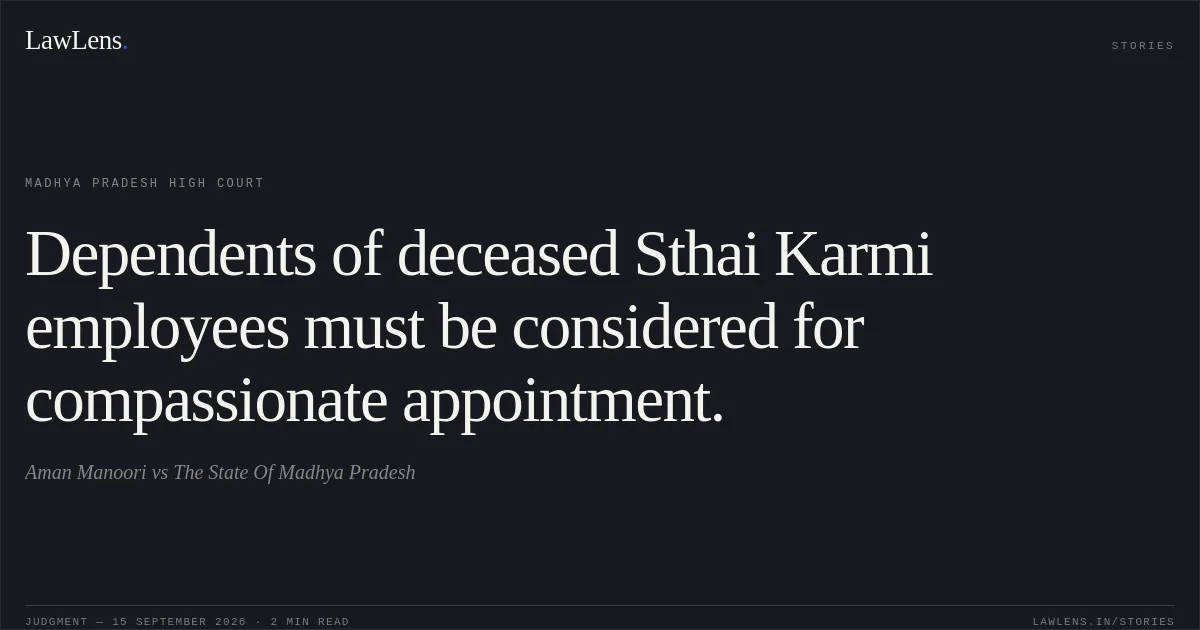
The petitioner filed a writ petition under Article 226 of the Constitution challenging the order dated 18 August 2026 passed by Respondent No. 5, whereby his claim for compassionate appointment was rejected.
Source reference: p.1He sought reconsideration of his claim under the applicable compassionate-appointment policies dated 29 September 2014 and 31 August 2016.
Source reference: p.1The petitioner contended that he was identically situated to the petitioner in Shushan Shelke v. State of Madhya Pradesh and Others, W.P. No. 15385 of 2025, decided on 1 May 2025, in which the High Court had directed reconsideration of a similar claim.
Source reference: p.1The State conceded that the matter was covered by the decision in Shushan Shelke and requested disposal of the petition in the same terms.
Source reference: p.2Issues
Whether the petitioner’s rejection of compassionate appointment was liable to be quashed and reconsidered in light of the decision in Shushan Shelke?
Source reference: pp.1–2Whether the dependants of an employee classified as “Sthai Karmi” could be considered for compassionate appointment under the applicable policy?
Source reference: pp.3–4Law Applied
The Court exercised its jurisdiction under Article 226 of the Constitution of India to examine the legality of the impugned administrative order.
Source reference: p.1It applied the compassionate-appointment policies dated 29 September 2014 and 31 August 2016, along with the Government Circular dated 7 October 2016 concerning classification of daily-rated employees as “Sthai Karmi” in specified categories and pay scales.
Source reference: pp.1, 3–4Relying on Ashish Soni v. Rani Durgavati Vishwavidyalaya, W.P. No. 11742 of 2021, and Shushan Shelke v. State of Madhya Pradesh and Others, the Court held that once a daily-rated employee is classified as a “Sthai Karmi” under the 7 October 2016 Circular, he is no longer to be treated merely as a daily-rated employee for this purpose; consequently, there is no legal impediment to consideration of the dependant’s claim for compassionate appointment.
Source reference: pp.2–4Reasoning
The petitioner relied on the coordinate Bench’s decision in Shushan Shelke, and the State expressly accepted that the case was governed by that precedent.
Source reference: pp.1–2In Shushan Shelke, the Court had held that classification as “Sthai Karmi” under the 7 October 2016 Circular altered the employee’s relevant status and that the compassionate-appointment claim of the dependant could not be rejected solely on the ground that the deceased employee had originally been a daily-rated worker.
Source reference: pp.3–4Since the petitioner was accepted to be similarly situated and the State raised no distinguishing ground, the Court applied the same reasoning and directed reconsideration rather than undertaking the merits of the appointment claim itself.
Source reference: pp.1–2, 5Holding
The petition was disposed of in terms of Shushan Shelke.
The respondents were directed to reconsider the petitioner’s claim for compassionate appointment under the applicable policy within 90 days from the date of receipt of the certified copy of the order.
Source reference: p.5The impugned order dated 18 August 2026 was consequently treated as liable to reconsideration in accordance with the governing legal position.
Source reference: pp.1, 5Original Court PDF
Aman ManoorivsThe State Of Madhya Pradesh
Click to open original judgment
Original judgment, available to read, download and summarize on LawLens.in