01Facts
The Petitioner stood as a guarantor for a loan granted by Respondent No. 1 Bank.
Upon default, a recovery certificate under Section 101 of the Maharashtra Co-operative Societies (MCS) Act, 1960, was issued on 24th September 2013.
p. 7 · ¶ 4Subsequently, the Recovery Officer issued a notice of attachment of the Petitioner’s property under Rule 107 of the MCS Rules, 1961.
p. 7 · ¶ 4The Petitioner filed a revision application under Section 154 of the Act, challenging only the attachment notice (derivative action) and not the recovery certificate itself.
The Revisional Authority rejected the application on 14th February 2014 for failure to deposit 50% of the recoverable dues as mandated by Section 154(2A).
p. 7 · ¶ 5A reference was made to a Larger Bench due to conflicting decisions in *Greater Bombay Co-operative Bank Ltd. v. Dhillon P. Shah* (requiring deposit) and *Pravin Yashwant Dhanawade v. Jawali Sahakari Bank Ltd.* (exempting deposit).
p. 6 · ¶ 102Issues
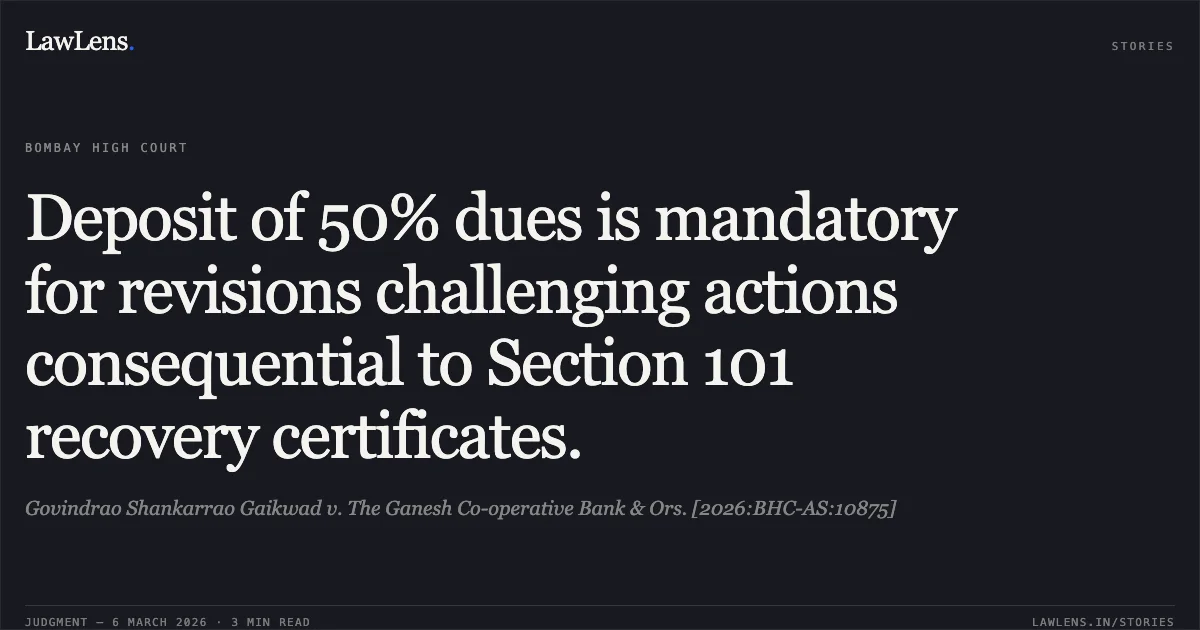
i.1. Whether a litigant, who challenges an action consequential to the issuance of a certificate under Section 101 of the MCS Act, 1960 in a revision under Section 154, and not the recovery certificate itself, is required to deposit an amount equivalent to 50% of the dues recoverable under the recovery certificate or not?
p. 6 · ¶ 2 · p. 12 · ¶ 903Law Applied
The Court applied Section 154(2A) of the MCS Act, 1960, which mandates a 50% deposit for entertaining a revision against a recovery certificate.
p. 14 · ¶ 12It relied on the "Heydon’s Rule" (Mischief Rule) of statutory interpretation and the principle of "Purposive Construction" to suppress the mischief of dilatory tactics.
p. 10 · ¶ 8 · p. 21 · ¶ 21The Court cited *X v. Principal Sec. Health and Family Welfare Dept.* regarding the identification of legislative intent.
p. 21 · ¶ 21The Court cited *Bengal Secretariat Co-op. Land Mortgage Bank v. Aloke Kumar* regarding the constitutional mandate under Part IX-B (97th Amendment) to ensure economically sound functioning of cooperatives.
pp. 27-32 · ¶ 31-36Provisions in the judgment · 6 · Linked ones open on LawLens
Code of Civil Procedure, 1908 Section 60
Maharashtra Co-operative Societies Act, 1960 Section 101Section 154Section 91Section 93Section 98
04Reasoning
The Court observed that the Statement of Objects and Reasons for inserting Section 154(2A) was specifically to curb the practice of defaulters delaying recovery by filing revision applications.
p. 20 · ¶ 19Although a literal reading of Section 154(2A) mentions revisions against the "recovery certificate," a narrow interpretation excluding derivative actions (like attachment notices under Rule 107) would render the provision otiose and allow litigants to bypass the deposit requirement by ostensibly challenging only execution steps.
p. 22 · ¶ 23 · p. 26 · ¶ 29The Court invoked the doctrine of *casus omissus*, noting that it is the duty of the judge to "iron out the creases" to give life to the legislative intent.
p. 34 · ¶ 51The Court concluded that the term "recovery certificate" must encompass all consequential decisions and orders arising therefrom to prevent the frustration of the law and safeguard the financial health of cooperative societies.
p. 26 · ¶ 30 · p. 32 · ¶ 3705Holding
The Court answered the reference in the affirmative, holding that any revision challenging either the recovery certificate itself or any derivative/consequential action (such as attachment or sale notices) arising from it requires a mandatory deposit of 50% of the recoverable dues under Section 154(2A) of the MCS Act.
p. 32 · ¶ 37 · p. 35 · ¶ 38The view expressed in *Greater Bombay Co-operative Bank Ltd.* was upheld, and the contrary view in *Pravin Yashwant Dhanawade* was disapproved.
p. 25 · ¶ 29The matters were directed to be placed before the learned Single Judge for further consideration.
p. 35 · ¶ 38Original Court PDF
Govindrao Shankarrao Gaikwad v. The Ganesh Co-operative Bank & Ors. [2026:BHC-AS:10875]
Click to open original judgment
Original judgment, available to read, download and summarize on LawLens.in