Facts
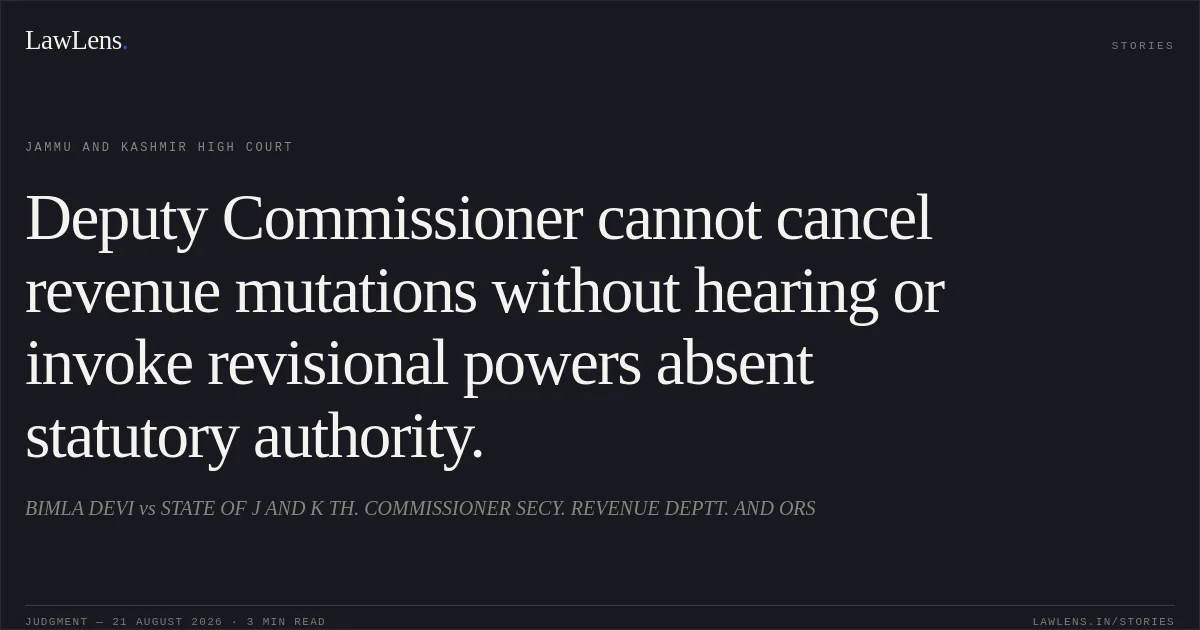
The four connected writ petitions challenged a common order dated 04.09.2018 passed by the Deputy Commissioner-cum-Collector, Jammu, cancelling various revenue mutations attested in favour of the petitioners in respect of lands situated in Nagrota, Jagti and adjoining villages.
Source reference: p.2In WP(C) No. 2345/2019, Mutation No. 898 concerning 10 kanals 16 marlas was cancelled as patently illegal and void ab initio.
Source reference: p.2In OWP No. 2089/2018, Mutations Nos. 1468, 1478, 1463, 1471, 43 and 1459 concerning 53 kanals 11 marlas were cancelled.
Source reference: p.3OWP No. 2146/2018 concerned cancellation of Mutation No. 1408 dated 27.08.2016 relating to 14 kanals 18 marlas.
Source reference: p.3OWP No. 2016/2018 challenged cancellation of Mutations Nos. 374 and 376 concerning 27 kanals of land at Nagrota.
Source reference: p.4The petitioners contended that the mutations had been cancelled without notice or an opportunity of hearing and that the Deputy Commissioner lacked jurisdiction to review or revise orders of subordinate revenue officers.
Source reference: pp.2–5The respondents maintained that the mutations were illegally entered and attested in violation of Government Orders Nos. LB-6 of 1958 and S-432 of 1966, including in respect of non-cultivable land, and that an administrative enquiry had established their illegality.
Source reference: pp.2–5Issues
1. Whether the Deputy Commissioner could cancel the mutations without issuing notice to, or affording an opportunity of hearing to, the affected petitioners?
Source reference: para. 12; pp.5–62. Whether the Deputy Commissioner had jurisdiction under the Land Revenue Act to review or recall orders passed by subordinate revenue officers, or to exercise revisional power over such orders?
Source reference: para. 12; p.63. Whether the impugned cancellation order dated 04.09.2018 was sustainable despite the respondents’ allegation that the mutations were illegally attested?
Source reference: paras. 3, 5, 7, 9–13; pp.2–6Law Applied
The Court applied the principles of natural justice, particularly the requirement that a person whose rights or interests are adversely affected must ordinarily receive notice and a meaningful opportunity of hearing before the adverse order is passed.
Source reference: para. 12It further held that, under the Land Revenue Act, the Deputy Commissioner could not review or recall orders passed by subordinate revenue officers such as the Tehsildar or Naib Tehsildar, and had no independent revisional jurisdiction unless expressly conferred by statute.
Source reference: para. 12The Court also considered the respondents’ reliance on Government Orders Nos. LB-6 of 1958 and S-432 of 1966, which were invoked to contend that the mutations had been illegally attested and that rights had been conferred contrary to the applicable revenue restrictions.
Source reference: paras. 3, 7, 9The Court followed the principles stated in Mohd. Farooq and Others v. Union Territory of J&K and Others, WP(C) No. 2571/2021, and Om Parkash v. Union Territory of J&K and Others, WP(C) No. 1588/2026, as cited in the judgment.
Source reference: para. 10Reasoning
The Court found that the petitioners had not been afforded any opportunity of hearing before the Deputy Commissioner cancelled the mutations, despite the cancellation directly affecting their asserted revenue and possessory rights.
Source reference: para. 12The Court held that the alleged illegality of the mutations did not dispense with compliance with natural justice; the competent authority was required to examine the matter in proceedings conducted in accordance with law after hearing the affected parties.
Source reference: no citationIndependently, the Court held that the Deputy Commissioner was not competent to review or recall the orders of subordinate revenue officers and did not possess revisional power under the Land Revenue Act for that purpose.
Source reference: para. 12Consequently, the common cancellation order could not be sustained, irrespective of the respondents’ allegations regarding violation of Government Orders Nos. LB-6 and S-432.
Source reference: no citationHolding
The Court allowed all four writ petitions and quashed the order dated 04.09.2018 insofar as it affected the petitioners.
However, the Court clarified that the competent authority under the Land Revenue Act remained free to pass appropriate orders concerning the subject lands after providing the petitioners an opportunity of hearing and proceeding in accordance with law.
Source reference: para. 13Original Court PDF
BIMLA DEVIvsSTATE OF J AND K TH. COMMISSIONER SECY. REVENUE DEPTT. AND ORS
Click to open original judgment
Original judgment, available to read, download and summarize on LawLens.in