01Facts
The appellants are agriculturists of Ghalapooji Village, Byadagi Taluk, Haveri District, who claim continuous, open cultivation of portions of R.S. No. 168 for over 40 to 45 years.
¶ 3.1Appellant No. 1 cultivates 2 acres, Appellant No. 2 cultivates 3 acres, and Appellant No. 3 cultivates 2 acres.
¶ 3.1On 02.02.2019, they filed Form 57 applications before the Committee under Section 94-A(4) of the Karnataka Land Revenue Act, 1964 ("Act") read with Rule 108-CCC of the Karnataka Land Revenue Rules, 1966 ("Rules").
¶ 3.2A spot inspection by revenue officials, with villagers present, produced a panchanama and spot sketch confirming the appellants' possession and cultivation and recording that no portion of R.S. No. 168 was "B Kharab" land.
¶ 3.2On 19.04.2022, the Deputy Commissioner directed the Tahsildar to verify the applications and list ineligible applicants.
¶ 3.3On 21.04.2022, the Tahsildar listed 59 applicants as ineligible, citing "Mofat Gayrana lands," without reference to the spot inspection and survey records.
¶ 3.3By resolution dated 24.06.2022, the Committee forwarded the appellants' applications to the Deputy Commissioner as ineligible.
¶ 3.3That resolution recorded that the Revenue Inspector and Village Accountant reported "no cultivation," yet it stated that the lands were "Mofat Gayrana lands" without enquiry.
¶ 3.3On 20.07.2023, the Deputy Commissioner rejected the applications on a different ground, namely that R.S. No. 168 was "B Kharab" land, which the appellants contended is contrary to the Record of Rights.
¶ 3.4The appellants filed W.P. No. 108533/2025 seeking certiorari against both orders and mandamus for regularisation.
¶ 3.5The learned Single Judge declined to entertain the petition on the ground of an alternative remedy before the Karnataka Administrative Tribunal, treating the Deputy Commissioner's order as falling under Rule 108-I.
¶ 3.5, 402Issues
i.1. Whether the learned Single Judge was justified in declining the writ petition on the ground of availability of an alternative remedy.
¶ 11(i)ii.2. Whether the Committee's resolution dated 24.06.2022 (Annexure-F) and the Deputy Commissioner's order dated 20.07.2023 (Annexure-G) are sustainable in law.
¶ 11(ii)03Law Applied
The exhaustion of alternative remedies is a rule of self-imposed restraint, not a bar to jurisdiction under Article 226, and a writ lies where the impugned order is without jurisdiction, violates natural justice, or is contrary to statute, as laid down in Whirlpool Corporation v. Registrar of Trade Marks (1998) 8 SCC 1.
¶ 12Section 94-A(4) of the Act empowers the Committee to grant land to persons who unauthorisedly occupied it before 1 January 2005, subject to the Rules.
¶ 13Rule 108-CCC(3) of the Rules, as amended in 2020, permits the Tahsildar to forward only ineligible applications to the Deputy Commissioner, who may reject them, while all eligible applications go to the Committee.
¶ 14, 15Rule 108-CCC(4)–(5) requires the Committee to conduct a verifying enquiry before recommending grant or dismissal.
¶ 14Rule 108-I bars grant of specified public-purpose lands and does not extend to "Mofat Gayrana/Gomal" lands, as held in State of Karnataka v. Holeyappa, ILR 2007 KAR 259.
¶ 7, 8, 24The power to decide regularisation vests exclusively in the Committee, and the Act provides no appeal against its decisions.
¶ 18Provisions in the judgment · 1 · Linked ones open on LawLens
KARNATAKA HIGH COURT ACT, 1961 Section 4
04Reasoning
The Deputy Commissioner's power under Rule 108-CCC(3) is a threshold power limited to the ground on which applications were forwarded.
¶ 15, 19The Tahsildar forwarded the applications as "Mofat Gayrana" lands, but the Deputy Commissioner rejected them on the new ground that the lands were "B Kharab," a factual premise contradicted by the spot inspection, the panchanama, the survey sketch and the Record of Rights.
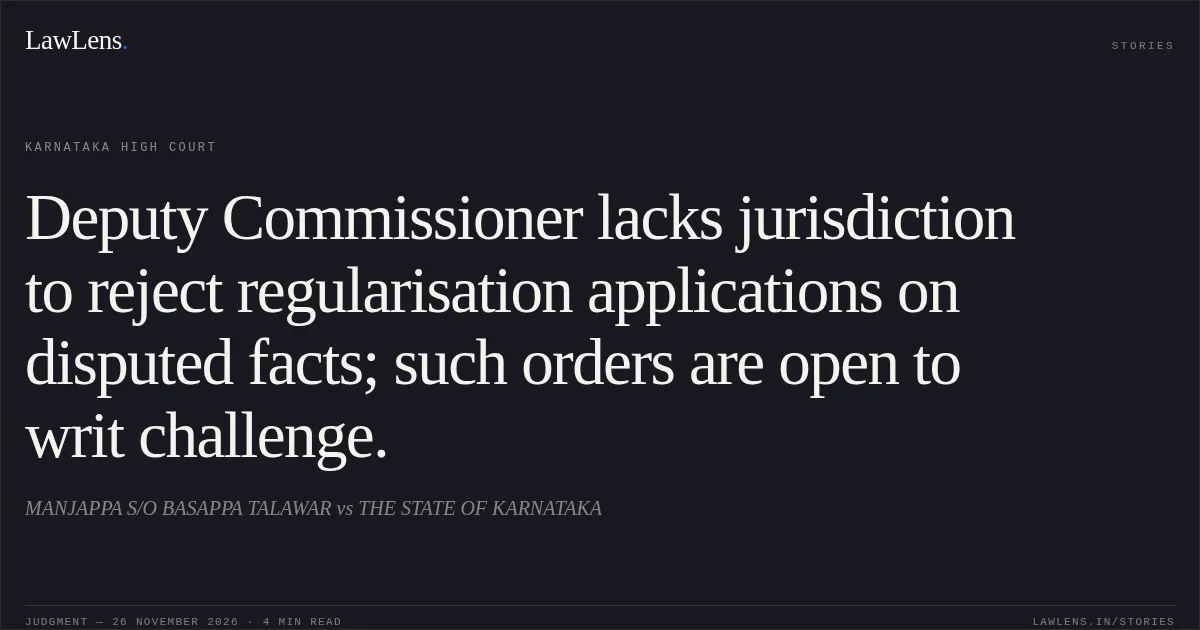
¶ 16, 19Whether the appellants cultivated the land and how the land is classified were disputed questions of fact that the Committee, not the Deputy Commissioner, had to determine.
¶ 15–16By adjudicating those questions while the applications were pending before the Committee, the Deputy Commissioner usurped the Committee's exclusive jurisdiction.
¶ 17Since no appeal lies against the Committee's decision under the Act, and the impugned orders were without jurisdiction, the alternative remedy did not bar the writ petition.
¶ 18, 21The Committee's resolution was self-contradictory: it recorded "no cultivation" and "Mofat Gayrana" status while referring the applications for rejection as uncultivable, and it conducted no enquiry under Rule 108-CCC.
¶ 20, 22–23The Deputy Commissioner's order was also held to be ultra vires because "Mofat Gayrana" land falls outside Rule 108-I, so the applications were not ineligible at the threshold and could not lawfully have been forwarded for rejection.
¶ 24–2505Holding
The Court answered Point (i) in the negative, holding that the alternative remedy was no bar, since the impugned orders were without jurisdiction.
¶ 18The Court answered Point (ii) in the negative, holding that the Committee's resolution and the Deputy Commissioner's order are not sustainable in law.
¶ 25The writ appeal is allowed. The learned Single Judge's order dated 17.11.2025 in W.P. No. 108533/2025 is set aside. The Deputy Commissioner's order dated 20.07.2023 (Annexure-G) is quashed. The applications are remanded to the Committee under Section 94-A, which must conduct the enquiry required by Rule 108-CCC and pass a reasoned order, with reference to the spot inspection report and survey sketch, as expeditiously as possible.
¶ 26(b)–(d)Pending interlocutory applications stand disposed of. The Court did not expressly quash the Committee's resolution at Annexure-F, though it held it unsustainable; the remand directs fresh consideration of the applications by the Committee.
¶ 25, 26, 26(d)Original Court PDF
MANJAPPA S/O BASAPPA TALAWARvsTHE STATE OF KARNATAKA
Click to open original judgment
Original judgment, available to read, download and summarize on LawLens.in