01Facts
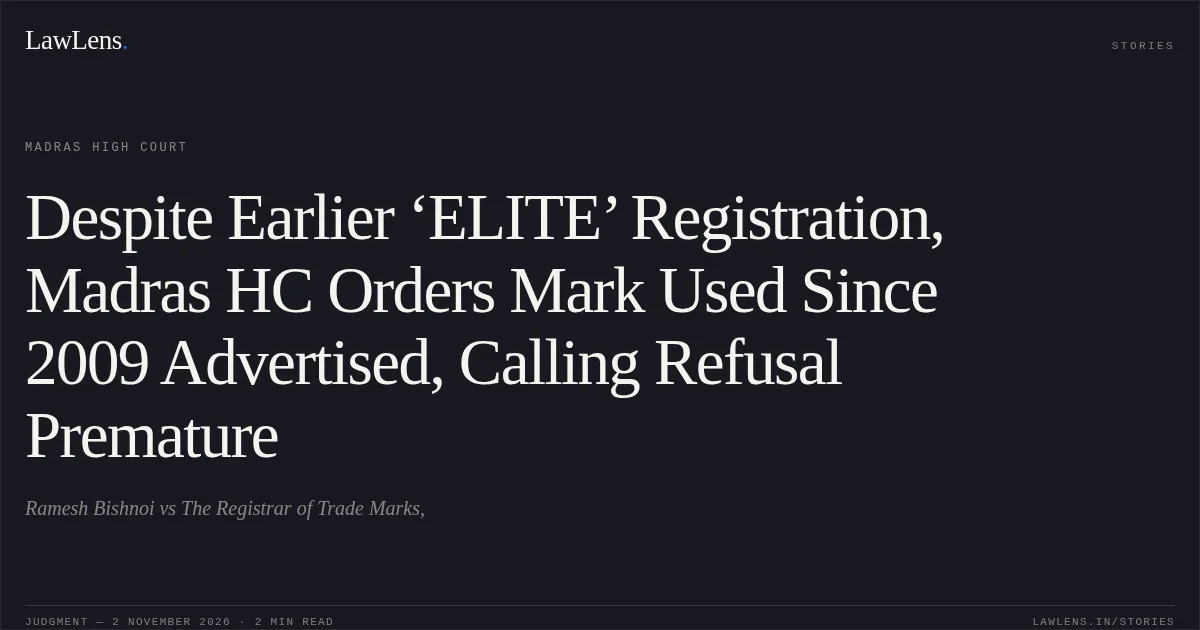
The appellant applied to register the “ELITE” device mark in Class 11 on 18 February 2021.
pp. 1–4, 7–8He claimed use since 2009 and relied on material including WhatsApp messages with the husband of Mrs. Saroj Sharma, who held an earlier registration for “ELITE” in Class 11.
pp. 1–4, 7–8The Registrar refused the application, principally on the ground that the mark was identical or similar to earlier marks and could cause public confusion under Section 11(1) of the Trade Marks Act, 1999.
pp. 1–4, 7–8After an earlier remittal for fresh consideration, the Registrar again refused registration by order dated 2 March 2026.
pp. 1–4, 7–8The appellant challenged that order under Section 91 of the Act.
pp. 1–4, 7–802Issues
i.1. Whether the Registrar could refuse the application under Section 11(1) at the examination stage, before advertisement in the Trade Marks Journal, without addressing the possibility of registration under Section 12.
pp. 8–9ii.2. Whether the absence of a user affidavit under Sections 48 and 49 justified refusal where the appellant claimed an independent right to the mark.
p. 9iii.3. Whether the refusal should be set aside and the application directed to proceed to advertisement, leaving objections to be considered thereafter.
pp. 9–1003Law Applied
Section 11(1) of the Trade Marks Act, 1999 concerns refusal where an applied-for mark is identical or similar to an earlier mark for identical or similar goods or services and there is a likelihood of confusion.
pp. 6, 8–9Section 12 permits the Registrar, in cases of honest concurrent use or other special circumstances, to allow registration of identical or similar marks by more than one proprietor, subject to the statutory conditions.
pp. 6, 8–9Sections 48 and 49 concern registered users and the registration of permitted use; the Court treated them as inapplicable where the applicant claimed an independent right rather than seeking registration as a licensee.
pp. 6, 8–9The judgment also referred to Rule 115 of the Trade Marks Rules, 2017 in recounting the virtual hearing on remittal.
p. 4Provisions in the judgment · 6 · Linked ones open on LawLens
Trade Marks Act, 1999 Section 91Section 12Section 33Section 11Section 48Section 49
04Reasoning
The Court considered that the appellant’s material indicated use of “ELITE” from 2009 and that the WhatsApp exchanges from 2019 undermined the objector’s claim of ignorance of that use.
pp. 7–8It also noted that, despite the exchange of notices, no interim injunction was operating against the appellant and the objector’s suit remained at the pre-suit mediation stage.
pp. 7–8The Registrar had refused the application at the examination stage under Section 11(1) without addressing Section 12 or the possibility of honest concurrent use.
pp. 8–9The Court held that Sections 48 and 49 did not support the refusal because the appellant asserted an independent right, not a licensee’s right.
pp. 8–9Since interested persons, including the earlier registrant, could object after advertisement, proceeding to advertisement would not foreclose their rights.
pp. 9–1005Holding
The Court allowed the appeal and set aside the Registrar’s order dated 2 March 2026.
p. 10It directed the Registrar to advertise the appellant’s mark in the Trade Marks Journal and to decide the application in accordance with law, subject to any objections received.
p. 10No costs were awarded.
p. 10Original Court PDF
Ramesh BishnoivsThe Registrar of Trade Marks,
Click to open original judgment
Original judgment, available to read, download and summarize on LawLens.in