Facts
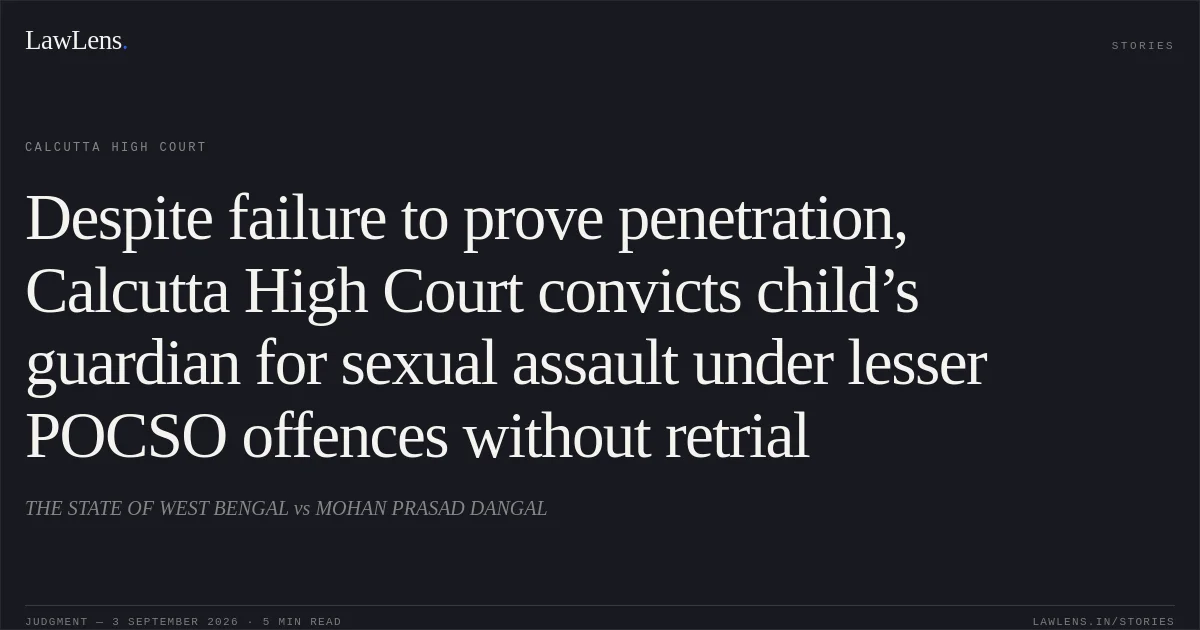
The prosecution arose from a Childline complaint concerning the alleged sexual abuse of an approximately 11-year-old boy by Mohan Prasad Dangal, whom the child regarded as his uncle and local guardian.
Source reference: paras. 1–3, pp. 2–3The child was residing with the accused’s family and assisting with domestic and agricultural work.
Source reference: paras. 1–3, pp. 2–3The complaint alleged repeated sexual abuse over approximately three years, with the last incident occurring on 16 July 2018.
Source reference: paras. 1–3, pp. 2–3Following intervention by Childline, a police case was registered, the child’s statement was recorded under Section 164 CrPC, and he was medically examined.
Source reference: paras. 1–3, pp. 2–3The accused was charge-sheeted and tried under Section 6 of the POCSO Act.
Source reference: paras. 1–3, pp. 2–3The Special Court acquitted him on 20 April 2021, principally finding that penetrative sexual assault was not proved and that the medical evidence did not corroborate the allegation.
Source reference: paras. 1–3, pp. 2–3The State appealed against the acquittal.
Source reference: paras. 1–3, pp. 2–3Before the High Court, the child gave a more detailed account alleging anal penetration, repeated sexual abuse, physical contact, and abuse when the accused’s wife was absent.
Source reference: paras. 13–18, pp. 10–16The High Court also considered the child’s earlier disclosure to Childline and his Section 164 CrPC statement, in which he had stated that the accused had subjected him to “dirty work,” including anal sexual acts causing pain and bleeding.
Source reference: paras. 13–18, pp. 10–16The record further showed that the child had been admitted to hospital for a day and that the discharge certificate recorded the final diagnosis as sexual assault.
Source reference: para. 24, pp. 20–21Issues
Whether the Special Court’s acquittal under Section 6 of the POCSO Act was palpably wrong, manifestly erroneous, blatantly illegal, or perverse so as to warrant appellate interference.
Source reference: paras. 12–13, pp. 9–10Whether the child’s testimony, despite omissions and variations between his statements, established sexual assault under Section 7 of the POCSO Act notwithstanding the absence of medical evidence proving penetration.
Source reference: paras. 17–24, pp. 14–21Whether the accused’s status as the child’s guardian or member of the household attracted aggravated sexual assault under Section 9(n), punishable under Section 10 of the POCSO Act.
Source reference: paras. 22, 27–28, pp. 18–25Whether the High Court could convict the accused for lesser or alternative offences under Sections 7/8 and 9(n)/10 without ordering a retrial on the original charge under Section 6.
Source reference: paras. 27–30, pp. 23–26Law Applied
The Court applied Sections 7 and 8 of the POCSO Act, under which intentional physical contact with a child’s anus or any other act involving physical contact without penetration constitutes sexual assault and is punishable with imprisonment of three to five years.
Source reference: pp. 23–24Section 9(n) aggravates sexual assault committed by a relative through guardianship, a person in a domestic relationship with the child’s parent, or a person living in the same or shared household; Section 10 prescribes the punishment for aggravated sexual assault.
Source reference: p. 24Sections 29 and 30 create rebuttable presumptions regarding commission of the offence and culpable mental state once the prosecution establishes the foundational facts.
Source reference: paras. 25, 29, pp. 21–22, 25–26Section 118 of the Evidence Act permits a child to testify if capable of understanding questions and giving rational answers, and a credible child witness’s testimony may independently sustain a conviction.
Source reference: para. 14, pp. 11–12The Court relied on Chandrappa v. State of Karnataka, Basheera Begum v. Mohammad Ibrahim, and Rajesh Prasad v. State of Bihar for the principle that an appellate court ordinarily should not disturb an acquittal merely because another view is possible, but may interfere where the trial court’s view is palpably wrong, manifestly erroneous, illegal, or perverse.
Source reference: para. 12, pp. 9–10It also relied on Dattu Ramrao Sakhare v. State of Maharashtra, Tehal Singh v. State of Punjab, and State of Madhya Pradesh v. Balveer Singh regarding the competency and evidentiary value of child witnesses.
Source reference: paras. 14–15, pp. 11–13Reasoning
The High Court held that the trial court had incorrectly treated the absence of medical signs of penetration as fatal to the prosecution case.
Source reference: paras. 19–24, pp. 16–21Although the child’s detailed account before the trial court contained developments not expressly appearing in his earlier statements, the Court found that the core allegation of repeated sexual abuse by the accused remained consistent.
Source reference: paras. 19–24, pp. 16–21The child’s disclosure to Childline, the Section 164 statement referring to anal sexual acts and rectal pain, his residence under the accused’s guardianship, the hospital admission, and the discharge diagnosis of sexual assault collectively established the foundational facts of sexual assault.
Source reference: paras. 19–24, pp. 16–21The Court rejected the defence argument that the child’s alleged theft and propensity to lie furnished a sufficient motive for fabrication, observing that such circumstances did not plausibly explain a false allegation of grave sexual abuse against his host and guardian.
Source reference: para. 24, pp. 20–21On the statutory framework, the Court reasoned that even if penile-anal penetration sufficient for Section 6 was not proved, the evidence established intentional physical contact of a sexual nature without penetration, satisfying Section 7.
Source reference: paras. 22, 27, 29, pp. 18–19, 23–26Since the accused occupied a position of guardianship and lived with the child, the conduct also fell within Section 9(n).
Source reference: paras. 22, 27, 29, pp. 18–19, 23–26The child was found competent to testify, and the Court held that corroboration was not legally indispensable where his evidence was credible and contained the relevant ingredients of the offence.
Source reference: paras. 22, 27, 29, pp. 18–19, 23–26The trial court’s failure to consider these lesser and aggravated non-penetrative offences, and its rejection of the child’s evidence on the basis of omissions and medical non-corroboration, rendered the acquittal perverse and liable to be set aside.
Source reference: paras. 28–30, pp. 24–26Holding
The appeal was allowed.
The High Court set aside the Special Court’s judgment of acquittal dated 20 April 2021 and held Mohan Prasad Dangal guilty under Section 7 read with Section 8 and Section 9(n) read with Section 10 of the POCSO Act.
Source reference: paras. 33–35, p. 26As these were lesser offences than the Section 6 charge, the Court held that no de novo trial was necessary.
Source reference: para. 30, p. 26The accused was directed to surrender before the Trial Judge within three days, failing which a warrant of arrest would issue.
Source reference: paras. 36–37, pp. 26–27The matter was directed to be placed before the High Court on 8 September 2026 for hearing on sentence.
Source reference: paras. 36–37, pp. 26–27Acts & Sections Cited
11 provisions across 2 statutes referred to in this judgment. Each provision opens on LawLens.
Protection of Children from Sexual Offences Act, 2012
Code of Criminal Procedure, 19732
Original Court PDF
THE STATE OF WEST BENGALvsMOHAN PRASAD DANGAL
Click to open original judgment
Original judgment, available to read, download and summarize on LawLens.in